Case file · JEEP-WRANGLER-2007-2018 · JK
Jeep Wrangler 2007–2018Common problems, reliability & repair costs
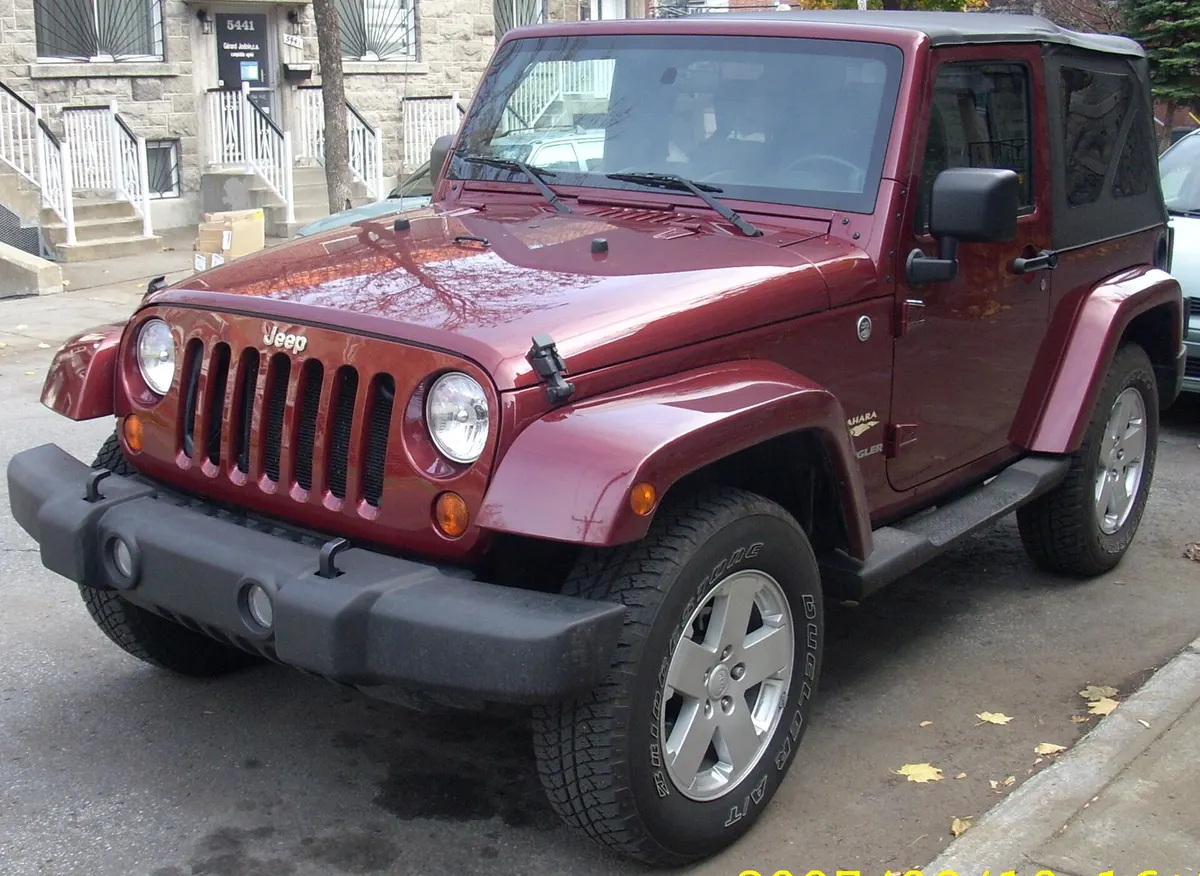
The JK Wrangler is the icon people actually want: body-on-frame, solid axles, removable everything. It's also the generation where you buy the chassis, not the drivetrain. The early 3.8L V6 (2007–2011) drinks oil and is merely adequate; the 3.6L Pentastar (2012–2018) is far better but the 2012–2013 left cylinder head fails so often Chrysler extended the warranty. On top of the engine question sit three Wrangler-wide headaches: death wobble, a flaky TIPM fuse box, and a leaky plastic oil cooler housing. Buy on documented history and you get a 200k-mile machine; buy blind and you inherit a list.
2014, 2015, 2016
2012–2013 (3.6L left cylinder head failure) unless head alre +1 more
Engines
- EGH · 3.8L gasoline, 202 hp
- ERB · 3.6L gasoline, 285 hp
Transmissions
- NSG370 · manual, 6-speed
- 42RLE · automatic, 4-speed
- W5A580 · automatic, 5-speed
Drivetrain
4WD
Body
2-door SUV, 4-door SUV (Unlimited)
Trims
Sport, Sport S, Sahara, Rubicon, Willys Wheeler, Freedom Edition
Jeep Wrangler part-number cross-reference
Start from the OEM number, then pick the brand you trust. Verified equivalents for the Jeep Wrangler (2007–2018).
Part links go to Amazon, and to eBay where Amazon does not stock the part. Affiliate links, so we may earn a commission if you buy. Your price is unchanged, and a commission never changes a verdict.
Oil filter
Verified via: oilfilter-crossreference: Mopar MO-409 equivalents (Fram PH3614, Purolator L10241), Go-Parts: Wix 51348 fitment, Jeep Wrangler 3.8L, Mopar eStore: 04105409AE oil filter (07-11 Wrangler 3.8L)
Oil filter
Verified via: oilfilter-crossreference: Mopar MO-744 equivalents (Fram CH10955, Wix 57526), JEGS: Fram CH10955 fits 2011-13 Chrysler/Dodge/Ram 3.6L, Walmart: Wix 57526 fits 2012-2013 Jeep Wrangler / 3.6L Pentastar, Quadratec: Mopar 68079744AD for 12-13 Wrangler JK 3.6L
Oil filter
Verified via: oilfilter-crossreference: Mopar 68191349AC equivalents (Fram CH11665, Purolator L36296, Wix WL10010), FinditParts: Fram CH11665 element + cross reference, Quadratec: Mopar 68191349AC for 14-20 Wrangler JK/JL 3.6L
Engine air filter
Verified via: Quadratec: Mopar 68257791AA air filter, 07-18 Wrangler JK 3.6/3.8L, ExtremeTerrain: K&N 33-2364 drop-in, 07-18 Wrangler JK 3.6L/3.8L
Cabin air filter
Verified via: ExtremeTerrain: K&N VF1010 cabin filter, 11-18 Jeep Wrangler JK, WranglerForum: 'Do all JK have cabin air filters?' (slot exists, many shipped without a filter), JeepCorner, JK cabin filter: many 2007-2016 not equipped from factory, slot present
Spark plugs
Champion
double platinum; the OE plug. The 2008-2011 books print RE14PLP5 (2008 PDF p426, 2009 p444, 2010 p503, 2011 p552)
Look up Champion spark plugs on AmazonVerified via: ExtremeTerrain: NGK PLZTR5A-13 for 07-11 Wrangler JK 3.8L, SportCompactWarehouse: NGK LZTR5A-13 fitment, 2008 Jeep Wrangler, JeepGarage: 3.8L OE plug Champion RE14PLP5, gap 0.050
Spark plugs
NGK
SILZKR7B11 Laser Iridium, correct reach. Do NOT use NGK 93175, wrong reach for the Pentastar
Check NGK spark plugs, 3.6LVerified via: JeepGarage: 3.6 Pentastar OE plug Mopar SP149125AD = Champion RER8ZWYCB4, gap 0.043, NGK.com: 9723 (SILZKR7B11) Laser Iridium, correct-reach plug for 3.6L Pentastar
Front brake pads
Verified via: Quadratec: Mopar 68003701AB front pad kit, 07-18 Wrangler JK, Amazon: Wagner ZD1273 front pads, 2007-2017/2018 Jeep Wrangler (FMSI D1273), PartsHawk: Akebono ACT1273 ProACT front set (FMSI D1273)
Wiper blades (front)
Mopar / Trico (OE)
Check Mopar / Trico wiper blades on AmazonVerified via: AutoPadre, Jeep Wrangler wiper sizes: 15/15 front (2007-2017), 12 rear, ExtremeTerrain: Omix 15 in front wiper blade, 07-18 Jeep Wrangler JK
Serpentine belt
Verified via: Mopar eStore: 53032857AB serpentine belt, 2007-2011 Wrangler, Sixity/Gates listing: K060900 cross-references Chrysler 53032857AB (= Dayco 5060900)
Serpentine belt
Verified via: Quadratec: Mopar 04627043AA serpentine belt, 12-18 Wrangler JK, FinditParts: Continental AG 4060878 lists Chrysler 4627043AA as a cross reference
Battery
BCI group size
Look up BCI group size battery on AmazonVerified via: AutoPadre: Wrangler battery Group 34/78 (2007-2010), Group 78 (2011, 3.8L), JK-Forum: Wrangler JK 2007-2015 battery information (early = Group 34)
Battery
BCI group size
See BCI group size battery on AmazonVerified via: AutoPadre: 2012-2018 Wrangler battery Group H6 (48), WranglerForum: battery group size change on later JK (to H6/48)
Should I buy a 2007–2018 Jeep Wrangler?
Buy the chassis, vet the drivetrain. The JK is a genuinely durable, endlessly fixable platform with huge parts support, but reliability swings hard on year and history. Skip the 2012–2013 3.6L unless the left cylinder head was already replaced (or you confirm it's the updated head); a 2014–2017 3.6L is the sweet spot. The 2007–2011 3.8L is acceptable if you accept oil consumption and a slower truck. On ANY JK, factor in death wobble (steering/track-bar inspection), a possible TIPM fuel-pump-relay failure, and the plastic oil cooler housing leak on Pentastar cars. Stock, well-maintained, unmodified examples are far safer buys than lifted ones with mystery suspension work.
Best years
2014, 2015, 2016, 2017
Years to avoid
2012–2013 (3.6L left cylinder head failure) unless head already replaced, 2007 (first model year; more electrical/build bugs)
Pre-Purchase Checklist for Jeep Wrangler
- ☐Drive at highway speed and hit a few expansion joints/bumps. Any front-end shimmy that builds into a violent shake (death wobble) means a steering/suspension inspection before you buy: track bar, ball joints, tie rods, steering damper.
- ☐On 2012–2013 3.6L cars: scan for cylinder 2/4/6 misfire codes and listen for a top-end tick. Ask whether the left cylinder head was replaced under Chrysler's warranty extension; a documented replacement is a plus, not a minus.
- ☐On 2007–2011 3.8L cars: check the oil level and ask the owner how often they top it off. A quart every 1,500–2,000 miles is common. Look under for exhaust manifold ticking on cold start and weeping intake/thermostat gaskets.
- ☐On any Pentastar (3.6L): look for oil seepage and dried oil down the back of the engine valley. The plastic oil cooler/filter housing leaks oil and coolant.
- ☐Test EVERY power window and door lock several times. Listen for a pop or grind. Window regulators snap a cable and drop the glass.
- ☐Try several cold and warm starts. An intermittent crank-no-start, a fuel pump that won't prime, or odd electrical gremlins point at the TIPM.
- ☐Crawl the frame, especially behind the rear wheels and at the rear crossmember. JK frames rust in salt states; check for perforation and bad past welds.
- ☐If lifted, ask for receipts. A lift done wrong is the #1 trigger for death wobble and a common reason a 'great deal' becomes a steering project.
Common Jeep Wrangler problems & repair costs
Death wobble (front-end shimmy)
$150–$1,200Symptoms: A bump at speed (often 40–60 mph) sets off a rapid, violent side-to-side shake in the steering wheel and front end that doesn't stop until you slow way down. Terrifying but usually a worn-component or alignment problem, not the frame.
Fix: Diagnose the whole front end. The most common single cause on the JK is the track bar (worn bushings or loose mount), followed by ball joints, tie-rod ends, and a tired steering stabilizer. Fix ranges from a track bar bolt/bushing and alignment up to ball joints and a full steering refresh. A correctly set-up lift matters. Bad lift geometry is a frequent trigger.
Sources: NHTSA: Jeep Wrangler steering investigation/complaints, Safety Research & Strategies: NHTSA death-wobble reporting, ExtremeTerrain: Chrysler TSB for death wobble
3.6L Pentastar left cylinder head failure (2012–2013)
$1,500–$3,000Symptoms: Misfire on cylinders 2, 4 and 6 (the left bank), a check-engine light, and often a tick at the top end. Caused by undersized cooling passages and valve-seat/valve-guide trouble that burns the exhaust valves.
Fix: Left cylinder head replacement with the updated part. Chrysler extended the warranty on affected Pentastar heads, so many were replaced free. Confirm by VIN. Out of coverage, it's a head job at an independent shop.
Sources: TorqueNews: Chrysler replacing Pentastar V6 cylinder heads, Jeep Wrangler JK Forum: 3.6 misfire cyl 1/3/5 & 2/4/6
TIPM fuel-pump-relay failure (no-start)
$100–$700Symptoms: Intermittent crank-but-no-start, the fuel pump won't prime (no 2-second hum at key-on), sometimes the pump runs constantly and drains the battery, plus assorted electrical gremlins. Often shows up cold and gets worse over time.
Fix: The failure is the fuel-pump relay inside the TIPM (the under-hood power module/fuse box). Cheapest path is an external relay bypass kit; full fix is a rebuilt/replacement TIPM. Diagnose the TIPM before throwing a fuel pump at it. That's the classic wasted repair on this truck.
Sources: Circuit Board Medics: 2007–2018 Wrangler TIPM problems, Go-Parts: 2005–2018 Wrangler fuel pump & TIPM
3.6L oil cooler / filter housing leak
$400–$900Symptoms: Oil and/or coolant seeping from the top of the engine valley, oil down the back of the block, low coolant, and sometimes a burning-oil smell. The housing is plastic and warps/cracks with heat cycles.
Fix: Replace the oil cooler/filter housing (and the brittle rear hose). The intake manifolds come off to reach it, so it's labor-heavy. The OEM plastic part can re-fail; many shops and owners fit an aluminum upgraded housing instead.
Sources: Curbside Classic: replacing the Pentastar 3.6 oil cooler housing, Jeep Wrangler JK Forum: oil filter/cooler housing replacement
3.8L V6 oil consumption & cracked exhaust manifolds
$300–$1,500Symptoms: Burns oil (a quart every ~1,500–2,000 miles is common), a tick/exhaust leak from cracked manifolds (loudest on cold start), and weeping intake-manifold and thermostat-housing gaskets. Rare but real worst case: spun bearings on neglected engines.
Fix: Oil consumption itself is managed by keeping it topped up and running a heavier oil (Mopar's own replacement engines spec 10W-30, not the original 5W-20). Cracked exhaust manifolds and leaking gaskets are individual repairs; budget on the higher end if both manifolds and gaskets are due.
Sources: 8020 Automotive: common Chrysler 3.8 engine problems, WranglerForum: 3.8L JK engine problems
Power window regulator failure
$229–$327Symptoms: A pop or grinding noise when you run a window, the glass moving crookedly, or the window dropping into the door and not coming back up. The internal cable snaps or a plastic pulley breaks.
Fix: Replace the window regulator (often sold with the motor). The door panel comes off to do it. Owners widely recommend OEM or quality parts. Cheap aftermarket regulators tend to fail again quickly.
Sources: RepairPal: Wrangler window regulator replacement cost, RepairPal: Jeep Wrangler window regulator and motor replacement cost (2007-2017 rows $229-$327), Go-Parts: 2007–2018 Wrangler JK window regulator failure
The JK is cheap to fix in the sense that parts are everywhere, the layout is simple, and most jobs are DIY-friendly, but it asks for that work more often than a Toyota would. Plan for steering/front-end attention (the death-wobble parts wear and need periodic replacement), a likely TIPM relay fix at some point, and on Pentastar trucks the oil cooler housing. The 3.8L adds an oil-budget line item. Fuel economy is poor across the board. None of it is exotic; the cost is in the frequency, not the difficulty.
Cost calculator
What will this Jeep Wrangler cost you by a given mileage?
Drag to a mileage. We total the documented problems whose typical onset falls at or before it. The same cost ranges listed above, nothing new invented.
$0 estimated repair range
5-Year Maintenance Schedule & Cost to Own
Every scheduled service by mileage, fluid capacities, independent shop ranges, and parts cross-references.
Have a repair quote for this Jeep Wrangler?
Audit against OEM book times, uncover duplicate pad and rotor labor, and verify parts markups.
How to fix common Jeep Wrangler problems (DIY)
Replace the front track bar
Tools: Floor jack + jack stands, Socket set + large sockets (18–21mm), Breaker bar, Torque wrench, Penetrating oil
- Park on level ground, chock the rears, and safely support the front frame on stands.
- Soak the track bar bolts (axle end and frame end) in penetrating oil; they're often seized.
- Remove the axle-side bolt, then the frame-side bolt, and drop the old track bar out.
- Install the new track bar, hand-start both bolts, then torque to spec with the suspension at ride height (on the wheels or with the axle supported).
- Recheck the bolts after a short drive and get a front alignment. Death-wobble symptoms often need the steering geometry reset too.
Parts
- Front track bar (JK Wrangler) · Amazon $70–$160
- Steering stabilizer / damper (often replaced together) · Amazon $40–$90
Install a TIPM fuel-pump relay bypass
Tools: Basic hand tools, Multimeter (to confirm the relay is the fault)
- Confirm the symptom: key-on should give a ~2-second fuel-pump hum from the rear; no hum points at the relay.
- Locate the TIPM under the hood and identify the fuel-pump relay circuit per the bypass kit instructions.
- Wire the external relay bypass harness inline so a new external relay drives the pump instead of the TIPM's failed internal one.
- Mount the external relay securely, reconnect the battery, and verify the pump primes and the Jeep starts reliably (warm and cold).
Parts
- TIPM fuel pump relay bypass kit (JK Wrangler) · Amazon $30–$60
Replace a power window regulator
Tools: Trim/panel removal tools, Torx + socket set, Painter's tape (to hold the glass)
- Lower the glass partway if it still moves, then disconnect the battery.
- Remove the door panel screws and clips and unplug the switch/lock connectors to free the panel.
- Peel back the vapor barrier, support the glass with tape, and unbolt the glass from the regulator.
- Unbolt the old regulator/motor and feed it out through the access hole.
- Install the new regulator, reattach the glass, reconnect the motor, and test full up/down travel before reassembling the panel.
Parts
- Window regulator with motor (JK Wrangler) · Amazon $45–$120
Some parts links are affiliate links. We may earn a commission at no cost to you. We only list parts that fit this generation.
The short version
The 2007–2018 Wrangler (JK) is the Jeep most people picture, and it earns the love: solid front and rear axles, a separate frame, doors and a top that come off, and a parts ecosystem so deep you can fix almost anything in a driveway. What it is not is a set-and-forget reliable car. You’re buying a great chassis and then doing your homework on the drivetrain and the electrics.
Two engine eras. The 2007–2011 trucks use the 3.8L V6, an old, adequate engine that commonly burns oil and cracks exhaust manifolds. The 2012–2018 trucks got the 3.6L Pentastar, a much stronger engine, but the 2012–2013 cars suffer a left-bank cylinder head failure that Chrysler ended up covering with a warranty extension. Confirm by VIN whether the head was done.
The three things every JK shares
Regardless of engine, plan around three Wrangler-wide items. Death wobble, a violent front-end shake after a bump at speed, is the famous one; it’s scary but almost always a worn track bar, ball joints, or tie rods, and it’s fixable. The TIPM (the under-hood power module) has a failure-prone fuel-pump relay that causes intermittent no-starts and gets blamed on the fuel pump. And on Pentastar trucks the plastic oil cooler housing warps and leaks oil and coolant.
What that means when you’re shopping
Buy on documentation, not vibes. A 2014–2017 3.6L is the sweet spot. On a 2012–2013, confirm the cylinder head was replaced. On a 2007–2011 3.8L, accept that it’ll want oil and won’t be quick. On any JK, inspect the front end (especially if it’s lifted, since bad lifts cause death wobble), test every window, try several cold starts, and crawl the frame for rust if it lived where they salt roads.
How this file is built: failure modes and cost ranges are compiled from NHTSA complaint and investigation data, Chrysler’s own warranty-extension actions and TSBs, repair-cost estimators, and owner forum reporting, then sanity-checked against shop-floor experience. Cost figures are independent-shop estimates and vary by region. Spot something off? Tell us.
Viral car myths, checked against this car
- Mostly False
Does a "$3 liquid" really kill car rust permanently? The phosphoric-acid reality.
The $3 liquid is almost certainly phosphoric acid (sold as Ospho or Naval Jelly). It converts surface rust to iron phosphate. It does not kill rust 'permanently,' does not restore perforated steel, and was never buried by anyone. It has been on hardware store shelves continuously since the 1940s.
- Misleading
Is the "$2 liquid that stops any leak" really banned in 11 states?
Automotive stop-leak products are not banned in any US state. The products are real (Bar's Leaks, BlueDevil), they work in specific narrow situations, and they can permanently damage your cooling or oiling system if applied to the wrong leak.
- Dangerous
Is the "$2 liquid that destroys engine sludge forever" real? Our shop-floor verdict.
An aggressive solvent flush on a high-mileage engine is a textbook way to spin a bearing. The viral 'kitchen-cabinet flush' is folklore that real shops spend money cleaning up after.
Frequently asked questions
Which Jeep Wrangler JK years should I avoid?
The 2012–2013 models with the 3.6L Pentastar are the ones to vet hardest because of the left cylinder head failure. Only buy one if the head was already replaced (or you confirm the updated head). The 2007 first-year truck has more electrical and build bugs. The best buys are 2014–2017 3.6L Wranglers, which keep the strong engine but largely move past the head problem.
What is Jeep death wobble and is it dangerous?
It's a violent, rapid side-to-side shake of the front end and steering wheel, usually triggered by a bump at highway speed. It's alarming and absolutely warrants fixing before you keep driving, but on the JK it's almost always a worn or loose front-end part rather than a broken frame: most often the track bar, plus ball joints, tie rods, and a tired steering damper. A proper inspection and alignment fixes it. Badly installed lift kits are a frequent cause.
Is the 3.8L or the 3.6L engine better?
The 3.6L Pentastar (2012–2018) is the better engine by a wide margin, far more power and smoother, as long as you avoid or have addressed the 2012–2013 head issue and keep an eye on the oil cooler housing. The 3.8L (2007–2011) is an older, weaker design that commonly burns oil and cracks exhaust manifolds. It can still go the distance with care; it's just slower and thirstier.
Why won't my Wrangler start even though it cranks?
On the JK, a crank-but-no-start that comes and goes is very often the fuel-pump relay inside the TIPM (the under-hood fuse/power module), not the fuel pump itself. Check for the key-on fuel-pump prime; if it's missing, diagnose the TIPM first. A relay bypass kit is a cheap fix versus replacing the whole module.
How many miles will a Jeep Wrangler JK last?
A well-maintained JK regularly reaches 200,000 miles and beyond. The platform is simple and rebuildable. The limiting factors are the specific issues here (engine choice, death-wobble parts, TIPM, rust in salt states) and how the truck was treated off-road and modified, far more than the basic chassis wearing out.
Cross-shopped rivals
Files on what buyers weigh against the Jeep Wrangler of this era.