Case file · KIA-OPTIMA-2011-2015 · 3rd gen (TF)
Kia Optima 2011–2015Common problems, reliability & repair costs
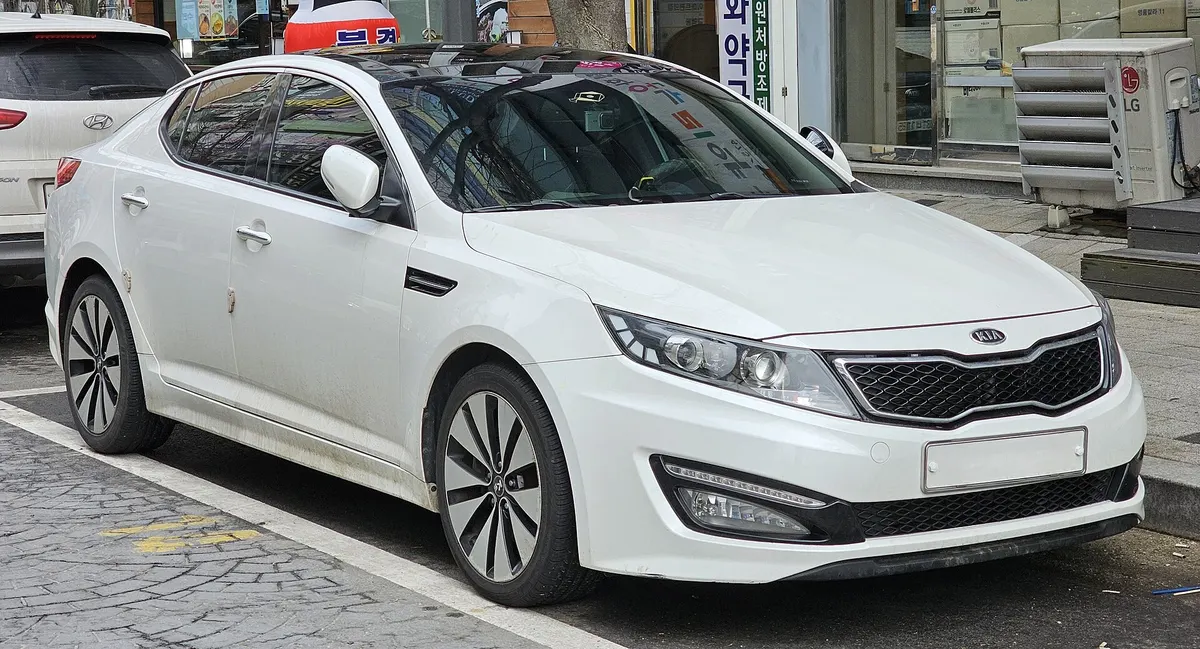
The TF Optima was the car that made people take Kia seriously : sharp Peter Schreyer styling, a long warranty, and a lot of equipment for the money. The catch is the 2.4L Theta II engine, which can spin a rod bearing and seize from the factory machining defect at the center of a massive recall and class-action settlement. A car with the knock-sensor (KSDS) update done and the engine warranty extension intact can be a genuine bargain; one without is a gamble on a $5,000 engine.
2015 (latest build, most likely KSDS-updated; still covered by the warranty extension), 2014 (within the bearing recall, so eligible for the recall remedy)
2011–2012 (highest engine-failure complaint volume; oldest, +1 more
Engines
- Theta II G4KE · 2.4L gasoline, 200 hp
- Theta II G4KH · 2.0L turbo gasoline, 274 hp
- Theta II (hybrid) · 2.4L hybrid, 199 hp
Transmissions
- automatic , 6-speed
- automatic , 6-speed
Drivetrain
FWD
Body
sedan
Trims
LX, EX, SX, SXL, Hybrid
Kia Optima part-number cross-reference
Start from the OEM number, then pick the brand you trust. Verified equivalents for the Kia Optima (2011–2015).
Part links go to Amazon, and to eBay where Amazon does not stock the part. Affiliate links, so we may earn a commission if you buy. Your price is unchanged, and a commission never changes a verdict.
Oil filter
Kia/Mobis
The long-running Hyundai/Kia 4-cyl spin-on; supersedes 26300-35503/-35504. Kia's product page records 664 variants across 17 Kia models between 2001 and 2026, which is the scale but not the fitment: that page takes its vehicle name from the URL slug and agrees with whatever you type. Fitment for THIS car comes from Wix, whose application list for the 51334 cross names Optima 2011-2012 and 2013-2020 on the 2.0L and 2006-2020 on the 2.4L. Corrected 09-17-2026.
Find Kia/Mobis oil filter on AmazonVerified via: parts.kia.com product page for 26300-35505. Supersession chain and price only. Its title takes the vehicle name from the URL slug, so it does not establish that this car takes this filter, Oilfilter-crossreference - Fram PH9688 equivalents (Purolator L14459, Bosch 3312, OE 26300-35505), FinditParts - Purolator L14459 cross reference (Kia Optima / Hyundai Sonata 2.4)
Engine air filter
Kia/Mobis
TRAP: this is the GAS-car element. The Optima HYBRID uses a different filter, 28113-3S100 (next entry). Do not use a 2016+ Optima filter (28113-C1100 / 28113-A9100 / 28113-D4100) - those are the next generation
Compare Kia/Mobis engine air filter on AmazonVerified via: MyKiaParts - Air Filter 28113-2P100, 2011-2015 Kia (gas 2.4/2.0T), Airfilter-crossreference - 28113-2P100 (Fram CA10881, Wix WA9711, Denso 143-3511, Mann C28010, Hengst E1285L), Amazon - AirTechnik CA10881 (28113-2P100) fits 2013-2015 Kia Optima
Engine air filter
Kia/Mobis
Hybrid (Korea-built 2.4) filter, shared with the Sonata Hybrid. Frequently mis-cross-listed by aftermarket sellers as fitting all 2011-2015 Optimas - it does NOT fit the 2.4 GDI or 2.0T gas cars (those take 28113-2P100)
Find Kia/Mobis engine air filter on AmazonVerified via: Kia.Parts - Air Filter 28113-3S100, 2011-2016 Kia (Optima Hybrid 2.4 Electric/Gas), eBay - 2011-2013 Kia Optima Engine Air Filter OEM 28113-3S100, QuirkParts - 2015 Kia Optima Hybrid LX 2.4L air intake (28113-3S100)
Cabin air filter
Kia/Mobis
Also cataloged/superseded as 97133-2W000, 3SF79-AQ000, 2TF79-AQ000 and 97133-A9000 - all the same physical filter
Look up Kia/Mobis cabin air filter on AmazonVerified via: Walmart - Wix 24013 fits 2015 Kia Optima / 2011-2014 Hyundai Sonata, Mann-Filter CU 26 017 cross (OE 97133-2W000 / 97133-3SAA0 / A9C79-AC000; Fram CF11178, Wix 24013), SixityAuto - Fram Fresh Breeze cabin filter for 2011-2015 Kia Optima
Spark plugs
Hyundai-Kia/NGK
NGK Laser Iridium SILZKR7E11 (NGK stock no. 92315). Do NOT use the 2.0T's colder 18849-09085 plug
Find Hyundai-Kia/NGK spark plugs on AmazonVerified via: Amazon - Genuine 18849-11070 = NGK SILZKR7E11 (select Hyundai/Kia), Amazon - NGK SILZKR7E11 (92315) fits Kia Optima 2.4L, AutoZone - 2013 Kia Optima spark plug application
Spark plugs
Hyundai-Kia/NGK
NGK Laser Iridium SILZKR8E9G (NGK stock no. 92422). Turbo-specific - do not substitute the 2.4 GDI plug. Some catalogs also list 18849-09085 for the Optima Hybrid; verify for a hybrid
Check Hyundai-Kia/NGK spark plugs on AmazonVerified via: Kia.Parts - Spark Plug 18849-09085, 2011-2022 Kia (Optima turbo), eBay - 2011-2018 Kia Optima Turbo/Hybrid OEM spark plug 18849-09085, Amazon - 18849-09085 = SILZKR8E9G for 2011-2022 Kia Optima/Sorento/Sportage
Front brake pads
Kia/Mobis
Standard 2.4 front pad (FMSI D1444 shape), shared with the 2011-2014 Sonata 2.4. TRAP: Kia lists running-change OE numbers for the Optima front - 58101-2TA00/2TA21 (2011-2013) and 58101-4CA10 (2012-2015) - so match by VIN/build year. The 2.0T SX/SXL has a LARGER ~320 mm (12.6 in) front rotor and takes a different, larger pad (58101-4C-series); confirm your rotor/trim before buying
Compare Kia/Mobis front brake pads on AmazonVerified via: PartCatalog - Akebono ACT1444 fits Hyundai Sonata / Kia Optima (D1444), eBay - Akebono front disc pad set for 2011-2015 Kia Optima 2.4L, Kia.Parts - front pads 58101-2TA21 (2011-2013 Optima), Kia.Parts - front pads 58101-4CA10 (2012-2015 Optima)
Wiper blades
OE size
Any 24-in driver + 18-in passenger beam or hook blade fits. Note this differs from the platform-twin Sonata (26/18). Some listings wrongly show 24/20 - 24/18 is correct for the TF Optima
See OE size wiper blades on AmazonVerified via: AutoPadre - Kia Optima windshield wiper size (2011-2015: 24"/18"), AllWiperSize - Kia Optima wiper blade size chart, Retailer listing - 2007-2015 Kia Optima wiper blades 24" & 18"
Serpentine belt
Kia/Mobis
6-rib V-ribbed (Micro-V) belt; metric spec 6PK2130. Running-change OE numbers 25212-2G700/-2G720/-2G760 also appear. Shared with the 2011-2014 Sonata / Tucson / Sportage 2.0-2.4
Compare Kia/Mobis serpentine belt on AmazonVerified via: Amazon - 25212-2G710 belt for 2011-2013 Kia Optima / Sonata / Tucson / Sportage, eBay - Gates serpentine belt for 2014-2015 Kia Optima L4-2.4L, SixityAuto - Bando 6PK2130 cross (OE 25212-2G710; Continental 4060840, Dayco 5060840), O'Reilly - serpentine belt application, 2015 Kia Optima
Battery
BCI group
Catalogs genuinely disagree for the TF Optima: group 47/H5 is the widely-sold replacement (AutoZone lists H5/47 for the Optima), but 124R and 48/H6 also appear depending on build year/plant and options - owner forums report the same conflict. The Optima HYBRID uses a separate group H6R 12V auxiliary battery (plus its lithium-polymer traction pack). Measure the tray and read the old battery's group before buying
Compare BCI group battery on AmazonVerified via: AutoZone - Kia Optima battery (group 47/H5 among listed fitments), AutoPadre - Kia Optima battery size by year (lists H6/48, 124R, H6R hybrid), Kia Optima Forums - stock battery replacement (owner group-size discussion)
Should I buy a 2011–2015 Kia Optima?
Buy only with eyes open. The TF Optima is a lot of car for the money and the interior still feels modern, but the 2.4L Theta II engine is a real liability, not internet panic. Kia recalled 2011–2014 cars for bearing wear and settled a class action that extended the engine short-block/long-block warranty to 15 years / 150,000 miles and required the KSDS knock-sensor software update. Before you buy, confirm the KSDS update was performed and whether the engine was ever replaced under recall. A car with a fresh recall engine and the warranty extension intact is arguably the safest version of this car. Skip any example with unexplained engine noise, oil consumption, or a seller who can't speak to the recall.
Best years
2015 (latest build, most likely KSDS-updated; still covered by the warranty extension), 2014 (within the bearing recall, so eligible for the recall remedy)
Years to avoid
2011–2012 (highest engine-failure complaint volume; oldest, hardest-used Theta II units), Any year with no KSDS update and no documented engine history
Pre-Purchase Checklist for Kia Optima
- ☐Decode the VIN at a Kia dealer or on the recall/settlement sites and confirm the KSDS (knock-sensor detection) software update was performed. It was the settlement's eligibility gate.
- ☐Ask whether the engine was ever replaced under recall 17V224000; a documented recall engine is a plus, not a red flag.
- ☐Cold-start it and listen for a deep knock or ticking from the bottom end. Rod-bearing wear announces itself as knock before it seizes.
- ☐Check the oil level and look at the dipstick; Theta II GDI engines can burn oil, and a low/dirty level on a 'maintained' car is a warning.
- ☐Confirm the fuel-line recall (20V100000 / 22V093000) and HECU brake/fire recalls (20V519000 etc.) were completed. These are fire-risk items.
- ☐On the 2.0T (SX/SXL), look harder at oil history and any turbo whine or smoke; it works the same engine family harder.
- ☐Test the electric steering on a straight road. Wandering, pulling, or a notchy on-center feel is a common complaint on this generation.
- ☐Check for chewed wiring / rodent damage; the soy-based wire coating attracts rodents and repairs get expensive.
Common Kia Optima problems & repair costs
2.4L Theta II engine bearing failure / seizure
$4,000–$7,000Symptoms: A deep knocking from the bottom of the engine that gets louder with RPM, often after some oil consumption. Can progress to a sudden stall or total seizure while driving. That is the dangerous part. The KSDS update makes the check-engine light blink as an early bearing-wear warning before limp mode.
Fix: If in coverage, the fix is a free short-block or full engine replacement under Kia's powertrain warranty extension (15 years / 150,000 miles for connecting-rod-bearing damage, original and subsequent owners), provided the KSDS update was done. Out of coverage, a reman or used engine swap is the realistic repair and is what drives the high end of the cost range.
Sources: NHTSA recall 17V224000: engine bearing wear, Kia Engine Settlement: FAQ (warranty extension, KSDS, covered models), KiaComplaints: 3rd-gen Optima engine
HECU electrical short: engine-compartment fire risk
$0–$400Symptoms: Brake fluid can leak inside the Hydraulic Electronic Control Unit (HECU) and cause an electrical short, which can start a fire in the engine bay, including while parked. May be preceded by a brake or ABS warning light.
Fix: Covered by NHTSA recalls (20V519000, 21V331000, 23V652000). The remedy (fuse/relay and HECU inspection/replacement) is performed free at a Kia dealer. Confirm completion by VIN; out-of-pocket only if you're chasing related damage.
Sources: NHTSA recalls: Kia Optima HECU brake/fire, RecallExplained: Kia Optima recalls
Low-pressure fuel hose cracking: fire risk
$0–$300Symptoms: The low-pressure fuel hose can deteriorate and crack from underhood heat, leaking gasoline into the engine bay and creating a fire hazard. May smell of fuel.
Fix: Covered by recall (20V100000, followed by 22V093000 for damaged or missing heat-protective tape). Hose replacement / heat-shield correction free at a dealer. Verify completion by VIN.
Sources: NHTSA recall 20V100000: low-pressure fuel hose, RecallExplained: Kia Optima recalls
Electric power steering (EPS) complaints
$600–$2,500Symptoms: Car wanders or pulls to one side, steering feels tight or sticks on-center, or the assist cuts out. Behind the failures are the EPS motor and, less often, the rack itself.
Fix: Diagnosis first. Many cases are alignment or a failing EPS motor/sensor rather than the whole rack. A full EPS rack replacement is the expensive end and is why the range is wide. Some steering-coupling complaints exist on this generation; check for any open service campaign by VIN.
Sources: CarComplaints: 2013 Optima steering, KiaComplaints: 3rd-gen Optima steering
Airbag control unit (ACU) short circuit
$0–$300Symptoms: The airbag control unit can short-circuit, which can prevent the front airbags and seat-belt pretensioners from deploying in a crash. Often signaled by an airbag warning light.
Fix: Covered by recall 18V363000. ACU inspection/replacement free at a Kia dealer. If the airbag light is on, get this verified before relying on the car.
Sources: NHTSA recall 18V363000: air bag control unit, RecallExplained: Kia Optima recalls
Rodent-chewed (soy-coated) wiring
$150–$1,500Symptoms: Random electrical faults, warning lights, no-starts, or sensor errors traced to chewed wiring. The soy-based wire insulation attracts rodents that gnaw the harness.
Fix: Repair or splice the damaged harness sections; severe cases need harness replacement. Not a defect Kia repairs for free. It's a known materials gripe across the lineup. Rodent deterrents and parking habits are the prevention.
Set aside the engine and the recalls and the TF Optima is cheap to run: parts are common and inexpensive, routine service is ordinary, and the cabin holds up well. But you can't set those aside: the 2.4L Theta II is the single fact that defines ownership cost. With the KSDS update done and the 15-year / 150,000-mile engine warranty extension intact, your catastrophic-engine risk is largely underwritten by Kia. Without that paperwork, budget for the possibility of a $4,000–$7,000 engine on top of normal wear (brakes, tires, the occasional EPS or electrical gremlin). The GDI engines can also consume oil, so this is not a check-it-twice-a-year car. Watch the level.
Cost calculator
What will this Kia Optima cost you by a given mileage?
Drag to a mileage. We total the documented problems whose typical onset falls at or before it. The same cost ranges listed above, nothing new invented.
$0 estimated repair range
Have a repair quote for this Kia Optima?
Audit against OEM book times, uncover duplicate pad and rotor labor, and verify parts markups.
How to fix common Kia Optima problems (DIY)
Replace the engine air filter and cabin air filter
Tools: Hands (airbox clips), Small screwdriver (glovebox stops, if needed)
- Unclip the engine airbox lid, lift it, and note how the old panel filter sits.
- Drop in the new engine air filter the same orientation and re-clip the lid.
- Open the glovebox, release the side stops so it drops fully, and remove the cabin filter cover.
- Slide the old cabin filter out, insert the new one with the airflow arrow pointing down, and reassemble.
Parts
- Engine air filter (2011–2015 Optima) · Amazon $10–$20
- Cabin air filter (2011–2015 Optima) · Amazon $10–$18
Front brake pad replacement
Tools: Floor jack + jack stands, Lug wrench, Socket set + caliper bracket bolts, C-clamp or caliper piston tool, Torque wrench
- Loosen the lug nuts, lift the front, set on jack stands, and remove the wheels.
- Unbolt the caliper, hang it from the suspension with wire (don't stretch the hose), and remove the old pads.
- Compress the caliper piston with a C-clamp so the new, thicker pads will fit.
- Fit the new pads (and hardware/shims), reinstall the caliper, and torque the bolts to spec.
- Reinstall the wheels, torque the lugs, then pump the brake pedal until firm before driving.
Parts
- Front brake pads (2011–2015 Optima) · Amazon $25–$60
- Front brake rotors (pair, if needed) · Amazon $60–$120
Check engine oil level and top up (Theta II oil-consumption watch)
Tools: Clean rag, Funnel
- Park level, let the engine cool a few minutes, then pull and wipe the dipstick.
- Reinsert fully, pull again, and read the level against the marks.
- If low, add the correct spec oil a little at a time, rechecking. Don't overfill.
- Note how much it took and how often; steady consumption between changes is an early Theta II warning to investigate.
Parts
- Engine oil (correct spec for Theta II) · Amazon $25–$45 (5 qt)
Some parts links are affiliate links. We may earn a commission at no cost to you. We only list parts that fit this generation.
The short version
The 2011–2015 Kia Optima (the TF generation) is the car that changed how people saw Kia: handsome, well-equipped, cheap to buy used, and backed by a famously long warranty. It earns its place on a lot of shopping lists. It also earns a hard asterisk, and the asterisk is the engine.
The 2.4-liter Theta II four-cylinder (the engine in most of these cars) can fail from a manufacturing defect that leaves metal debris in the engine, starving the connecting-rod bearings of oil. When they go, the engine knocks and can seize, sometimes while you’re driving. This wasn’t a forum rumor: Kia recalled 2011–2014 cars (NHTSA 17V224000), a class-action settlement extended the engine warranty to 15 years / 150,000 miles for bearing damage, and the fix required a knock-sensor software update (KSDS) that gives early warning before a seizure.
What that means when you’re shopping
Treat the engine paperwork as the whole ballgame. Before anything else, get the VIN checked: was the KSDS update done? Was the engine ever replaced under recall? A car with the update performed and the warranty extension intact has its worst-case scenario largely covered by Kia, and a car that already got a fresh recall engine can be the safest one on the lot. A car with unexplained engine noise, real oil consumption, and a seller who shrugs at the recall is the one to walk away from.
Two more fire-risk recalls matter here and both are free to fix: the HECU brake-unit short that can start an engine-bay fire (2013–2015) and the low-pressure fuel hose that can crack and leak (2013–2014). Confirm both were completed. Beyond that, expect ordinary used-Kia stuff: some electric-steering complaints, the occasional rodent-chewed soy-coated wire, and GDI engines that like to sip oil, so check the level often.
Buy on the documentation, not the price tag. A clean, recall-complete Optima is a lot of car for the money. One without that history is a bet against a $5,000-plus engine.
How this file is built: failure modes and cost ranges are compiled from NHTSA recall and complaint data, the Kia engine class-action settlement documentation, CarComplaints/KiaComplaints owner reporting, and shop-floor experience. Cost figures are independent-shop estimates and vary by region. Spot something off? Tell us.
Viral car myths, checked against this car
- Dangerous
Is the "$2 liquid that destroys engine sludge forever" real? Our shop-floor verdict.
An aggressive solvent flush on a high-mileage engine is a textbook way to spin a bearing. The viral 'kitchen-cabinet flush' is folklore that real shops spend money cleaning up after.
- Misleading
Is the "$1 Japanese oil trick" that stops engine wear forever real?
The 'Japanese oil trick' is almost certainly MoS2 (molybdenum disulfide), a real industrial friction modifier. It is German, not Japanese (Liqui Moly popularized it), sold openly at every parts store for $15-20, has real but modest measured friction benefits, and was never buried by anyone.
Frequently asked questions
Which Kia Optima years should I avoid?
The whole 2011–2015 generation carries the 2.4L Theta II engine risk, but 2011–2012 cars have the highest engine-failure complaint volume and are the oldest, hardest-used examples. The smarter move isn't a specific year. It's buying any year where the KSDS knock-sensor update was done and the engine warranty extension is intact, or where the engine was already replaced under recall.
Is the Kia Optima engine problem covered by Kia?
Largely yes, if the paperwork is right. A class-action settlement extended the powertrain warranty on the engine short-block and long-block to 15 years / 150,000 miles for connecting-rod-bearing damage, for original and subsequent owners, but eligibility hinged on getting the KSDS software update performed. Confirm the update and recall history by VIN before you buy; that's what determines whether a future engine is Kia's bill or yours.
What is the KSDS update on a Kia Optima?
KSDS is the Knock Sensor Detection System software update Kia rolled out as part of the engine recall and settlement. It listens for the vibration of failing rod bearings and, if it detects them, makes the check-engine light blink and eventually drops the car into limp mode, an early warning before a full seizure. A car that's had the update is both safer and the version eligible for the warranty extension.
Is the 2.0 turbo Optima (SX) more reliable than the 2.4?
Not really. Both are Theta II engines and share the bearing-wear exposure, and the turbo works the engine harder and runs hotter. The 2.0T is the fun one, but it doesn't sidestep the core engine risk. Check oil history and any turbo noise closely.
Are the Kia Optima fire recalls something to worry about?
They're real, but they're fixable for free. The HECU brake-unit short (2013–2015) and the low-pressure fuel hose cracking (2013–2014 GDI) are both fire-risk recalls with no-cost dealer remedies. Verify both were completed by VIN. An unrepaired example is a genuine hazard, a repaired one is a non-issue.
Every Kia Optima generation
The full case file run, beyond the generation before and after this one.
Cross-shopped rivals
Files on what buyers weigh against the Kia Optima of this era.