Case file · MAZDA-CX-5-2013-2016 · 1st gen (KE)
Mazda CX-5 2013–2016Common problems, reliability & repair costs
The first-gen CX-5 is one of the more reliable compact crossovers of its decade. The Skyactiv-G 2.0L and 2.5L engines are durable, the 6-speed automatic is well-regarded, and there's no transmission landmine. The real annoyances are the MZD Connect infotainment that freezes and reboots, a windshield that chips and cracks far too easily, and on 2016 cars the daytime-running LED that burns out into a four-figure repair. Buy on condition; this is a sound used SUV, not a money pit.
2015, 2014 (2.5L)
2013 (oil-use reports, first-year MZD Connect bugs) +1 more
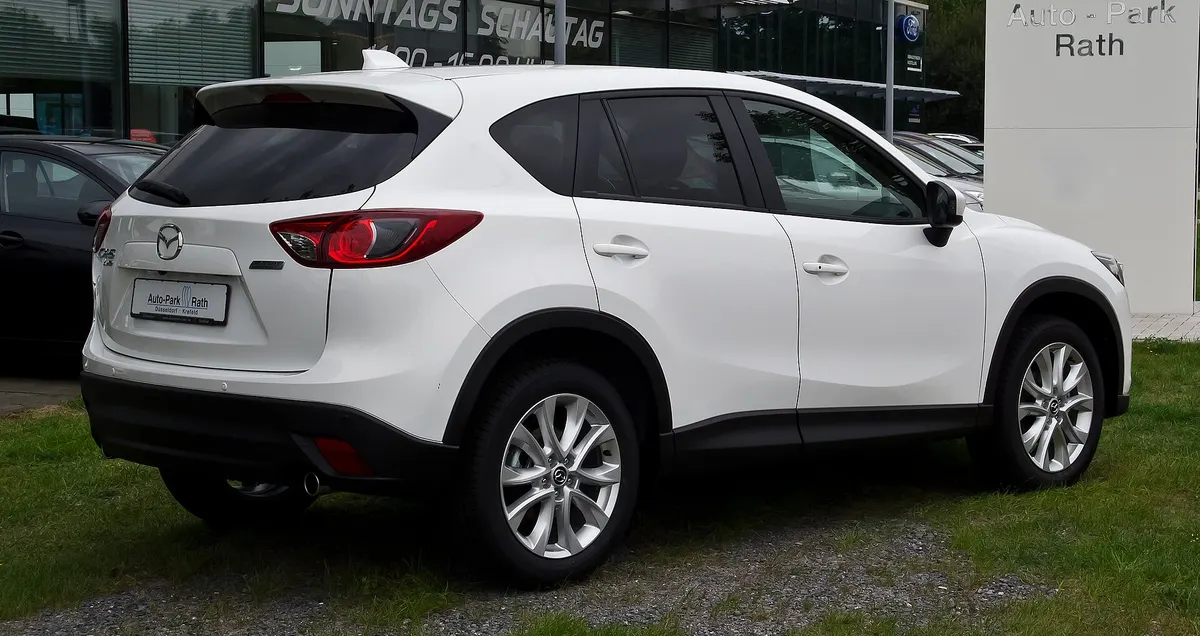
Engines
- PE-VPS (Skyactiv-G 2.0) · 2.0L gasoline, 155 hp
- PY-VPS (Skyactiv-G 2.5) · 2.5L gasoline, 184 hp
Transmissions
- Skyactiv-Drive · automatic, 6-speed
- manual , 6-speed
Drivetrain
FWD / AWD
Body
SUV / crossover
Trims
Sport, Touring, Grand Touring
Mazda CX-5 part-number cross-reference
Start from the OEM number, then pick the brand you trust. Verified equivalents for the Mazda CX-5 (2013–2016).
Part links go to Amazon, and to eBay where Amazon does not stock the part. Affiliate links, so we may earn a commission if you buy. Your price is unchanged, and a commission never changes a verdict.
Oil filter
Mazda
Also sold as PE01-14-302A and value-line PE01-14-302A-MV / 1WPE-14-302. It is a small SPIN-ON canister (thread M20x1.5) even though Mazda's catalog names it 'cartridge, oil filter.' Skyactiv-G 2.0 and 2.5 NA share it; the 2019+ turbo 2.5T (KF gen) uses a different filter.
Find Mazda oil filter on AmazonWix
The Skyactiv-specific spin-on: M20x1.5, 15-micron nominal media, 11-14 psi bypass, NO anti-drainback valve listed. TRAP: do not substitute the generic small spin-ons the cross-ref aggregators list for this number. Wix 51358, Wix 51365 and Ecogard X4612 do thread on (same M20x1.5) and each misses on media, 21 micron for the Wix pair and 30 micron at 97% for the Ecogard against 15 here, and each lists an anti-drainback valve, which this filter's spec sheet does not list at all. 51365 also drops the bypass to 8-11 psi; 51358's bypass matches, so media and the valve are the whole difference there. Wix 51348 is not the same mistake and cannot be fitted at all: its thread is 3/4-16 and Wix catalogs it to the CX-5 2.2 turbo diesel.
Look up Wix oil filterNAPA Gold
Physically the Wix 57002 (NAPA Gold is built by Wix), the same Skyactiv-spec filter.
Check NAPA Gold oil filterPurolator
PureONE; documented to meet/exceed Mazda's Skyactiv high-flow requirement. The longer PL14610 (3.52") is a higher-capacity variant some owners fit. Avoid the Purolator BOSS PBL14612 for spec reasons.
See Purolator oil filterVerified via: WIX catalog: 57002 spec sheet (M20x1.5, 11-14 psi bypass, 15 micron), WIX catalog: 51358 spec sheet (M20x1.5, 21 micron, anti-drainback), WIX catalog: 51365 spec sheet (M20x1.5, 8-11 psi bypass, 21 micron), WIX catalog: 51348 spec sheet (thread 3/4-16, so it cannot fit a Skyactiv gas engine), Ecogard catalog: X4612 for the 2016 CX-5 (M20x1.5, 30 micron at 97%, anti-drainback), O'Reilly Auto Parts: WIX 57002 oil filter, Mazdas247: CX-5 oil filter specs (spin-on, M20x1.5, Wix 57002 = OEM spec), MX-5 Miata Forum: OEM Mazda oil filter vs Wix 57002 / NAPA Gold
Engine air filter
Mazda
Also PE07-13-3A0 and value-line -MV. Shared with 2014+ Mazda 3 / Mazda 6 Skyactiv. Panel filter.
Compare Mazda engine air filter on AmazonWix
Also cataloged as WA9774 (international), the same panel filter; retailer fitment 2013-2018 CX-5 / 2012-2018 Mazda 3.
Find Wix engine air filterFram
Extra Guard; listed cross for PE07-13-3A0A by two independent references.
Look up Fram engine air filterEPAuto
Listing explicitly covers CX-5 2.0L/2.5L 2013-2018; equivalent to CA11259.
See EPAuto engine air filterVerified via: airfilter-crossreference.com: Mazda PE07-13-3A0A alternatives (Fram CA11259, Mann C27019, Wix WA9774), Walmart: WIX 49247 fitment (2013-2018 Mazda CX-5, 2012-2018 Mazda 3), PartsGeek: Mazda CX-5 air filter WIX 49247, Amazon: EPAuto GPA0A (PE07-13-3A0A) fitment incl. CX-5 2.0L/2.5L
Cabin air filter
Mazda
Also KD45-61-J6X-9U and value-line -MV. Shared with 2014+ Mazda 3 / Mazda 6.
Compare Mazda cabin air filter on AmazonDenso
Denso is the OE cabin-filter supplier; retailer fitment 2013-2017 CX-5.
Find Denso cabin air filterVerified via: PartsHawk: Denso 453-6044 cabin filter for Mazda CX-5 (2013-2017), PartsGeek: Mazda CX-5 cabin air filter WIX 24103, Amazon: EPAuto CPJ6X (KD45-61-J6X) fitment incl. CX-5 2013-2025, OEM Parts Online: Mazda cabin air filter KD45-61-J6X-9U (2013-2025 CX-5)
Spark plugs
Mazda
NGK-made OE plug (also PE5R-18-110A). Mazda also used a Denso-made OE plug, PE5S-18-110. Skyactiv-G high-compression engines. Use this exact plug, not a generic heat range.
Compare Mazda spark plugs on AmazonNGK
Laser Iridium, NGK stock #94124, the OE plug sold aftermarket. Retailer fitment: CX-5 2013-2016 2.0L and 2014-2023 2.5L. Pre-gapped ~0.044".
Find NGK spark plugsDenso
The Denso-made OE-equivalent (Mazda PE5S-18-110). Verify gap; less commonly stocked in the US than the NGK.
Look up Denso spark plugsVerified via: Mazda USA parts: spark plug PE5R18110A (CX-5), ML Performance: NGK ILKAR7L11 (94124) fits Mazda 3/6/CX-5, Walmart: NGK 94124 ILKAR7L11 (PE5R-18-110), fits 2013-2023 CX-5 / 2012-2022 Mazda 3, PlugSpecs: Mazda CX-5 spark plug (PE5R-18-110 / PE5S-18-110, gap spec)
Front brake pads
Mazda
Front pad sub-set; supersedes through K0Y1-33-28ZA and K0Y1-33-28ZB. NOT the KD45-33 series (a red-herring adjacent number). Confirmed for 2013-2016 (catalogs list 2013-2020).
Check Mazda front brake pads on AmazonAkebono
ProACT ultra-premium ceramic with hardware; retailer fitment 2013-2025 CX-5 front.
See Akebono front brake padsWagner
ThermoQuiet ceramic; retailer fitment 2013-2020 CX-5 front (QuickStop ZD1623 is the same D1623 shape).
Compare Wagner front brake padsPower Stop
Z23 carbon-fiber ceramic (also sold as Z16-1623 Evolution); fitment 2013-2025 CX-5 front.
Find Power Stop front brake padsVerified via: Mazda USA parts: front brake pad sub-set K0Y1-33-28Z (CX-5), Amazon: Genuine OEM 2013-2016 CX-5 front brake pad K0Y1-33-28ZB-MV, PartsGeek: Akebono ACT1623 front pad (2013-2025 CX-5), Walmart: Wagner QC1623 ThermoQuiet (fits 2013-2020 Mazda CX-5), Amazon: Power Stop Z-series front pads for CX-5 2013-25 (16-1623)
Wiper blades
Bosch
Beam blades; 24A = 24" driver, 18A = 18" passenger. Sold as the 24A18A pair. Matches the CX-5's 24"/18" front spec.
Look up Bosch wiper blades on AmazonTrico
Beam blades: 25-240 = 24" driver, 25-180 = 18" passenger. Verify sizes at purchase; sizes match the CX-5 24"/18" front spec.
Check Trico wiper bladesVerified via: MyWiperSize: Mazda CX-5 wiper sizes (24" / 18" front, 14" rear), AutoPadre: Mazda CX-5 windshield wiper size guide (2013-2024), Amazon: Bosch ICON 24A18A set (24A driver + 18A passenger), AutoZone: 2015 Mazda CX-5 Bosch ICON wiper blade fitment
Serpentine belt
Mazda
Drives alternator / AC / power steering. 961 mm, 6-rib. The 2.0L belt is ~10 mm SHORTER than the 2.5L belt. They are not interchangeable.
See Mazda serpentine belt on AmazonGates
Micro-V, 6-rib, 961 mm (37.84"); vendor fitment lists 2013-2016 CX-5 2.0L (Sport/Touring) specifically.
Compare Gates serpentine beltVerified via: MazdaSwag: OEM serpentine belt PE08-15-909C (2.0L Skyactiv-G), NewParts: Gates K060378 (6-rib, 961 mm) fits 2013-2016 CX-5 2.0L, MazdaStuff: CX-5 serpentine belt PE08-15-909C (2.0L Skyactiv)
Serpentine belt
Mazda
Drives alternator / AC / power steering. 971 mm, ~10 mm LONGER than the 2.0L belt; use the 2.5L-specific belt. Gates and Dayco catalog a CX-5 2.5L Micro-V belt, but aftermarket numbers conflict across sources (K060380 vs 5060382), so no single aftermarket number is listed here pending a clean two-source match. Match by the 2.5L fitment at the counter.
Find Mazda serpentine belt on AmazonVerified via: MazdaSwag: OEM serpentine belt PY01-15-909A (2.5L non-turbo), RealMazdaParts: serpentine belt PY01-15-909A (2014-2025 Mazda 2.5L, 971 mm)
Battery
Factory size
OEM is a flooded Group 35, ~550 CCA. AGM Group 35 is a common drop-in upgrade in the same tray.
Look up Factory size battery on AmazonInterstate
Flooded Group 35, 550 CCA; Interstate's fitment page confirms the 2015 CX-5.
Check Interstate batteryInterstate
AGM Group 35, 650 CCA, a higher-output spill-proof upgrade in the same Group 35 case.
See Interstate batteryVerified via: Interstate Batteries: MT-35 fitment (2015 Mazda CX-5 2.5L), Interstate Batteries: MTX-35 AGM (Group 35, 650 CCA), AutoZone: Mazda CX-5 battery (Group 35 fitment), PowerTex Batteries: 2016 CX-5 = BCI Group 35
Should I buy a 2013–2016 Mazda CX-5?
Buy it. The 1st-gen CX-5 is a genuinely reliable, fun-to-drive compact crossover with no expensive mechanical landmine. The Skyactiv engines and the 6-speed automatic are the strong points, not the weak ones. The 2.5L (2014+) is the better all-rounder. What you're actually buying around is nuisance stuff: a glitchy MZD Connect screen, a windshield that's known to crack easily, and on 2016 cars an LED daytime running light that's expensive when it fails. None of those is a dealbreaker. Check it like any used SUV and you'll get a dependable car.
Best years
2015, 2014 (2.5L)
Years to avoid
2013 (oil-use reports, first-year MZD Connect bugs), 2016 (highest complaint volume: DRL/LED failures, Smart City Brake gripes)
Pre-Purchase Checklist for Mazda CX-5
- ☐Check oil level on the dipstick. 2013–2014 2.0L cars sometimes burn oil. Low or dark oil on a car that was 'just serviced' is a flag.
- ☐Inspect the windshield closely for chips, stars, and divots. CX-5 windshields are documented to crack easily, and replacement on Smart-City-Brake cars is pricier because of the camera bracket.
- ☐Sit in the car and cycle the MZD Connect screen: navigation, Bluetooth pairing, audio. A unit that freezes or reboots is the known weak point, especially when cold.
- ☐On 2016 cars, confirm both daytime running lights work. A dead LED module is an expensive fix on this year.
- ☐Open and hold the liftgate. It should stay up. Sagging struts are a known corrosion recall (16V644000); confirm it was done.
- ☐Verify open recalls by VIN at nhtsa.gov: fuel filler pipe (16V064000), steering knuckle bolts (16V203000), liftgate struts (16V644000).
- ☐Test-drive for dashboard and door rattles, common on 2013–2015 cars; annoying but not mechanical.
- ☐On AWD cars, listen for driveline noise and confirm regular fluid service if mileage is high.
Common Mazda CX-5 problems & repair costs
MZD Connect infotainment freezes and reboots
$0–$300Symptoms: Touchscreen freezes or goes black; Bluetooth drops or won't pair; maps fail to load; on some cars the system reboots repeatedly in cold weather until the cabin warms up.
Fix: Most cases clear with the manual reset (hold Mute + Nav + Back ~10 seconds) or a software update at the dealer. Persistent failures point to the connectivity master unit (CMU); a replacement is the worst case but rarely needed.
Sources: Mazda Enthusiast Forums: infotainment reboots when cold, Mazda Connect Owner's Manual: troubleshooting
Windshield cracks and chips too easily
$300–$900Symptoms: Stress cracks and divots appear with little or no obvious impact. Early in the car's life this was common enough to cause a replacement-glass supply shortage.
Fix: Windshield replacement. On 2016 Smart-City-Brake cars the camera/LIDAR bracket must be transferred or replaced and the system recalibrated, which raises the cost. Use OEM-spec glass.
Sources: CarComplaints: 2015 CX-5 windshield (divots/cracks), What Car?: used CX-5 reliability (windscreen vulnerability)
Daytime running LED failure (2016)
$500–$1,200Symptoms: One or both LED daytime running lights stop working; warning may appear. This is the single most-reported issue on the 2016 model.
Fix: The DRL is an integrated LED module, not a bulb, so replacement is expensive. The headlight assembly or module is the part. Some owners pursue aftermarket LED repair to cut cost.
Smart City Brake Support unexpected activation (2016)
$0–$400Symptoms: The low-speed automatic emergency braking applies the brakes for no apparent reason. Owners link it to a dirty front Mazda-logo sensor, a windshield-mounted toll transponder interfering with the unit, or oversensitive control logic; dealers often can't reproduce it.
Fix: Keep the front emblem sensor and windshield camera clean; relocate any toll transponder away from the sensor zone. Dealer software/diagnosis where it persists. Separately, NHTSA recall 16E002000 covered certain replacement windshields whose sensor bracket was attached with tape only.
Sources: Top Class Actions: Mazda smart-brake defect lawsuit, Mazda Enthusiast Forums: Smart City Brake malfunction, new 2016 CX-5
Safety recalls: fuel filler pipe, liftgate struts, steering knuckle
$0–$0Symptoms: No driver symptom in most cases. These are inspect/replace recalls. Sagging or dropping liftgate is the one you may notice; corroded struts can break.
Fix: All performed free at a Mazda dealer. Fuel filler pipe (16V064000, 2014–2016, can rupture in a crash); liftgate support struts (16V644000, 2013–2016, corrode and break); front strut-to-knuckle bolts (16V203000, 2014–2016, can loosen). Verify completion by VIN before buying.
Sources: Cars.com: Mazda CX-5 recalls (campaign numbers), NHTSA: Mazda CX-5 recalls by VIN
Above-average oil consumption (early 2.0L)
$0–$200Symptoms: Oil level drops noticeably between changes on some 2.0L cars; if ignored, low oil can damage the engine over time.
Fix: Mostly a maintenance-discipline issue: check oil monthly and top up. Confirm no leaks. Heavy consumers should be diagnosed, but most CX-5 engines are durable when oil is kept full.
Sources: Samarins: Mazda CX-5 2013–2016 problems, What Car?: used CX-5 reliability
The CX-5 is cheap to run for a crossover. The Skyactiv engines and 6-speed automatic are reliable and don't have a known catastrophic failure, so most spend is normal wear: brakes, tires, fluids, and the occasional battery. Budget separately for two things specific to this car: a windshield (they crack easily, and 2016 sensor cars cost more to reglaze), and, on a 2016, the possibility of an expensive LED daytime-running-light repair. Routine maintenance is simple and parts are widely available and reasonably priced.
Cost calculator
What will this Mazda CX-5 cost you by a given mileage?
Drag to a mileage. We total the documented problems whose typical onset falls at or before it. The same cost ranges listed above, nothing new invented.
$0 estimated repair range
Have a repair quote for this Mazda CX-5?
Audit against OEM book times, uncover duplicate pad and rotor labor, and verify parts markups.
How to fix common Mazda CX-5 problems (DIY)
Reset a frozen MZD Connect screen
Tools: None
- Put the ignition in ACC or ON (engine can be off).
- On the center commander/console, press and hold three buttons together: Volume/Mute, Nav (Entertainment), and Back.
- Keep holding about 10 seconds until the screen goes dark and the Mazda logo reappears.
- Release and let the system fully reboot before touching anything.
- If it keeps freezing, check for a free MZD Connect software update at a Mazda dealer.
Parts
- No parts, software reset
Replace the engine air filter
Tools: Flat screwdriver (clips)
- Locate the black airbox on the driver's side of the engine bay.
- Release the clips on the airbox lid and lift it enough to reach the filter.
- Pull out the old panel filter, noting its orientation.
- Drop in the new filter the same way and re-seat the lid, snapping all clips down.
Parts
- Engine air filter (CX-5 Skyactiv 2.0/2.5) · Amazon $12–$22
Replace cabin air filter
Tools: None (hand-release glovebox)
- Open the glovebox, then squeeze the side walls inward to release the stops and let it drop down fully.
- Unclip the filter cover behind the glovebox.
- Slide out the old filter; note the airflow arrow direction.
- Insert the new filter with the arrow pointing the same way, refit the cover, and re-seat the glovebox.
Parts
- Cabin air filter (2013–2016 CX-5) · Amazon $10–$18
Some parts links are affiliate links. We may earn a commission at no cost to you. We only list parts that fit this generation.
The short version
The 2013–2016 Mazda CX-5 is one of the better-aged compact crossovers you can buy used. Mazda’s Skyactiv-G engines (the 2.0L and, from 2014, the stronger 2.5L) are durable, and the 6-speed Skyactiv-Drive automatic is a genuine plus: a normal torque-converter gearbox, not a CVT or dual-clutch, with no generational failure pattern. There’s no engine-grenade landmine here the way there is on some rivals.
What you’re actually buying around is nuisance-grade stuff. MZD Connect, the center screen, is known to freeze, drop Bluetooth, and reboot itself when it’s cold. The windshield is documented to crack and divot far too easily, common enough early on to cause a glass shortage. And on 2016 cars specifically, the daytime-running LED likes to burn out, and because it’s an integrated module rather than a bulb, the fix can run four figures.
What that means when you’re shopping
The 2014 (with the 2.5L) and 2015 cars are the sweet spot. The first-year 2013 had more oil-consumption reports on the 2.0L and the earliest infotainment bugs; the 2016 carries the most complaints, mostly from the LED light failures and the occasional Smart City Brake Support applying the brakes on its own.
Whatever year you look at, do three things: check the oil level (early 2.0L cars can use oil), study the windshield for chips and stress cracks, and cycle the MZD Connect screen through nav, audio, and Bluetooth to see if it stutters. Then run the VIN at nhtsa.gov. This generation has several free recalls (fuel filler pipe, liftgate struts, steering-knuckle bolts) and you want them already done.
Everything else is ordinary used-SUV maintenance. Keep the oil full and the recalls closed, and a clean CX-5 is a dependable, genuinely enjoyable car to own.
How this file is built: failure modes, recall campaign numbers, and cost ranges are compiled from NHTSA recall data, CarComplaints owner reports, owner forums, and used-car reliability reviews, then sanity-checked against shop-floor experience. Note: the widely-cited Mazda “melting/sticky dashboard” sun-glare lawsuit covers the 2009–2011 Mazda3 and Mazda6, not the CX-5, so it is deliberately not listed above. Cost figures are independent-shop estimates and vary by region. Spot something off? Tell us.
Viral car myths, checked against this car
- Dangerous
Is the "$2 liquid that destroys engine sludge forever" real? Our shop-floor verdict.
An aggressive solvent flush on a high-mileage engine is a textbook way to spin a bearing. The viral 'kitchen-cabinet flush' is folklore that real shops spend money cleaning up after.
Frequently asked questions
Is the first-gen Mazda CX-5 reliable?
Yes. The 2013–2016 CX-5 is one of the more dependable compact crossovers of its era. The Skyactiv 2.0L and 2.5L engines and the 6-speed automatic have no known catastrophic failure, and Consumer Reports rated reliability above average. The common complaints are nuisances (infotainment glitches, easily cracked windshields, and a 2016-specific LED light failure), not engine or transmission disasters.
Which Mazda CX-5 years should I avoid?
The 2016 collected the most complaints, driven largely by daytime-running LED failures and Smart City Brake gripes, so inspect a 2016 carefully. The first-year 2013 had more oil-consumption reports and early MZD Connect bugs. The 2014 (with the 2.5L) and 2015 are generally the sweet spot.
Does the CX-5 have transmission problems?
No widespread ones. The CX-5 uses a conventional Skyactiv-Drive 6-speed automatic, not a CVT or dual-clutch, and it's one of the car's strengths. Service the fluid on schedule and it's durable. A few owners report shift feel quirks, but there's no generational failure pattern.
Why do CX-5 windshields crack so easily?
It's a documented weak point on this generation. Stress cracks and divots appear with little obvious impact, and replacement glass was briefly in short supply early on. Budget for a windshield as a likely ownership cost, and note that 2016 Smart-City-Brake cars cost more to reglaze because the sensor must be recalibrated.
What recalls affect the 2013–2016 CX-5?
Several: a fuel filler pipe that can rupture in a crash (16V064000, 2014–2016), liftgate support struts that corrode and break (16V644000, 2013–2016), and front strut-to-knuckle bolts that can loosen (16V203000, 2014–2016). There was also a replacement-windshield bracket recall on 2016 Smart-City-Brake cars (16E002000). Check any specific VIN at nhtsa.gov.
Every Mazda CX-5 generation
The full case file run, beyond the generation before and after this one.
Cross-shopped rivals
Files on what buyers weigh against the Mazda CX-5 of this era.