Case file · MAZDA-MAZDA3-2014-2018 · 3rd gen (BM/BN)
Mazda Mazda3 2014–2018Common problems, reliability & repair costs
The 3rd-gen Mazda3 is one of the most reliable compacts you can buy used. Consumer Reports scored these years at or near the top of the class. The catches are specific: rear brake calipers that seize from a corroding parking-brake actuator (a 228k-car recall), a Mazda Connect infotainment unit that crashes or reboot-loops, and weak clutches on early manual cars. Clear those three and it's a 200k-mile car that's actually fun to drive.
2017, 2018
2014 (first-year car, most complaints by far: brakes, infota +1 more
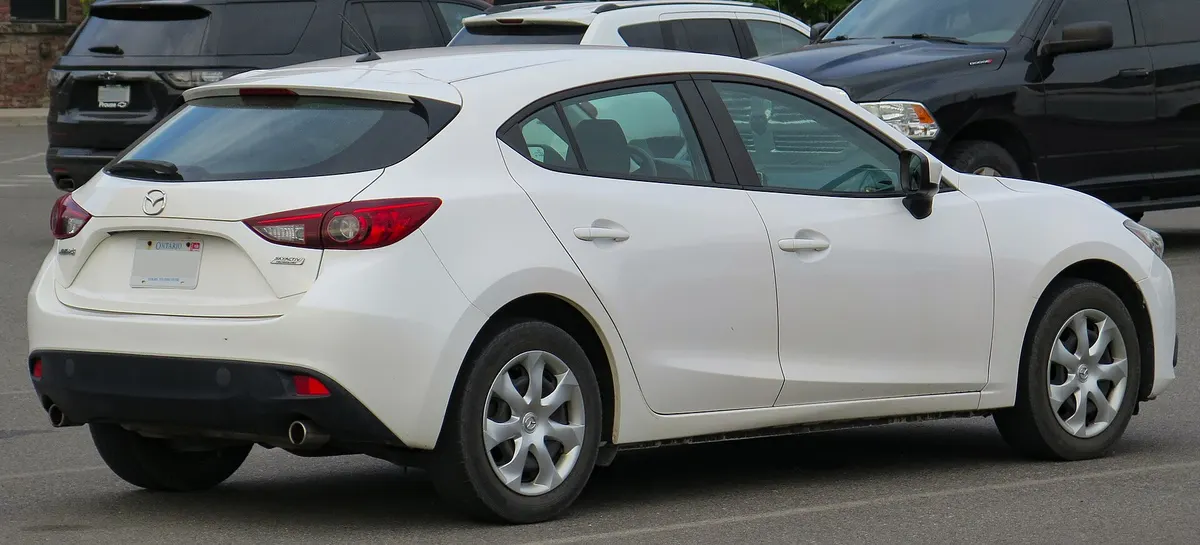
Engines
- PE-VPS (SkyActiv-G 2.0) · 2.0L gasoline, 155 hp
- PY-VPS (SkyActiv-G 2.5) · 2.5L gasoline, 184 hp
Transmissions
- SkyActiv-Drive · automatic, 6-speed
- manual , 6-speed
Drivetrain
FWD
Body
sedan, hatchback
Trims
i Sport, i Touring, i Grand Touring, s Touring, s Grand Touring, Sport (2017–2018), Touring (2017–2018), Grand Touring (2017–2018)
Mazda Mazda3 part-number cross-reference
Start from the OEM number, then pick the brand you trust. Verified equivalents for the Mazda Mazda3 (2014–2018).
Part links go to Amazon, and to eBay where Amazon does not stock the part. Affiliate links, so we may earn a commission if you buy. Your price is unchanged, and a commission never changes a verdict.
Oil filter
Mazda
Also sold as PE01-14-302A, value-line PE01-14-302A-MV, and updated 1WPE-14-302. It is a SMALL SPIN-ON canister (thread M20x1.5), even though Mazda's catalog calls it 'cartridge, oil filter.' SkyActiv-G 2.0 and 2.5 NA share it; the later turbo 2.5T (KF) uses a different filter.
Find Mazda oil filter on AmazonWix
The SkyActiv-specific spin-on: M20x1.5, 11-14 psi bypass, 15-micron nominal media, no anti-drainback valve listed. TRAP: do NOT accept the generic small spin-ons the cross-ref aggregators list for a SkyActiv Mazda3. Wix 51358 and 51365 and Ecogard X4612 all thread on (same M20x1.5) and all miss on media: 21 micron for the two Wix numbers, 30 micron at 97% for the Ecogard, against 15 for the 57002, and all three list an anti-drainback valve, which the 57002's spec sheet does not list at all. Note 51365 specifically also drops the bypass to 8-11 psi; 51358 does not, its bypass matches. Wix 51348 is a different error and does NOT fit at all: its thread is 3/4-16, and Wix catalogs it to the CX-5 2.2 turbo diesel. Use 57002.
Look up Wix oil filterNAPA Gold
Physically the Wix 57002 (NAPA Gold is built by Wix). Same SkyActiv-spec filter.
Check NAPA Gold oil filterPurolator
PureONE; documented to meet Mazda's SkyActiv high-flow requirement. Avoid substituting the generic PL/PH filters the aggregators list.
See Purolator oil filterVerified via: Walmart: WIX 57002 fitment (2012–2018 Mazda 3, 2013–2018 CX-5), Amazon: WIX 57002 (fits Mazda 12–20), WIX catalog: 57002 spec sheet (M20x1.5, 11-14 psi bypass, 15 micron), WIX catalog: 51358 spec sheet (M20x1.5, 21 micron, anti-drainback), WIX catalog: 51365 spec sheet (M20x1.5, 8-11 psi bypass, 21 micron), WIX catalog: 51348 spec sheet (thread 3/4-16, so it cannot fit a SkyActiv gas engine), Ecogard catalog: X4612 for the 2016 Mazda 3 (M20x1.5, 30 micron at 97%, anti-drainback)
Engine air filter
Mazda
Also PE07-13-3A0 and value-line -MV. Flat panel filter shared with 2014+ Mazda 6 and 2013+ CX-5 NA SkyActiv.
Compare Mazda engine air filter on AmazonEPAuto
Listing explicitly covers Mazda 3 2.0L/2.5L 2012–2025; equivalent to CA11259.
Check EPAuto engine air filterVerified via: PartsGeek: WIX 49247 air filter, 2012–2018 Mazda 3, AirFilter cross-reference: Mazda PE07-13-3A0A, Amazon: EPAuto GPA0A (PE07-13-3A0A), Mazda 3 2.0L/2.5L
Cabin air filter
Mazda
Also KD45-61-J6X-9U and value-line -MV. Shared with 2014+ Mazda 6 and 2013+ CX-5. Denso is the OE supplier.
See Mazda cabin air filter on AmazonDenso
Denso is the OE cabin-filter supplier; retailer fitment Mazda 3 / 6 / CX-5.
Compare Denso cabin air filterWix
Cross for KD45-61-J6X / 4536044; retailer fitment 2013–2024 Mazda 3.
Look up Wix cabin air filterVerified via: Amazon: EPAuto CPJ6X (KD45-61-J6X), Mazda 3 2014–2018, Walmart: DNA Motoring filter, replaces KD45-61-J6X / 4536044 / 24103 (2013–2024 Mazda 3/6/CX-5), PartsHawk: Denso 453-6044 cabin filter (Mazda 3/6/CX-5)
Spark plugs
Mazda
NGK-made OE plug (= NGK ILKAR7L11 / stock no. 94124). SkyActiv-G high-compression engines need this exact laser-iridium plug, not a generic heat range.
Check Mazda spark plugs on AmazonNGK
Laser Iridium, NGK stock #94124. The OE plug sold aftermarket. Pre-gapped ~0.044". Mazda's schedule is ~75k mi.
See NGK spark plugsVerified via: CorkSport: OEM replacement plugs for 2014–2018 Mazda SkyActiv (PE5R-18-110 = NGK ILKAR7L11), PlugSpecs: Mazda 3 spark plug (ILKAR7L11, gap ~0.044"), Go-Parts: 2015–2024 Mazda 3 spark plug replacement guide
Front brake pads
Mazda
Genuine front pad set for MEXICO-built cars (supersedes BJY7-33-28Z). JAPAN-built cars (VIN begins 'JM') use B4Y0-33-28Z (value-line B4Y0-33-28Z-C-MV). Match by VIN. Same D1728 shape is shared with the CX-3. IMPORTANT: the front ROTOR diameter differs by engine. 2.0L 'i' = 280 mm (rotor B45A-33-251A), 2.5L 's' = 295 mm (rotor B45G-33-251A). The PAD is shared but ROTORS must be matched to the engine.
Compare Mazda front brake pads on AmazonAkebono
ProACT ceramic w/ hardware; fitment 2014–2018 Mazda 3 / 3 Sport and 2016–2021 CX-3, front. (Akebono also catalogs ACT1759 for the same application.)
Find Akebono front brake padsWagner
ThermoQuiet ceramic (QuickStop equivalent ZD1728). Same D1728 shape.
Look up Wagner front brake padsPower Stop
Z16 Evolution ceramic; D1728 fitment 2014–2018 Mazda 3.
Check Power Stop front brake padsVerified via: Mazda-Parts (OEM catalog): front pads BJY7-33-28ZA, 2014–2018 Mazda 3 (Mexico-built), PartsHawk: Akebono ACT1728 (FMSI D1728), 2014–2018 Mazda 3 / 3 Sport / 2016–2021 CX-3, front, mazdaparts.org: value-line front pads B4Y0-33-28Z-C-MV, Japan-built (JM VIN) Mazda 3 2014–2018 + CX-3, Go-Parts: Mazda 3/CX-3 front-brake guide (280 mm 2.0L vs 295 mm 2.5L rotors)
Wiper blades
Mazda
OEM rear hatch wiper blade (12"), Japan-built cars. Hatchback only; aftermarket rear-arm fitment varies (Rain-X sells 12A–12E for different arm types), so verify the rear arm.
Find Mazda wiper bladesVerified via: MazdaShop USA: OEM wiper blades, Mazda3 Sedan & Hatchback (2014–2018), OttoBlades: 2018 Mazda 3 hatchback rear wiper 12", MyWiperSize: Mazda 3 (24" driver / 18" passenger front)
Serpentine belt
Mazda
Drives alternator / AC / power steering. ~961 mm, 6-rib. The 2.0L belt is ~10 mm SHORTER than the 2.5L belt. They are NOT interchangeable. (SkyActiv-G also uses a separate stretch-fit water-pump belt, sold apart from this accessory belt.)
Look up Mazda serpentine belt on AmazonGates
Micro-V, 6-rib, 961 mm (37.84"); vendor fitment lists 2013–2018 Mazda 3 2.0L specifically.
Check Gates serpentine beltVerified via: PartsGeek: Gates K060378 multi-rib belt, 2012–2020 Mazda 3 (alternator), Lethal Performance: Gates K060378, 2013–2018 Mazda 3 4-cyl 2.0L serpentine, MazdaStuff: OEM serpentine belt PE08-15-909C (Mazda 3)
Serpentine belt
Mazda
Drives alternator / AC / power steering. 971 mm, ~10 mm LONGER than the 2.0L belt; use the 2.5L-specific belt. Aftermarket Micro-V numbers conflict across catalogs (no clean two-source match), so no aftermarket number is listed here. Match by the 2.5L fitment at the counter.
See Mazda serpentine belt on AmazonVerified via: Mazda USA (parts.mazdausa.com): OEM belt PY01-15-909A (alternator/AC), MazdaSwag: OEM serpentine belt PY01-15-909A, 2014–2021 Mazda 2.5L non-turbo (971 mm)
Battery
Factory size
US-market OE is a flooded Group 35 (~500+ CCA). AGM Group 35 is a common drop-in upgrade in the same tray. Confirm the tray/terminals before buying.
Compare Factory size battery on AmazonInterstate
Flooded Group 35, 640 CCA; Interstate's fitment page confirms the 2014 Mazda 3 2.0L.
Find Interstate batteryDuralast
AutoZone lists Group 35 flooded/AGM (e.g. 35-DL / 35-AGM) as the fit for the 2014–2018 Mazda 3. Match CCA to OE or higher.
Look up Duralast batteryVerified via: Interstate Batteries: MTP-35 (Group 35, 640 CCA) fitment for 2014 Mazda 3 2.0L, AutoZone: Mazda 3 battery (Group 35)
Should I buy a 2014–2018 Mazda Mazda3?
Buy it. This is one of the safest used-compact bets of its era, and the SkyActiv drivetrains have no chronic engine failures. Do three things first: confirm the parking-brake/rear-caliper recall (NHTSA 17V-393) was performed by VIN, test the Mazda Connect screen through a full drive cycle, and on a manual car check the clutch hard. A 2017–2018 car sidesteps most of it. Those years have a fraction of the complaints, and the automatic is the lower-risk transmission across all years.
Best years
2017, 2018
Years to avoid
2014 (first-year car, most complaints by far: brakes, infotainment, interior quality), 2014–2016 manuals unless the clutch has been replaced or passes a hard test drive
Pre-Purchase Checklist for Mazda Mazda3
- ☐Run the VIN for open recalls, especially 17V-393 (rear parking-brake actuator corrosion, 2014–2016) and, on a 2018, the low-pressure fuel pump recall. A Mazda dealer or NHTSA.gov does this free.
- ☐Feel for brake drag: after a test drive, carefully check whether either rear wheel is hotter than the other. A seizing rear caliper is this car's signature failure.
- ☐Work Mazda Connect hard for the whole test drive: watch for reboots, freezes, a black screen, or ghost inputs. A flaky CMU is a four-figure dealer fix.
- ☐On manuals: full-throttle pull in 3rd–4th gear and watch for clutch slip; a high, vague engagement point on a low-mile car is the known pressure-plate failure starting.
- ☐Listen for a speed-dependent hum at 40+ mph that changes when you swerve gently. Front and rear wheel-bearing hubs are a common wear item on 2014–2015 cars.
- ☐Check brake pad and rotor life at all four corners. These cars eat rear brakes faster than most compacts, and prior owners often deferred it.
- ☐Confirm the automatic's fluid has been serviced at least once by 75k–100k miles; skipped fluid is the main thing that kills the otherwise-solid 6-speed.
Common Mazda Mazda3 problems & repair costs
Rear brake calipers seize (parking-brake actuator corrosion)
$500–$1,500Symptoms: One rear wheel drags or locks; burning smell or a glowing-hot rear rotor; parking brake won't fully hold or release; car pulls under braking. CarComplaints lists 'brakes locked up' as this car's #1 problem, averaging around $2,600 when owners paid out of pocket.
Fix: Water gets past the caliper's parking-brake actuator boot, the shaft corrodes and swells, and the caliper sticks. Mazda recalled ~228,000 Mazda3/Mazda6 (NHTSA 17V-393, Mazda 1217F) to inspect and replace corroded actuators free. If the recall was never done or the caliper already seized, the fix is new rear caliper(s), usually with pads and a cooked rotor on the affected side. Check the VIN before paying for anything.
Sources: NHTSA recall 17V-393: parking brake actuator corrosion, Mazda safety recall 1217F (2014–2017 Mazda3), CarComplaints: 2014 Mazda3 (brakes locked up, #1 problem)
Mazda Connect infotainment (CMU) crashes and reboot loops
$300–$1,400Symptoms: Screen reboots on its own, freezes, goes black, or the system shuts down minutes after startup and won't come back. Ghost touches and Bluetooth dropouts are related complaints. A corrupted navigation SD card can also cause a reboot loop.
Fix: Mazda's TSB 09-044/15 covers 2014–2015 Mazda3s where the system shuts down and won't reboot. The fix is a replacement connectivity master unit (CMU). A class-action settlement (Duffy v. Mazda) extended CMU warranty coverage on many 2014–2018 cars, but that window has passed for most. Today: try a software update and pulling the nav SD card first (free), then a used/refurb CMU; a new dealer-installed CMU runs $1,250–$1,400.
Sources: Mazda TSB 09-044/15: Mazda Connect shuts down, CMU replacement, CarComplaints: 2014 Mazda3 (infotainment crashes, #3 problem), Mazda3Revolution: CMU replacement thread (dealer quotes)
Premature clutch / pressure-plate failure (manuals)
$1,100–$2,000Symptoms: Clutch slips under load, engagement point rises or turns vague, pedal sticks to the floor, or the car suddenly won't shift. Owners report failures at mileages where a clutch should be nowhere near worn, some under 10k miles.
Fix: Failed pressure plates are the documented pattern, and a California class action targeted 2010–2015 Mazda3 clutch systems. Mazda often called it a wear item and denied warranty claims. The fix is a full clutch kit (disc, pressure plate, throwout bearing, and usually flywheel resurfacing or replacement) at an independent shop. On any used manual, test for slip before you buy.
Sources: MazdaProblems: Mazda clutch failure and warranty lawsuit, Mazda3Revolution: 2016 manual rapid clutch failure thread
Premature brake wear (pads and rotors, especially rear)
$250–$600Symptoms: Squeaking or grinding rear brakes well before the fronts are due; pads down to metal by 30k–35k miles; rotors scored or lipped early.
Fix: Pads and rotors per axle at an independent shop. This is the #2 complaint on the 2014 car (18 reports, ~33k miles average at CarComplaints) and persisted in smaller numbers on 2015–2016. Partly it overlaps with dragging rear calipers. Always check caliper slide pins and the parking-brake actuator when the rears wear fast.
Sources: CarComplaints: 2014 Mazda3 (premature brake wear, #2 problem), MazdaProblems: 3rd-gen (2014–2018) problem rankings
Wheel-bearing hub failure (hum at speed)
$350–$650Symptoms: Cyclical hum or drone above roughly 40 mph that changes pitch when you gently swerve left/right. Front or rear; often misdiagnosed as tire noise or a transmission problem. Mazda's own service notes flag that misdiagnosis.
Fix: Front and rear bearings on this generation are sealed hub-assembly units, so there is no pressing. The whole hub gets replaced. Cost above is per corner, parts and labor, using a quality hub (Timken/SKF). Note some parts differ between Japan-built and Mexico-built cars, so match by VIN.
Sources: Mazda3Revolution: wheel bearing threads (2014–2015 cars), Go-Parts: 2010–2023 Mazda3 wheel bearing & hub assembly guide
Day to day this is a cheap car to own: the SkyActiv engines have no chronic failure modes, the 6-speed auto is a conventional and durable unit, timing is by chain, and parts are compact-car cheap. Budget for brakes more often than you would on a Civic or Corolla, one wheel-bearing hub somewhere past 60k, and (if the previous owner never dealt with it) a possible CMU infotainment unit. The only genuinely expensive surprises are a seized rear caliper that was never recalled-out and a clutch job on an early manual. Fuel-system recalls (2014–2016 tank check valve, 2015–2016 shut-off valve, 2018 low-pressure fuel pump) were all free fixes. Just verify by VIN they were done.
Cost calculator
What will this Mazda Mazda3 cost you by a given mileage?
Drag to a mileage. We total the documented problems whose typical onset falls at or before it. The same cost ranges listed above, nothing new invented.
$0 estimated repair range
Have a repair quote for this Mazda Mazda3?
Audit against OEM book times, uncover duplicate pad and rotor labor, and verify parts markups.
How to fix common Mazda Mazda3 problems (DIY)
Rear brake pads + caliper service (the anti-seize job)
Tools: Floor jack + jack stands, Socket set + breaker bar, Rear caliper piston wind-back tool (piston screws in, so don't press it), Silicone brake grease, Wire brush
- Jack the rear, pull the wheels, and release the parking brake fully before touching the calipers.
- Unbolt the caliper, hang it on a hook (never by the hose), and remove the old pads.
- Wind the piston back with the rewind tool. The rear pistons screw in because of the mechanical parking brake; a C-clamp will damage them.
- Clean and re-grease the slide pins, and inspect the parking-brake actuator area for corrosion or a torn boot. This is where the recall failure starts.
- Fit new pads with fresh hardware, re-torque everything, and pump the pedal firm before moving the car.
- Cycle the parking brake several times and confirm both rear wheels spin free with it released.
Parts
- Rear brake pads (2014–2018 Mazda3) · Amazon $25–$60
- Rear rotors, pair (if lipped or heat-blued) · Amazon $60–$120
- Caliper rewind tool kit · Amazon $15–$30
Cabin & engine air filter change
Tools: None (maybe a small flathead for the airbox clips)
- Open the glovebox, squeeze the sides to drop it past the stops, and pull the cabin-filter cover behind it.
- Slide the old cabin filter out and insert the new one with the airflow arrow pointing the right way.
- Refit the cover and glovebox.
- Under the hood, release the airbox clips, lift the lid, swap the panel filter, and re-clip.
Parts
- Cabin air filter (2014–2018 Mazda3) · Amazon $10–$18
- Engine air filter (2014–2018 Mazda3) · Amazon $12–$25
Wheel-bearing hub assembly replacement (one corner)
Tools: Floor jack + jack stands, Breaker bar + large axle-nut socket (front), Socket set + torque wrench, Penetrating oil, wire brush
- Confirm which corner: hum that changes pitch on gentle swerves points at the loaded/unloaded side.
- Front: break the axle nut loose with the wheel on the ground, then jack, pull the wheel, and unbolt the caliper and rotor.
- Unbolt the hub assembly from the knuckle. The bearing is a sealed unit, so there's no pressing.
- Clean the knuckle mating face thoroughly; rust buildup here causes runout and a comeback.
- Bolt in the new hub (match the part to a Japan- vs Mexico-built VIN), torque everything to spec including a new axle nut.
- Refit brakes and wheel, then road-test above 40 mph to confirm the hum is gone.
Parts
- Wheel hub bearing assembly (2014–2018 Mazda3) · Amazon $60–$150
Some parts links are affiliate links. We may earn a commission at no cost to you. We only list parts that fit this generation.
The short version
The 2014–2018 Mazda3 (BM/BN) is the rare used compact where the reputation is deserved: top-of-class reliability scores, engines with no chronic failure modes, a conventional automatic instead of a CVT, and a chassis that’s actually enjoyable. Out of 36 Mazda generations tracked by complaint aggregators, this one’s total complaint count is low, and half of what exists is concentrated in the first-year 2014 cars.
The problems that do exist are unusually specific, which makes them checkable. Number one is the rear brake caliper: water corrodes the parking-brake actuator shaft inside it, and the caliper drags or locks. Mazda recalled about 228,000 cars for it (NHTSA 17V-393). Number two is the Mazda Connect infotainment computer (the CMU), which crashes, reboot-loops, or dies. That nuisance turns into a four-figure dealer bill if the unit needs replacement. Number three only applies to manuals: 2014–2016 cars ate pressure plates early enough to draw a class-action lawsuit.
What that means when you’re shopping
Start with the VIN, not the test drive. NHTSA’s free recall lookup tells you in seconds whether the parking-brake recall (plus the smaller fuel-system recalls and the 2018 fuel-pump recall) were ever performed. An open recall is still a free dealer fix; an already-seized caliper someone paid to fix won’t appear, so put a hand near each rear wheel after your drive and feel for one running hot.
Then abuse the infotainment. Leave it on the whole drive, switch sources, pair a phone. A screen that reboots once will do it again, and you should price the car as if a CMU is coming.
2017–2018 cars are the sweet spot: the fewest complaints of the generation by a wide margin, past the worst of the caliper and CMU years, and refreshed inside. The 2014 is the value play only if the recall is documented and the screen behaves. On any 2014–2016 manual, do a full-throttle pull in a high gear; slip or a vague, high engagement point means the known clutch failure, and that’s a $1,100–$2,000 negotiation item.
What it’s like to own
Cheap, mostly. Fuel economy is excellent for a non-hybrid, timing is by chain, and there’s no turbo, no CVT, and no direct-injection horror stories on the SkyActiv engines. Plan on brakes slightly more often than the class average (and insist whoever does them services the rear caliper slides properly), one wheel-bearing hub somewhere past 60k miles, and normal wear beyond that. Service the automatic’s fluid even though the schedule pretends you never need to.
How this file is built: failure modes and cost ranges are compiled from NHTSA recall documents, CarComplaints owner data, Mazda’s own TSBs and recall campaigns, and owner-forum reporting, then sanity-checked against shop-floor experience. Cost figures are independent-shop estimates and vary by region. Spot something off? Tell us.
Viral car myths, checked against this car
- Misleading
Is the "$1 Japanese oil trick" that stops engine wear forever real?
The 'Japanese oil trick' is almost certainly MoS2 (molybdenum disulfide), a real industrial friction modifier. It is German, not Japanese (Liqui Moly popularized it), sold openly at every parts store for $15-20, has real but modest measured friction benefits, and was never buried by anyone.
- Mostly False
Does a "$3 liquid" really kill car rust permanently? The phosphoric-acid reality.
The $3 liquid is almost certainly phosphoric acid (sold as Ospho or Naval Jelly). It converts surface rust to iron phosphate. It does not kill rust 'permanently,' does not restore perforated steel, and was never buried by anyone. It has been on hardware store shelves continuously since the 1940s.
Frequently asked questions
Which Mazda3 years should I avoid?
2014 is the one to be careful with. It has roughly half of this generation's total complaints on its own: seizing rear brakes, fast brake wear, and the crash-prone infotainment unit. It's not a bad car if the recall was done and the screen works, but 2017–2018 cars have a fraction of the problems and are worth the extra money. On manuals, treat any 2014–2016 car as clutch-suspect until it passes a hard test drive.
Is the 2014–2018 Mazda3 reliable?
Yes, genuinely. Consumer Reports rated these years at or near the top of the compact class, and the SkyActiv engines and conventional 6-speed automatic have no chronic failure patterns. The issues that exist are specific and checkable before purchase: rear brake calipers, the infotainment CMU, early-manual clutches, and wheel bearings. A clean example is a realistic 200,000-mile car.
How do I know if the parking-brake recall was done on a car I'm buying?
Run the VIN at NHTSA.gov/recalls or have any Mazda dealer check it. Takes minutes and it's free. The recall (NHTSA 17V-393 / Mazda 1217F) covered about 228,000 2014–2016 Mazda3 and Mazda6 cars for a corroding parking-brake actuator that can seize a rear caliper. If it shows open, a dealer still has to fix it free of charge, but a caliper that already seized and was repaired out of pocket won't show up, so also check for one rear wheel running hot after a drive.
What does the Mazda Connect infotainment fix cost?
Depends on the failure. A reboot loop is sometimes just a corrupted navigation SD card. Pull it, and the fix is free. A software update at a dealer is cheap. If the CMU (the computer behind the screen) is actually dead, a new dealer-installed unit runs about $1,250–$1,400; a used or refurbished CMU installed by an independent shop or a handy owner is a few hundred dollars.
Manual or automatic on this generation?
Mechanically, the automatic is the safer used buy. The SkyActiv 6-speed torque-converter auto has a strong record, while 2014–2016 manuals have a documented pattern of premature pressure-plate failure that Mazda usually refused to cover. If you want the manual (it's a good one to drive), budget as if a $1,100–$2,000 clutch job could be in your future, or buy a car with receipts showing it's already been done.
Cross-shopped rivals
Files on what buyers weigh against the Mazda Mazda3 of this era.