Case file · FORD-FOCUS-2008-2011 · 2nd gen (North America) (C170 (facelift))
Ford Focus 2008–2011Common problems, reliability & repair costs
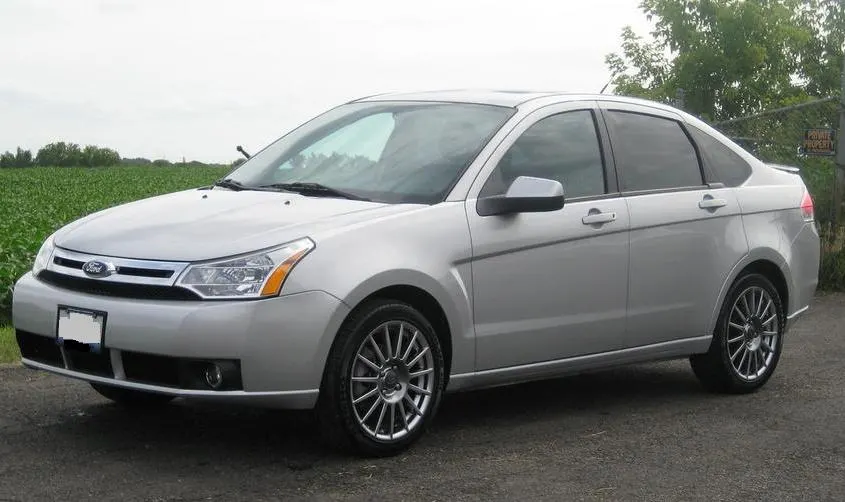
The 2008–2011 North American Focus is a heavily refreshed version of the original C170 platform, not the European Mk2, with one engine, one simple 4-speed automatic, and almost nothing exotic to break. Its faults are cheap and well documented: rear tires that wear out on the inner edge, ignition keys that stick or won't turn, power door lock actuators that die, and lug nuts that swell. No engine or transmission landmine; it's an honest cheap car.
2010, 2011
None are outright bad. 2008 (first year of the refresh) logg
Engines
- Duratec 20 · 2.0L gasoline, 140 hp
Transmissions
- manual , 5-speed
- 4F27E · automatic, 4-speed
Drivetrain
FWD
Body
sedan, coupe
Trims
S, SE, SES, SEL
Ford Focus part-number cross-reference
Start from the OEM number, then pick the brand you trust. Verified equivalents for the Ford Focus (2008–2011).
Part links go to Amazon, and to eBay where Amazon does not stock the part. Affiliate links, so we may earn a commission if you buy. Your price is unchanged, and a commission never changes a verdict.
Oil filter
Motorcraft
Ford's 2008-2011 owner guides list Motorcraft FL-910 (2008 p244, 2009-2010 p257, 2011 p258). FL-910S is the likely current number, unverified
Find Motorcraft oil filter on AmazonVerified via: Ford 2008 Focus owner guide, Motorcraft parts table (p244), Ford 2011 Focus owner guide, Motorcraft parts table (p258), Ford.com: Motorcraft Engine Oil Filter FL910S, FRAM part finder: 2010 Ford Focus L4 2.0L 121cid oil filter (PH3614), oilfilter-crossreference: Motorcraft FL910S equivalents (Fram PH3614, Wix 51348)
Engine air filter
Motorcraft
Ford OE 8S4Z-9601-A. TRAP, per Ford's 2008 book and 2008-2009 maintenance guides: a PZEV car (130 hp emissions-state car) has a lifetime filter, so the 30,000-mile change does not apply to it. AA1Car describes a SEALED airbox with a NON-replaceable element (Ford 4S4Z-9600-AA), where you replace the whole housing. For 2010-2011 Ford prints no PZEV exception, so check the airbox. Also do NOT use Fram CA10165 (that is the Honda Civic filter). The Focus Fram is CA10488.
See Motorcraft engine air filter on AmazonVerified via: airfilter-crossreference: Motorcraft FA-1890 equivalents (Wix 49890, Fram CA10488, Purolator A35775, Ford 8S4Z-9601-A), PartsGeek: Wix 49890 air filter, 2008-2011 Ford Focus, K&N: 33-2401 replacement air filter, Ford Focus 2.0L NON-PZEV, AA1Car: Ford Focus PZEV sealed air filter housing (2.0L Ford 4S4Z9600AA, element not replaceable)
Cabin air filter
n/a
Owners report NO replaceable cabin filter from the factory, only a fixed wire-mesh screen under the cowl. Ford's schedule lists a cabin filter only 'if equipped' (2008-2010 Scheduled Maintenance Guides, 2011 owner guide p. 282), and the 2008-2010 owner guides do not mention one. A functional filter can be RETROFITTED using an older-Focus (2000-2007) filter housing.
See n/a cabin air filter on AmazonVerified via: FilterLocation, Ford Focus cabin filter (owner reports: 2008-2011 have mesh only, no filter), Focus Fanatics: 'Cabin Air Filter on 2010 - or lack thereof' (no factory filter, mesh screen), Focus Fanatics: '2008 Focus - Cabin Air Filter?' (retrofit needed to add one)
Spark plugs
Motorcraft
AGSF32YRA double-platinum finewire. Retailer fitment (FSWERKS, Walmart): Ford's books print no plug part number. Also sold as SP-541AX.
Compare Motorcraft spark plugs on AmazonNGK
Laser Platinum (double platinum), pre-gapped 0.052 in, OE-equivalent for the 2.0L Duratec
Find NGK spark plugsVerified via: Ford 2011 Focus owner guide, engine specifications, plug gap (p262), FSWERKS: Motorcraft SP-541A (AGSF32YRA) double platinum, Ford Focus Duratec, Walmart: Motorcraft SP-541-A fits select 2005-2011 Ford Focus, Summit Racing: NGK PTR5A-13 Laser Platinum, Ford Focus, SixityAuto: NGK Laser Platinum PTR5A-13, 2006-2010 Focus 2.0L, gap 0.052 in
Front brake pads
Motorcraft
front disc pad set (also cataloged as BRF-1339)
Look up Motorcraft front brake pads on AmazonVerified via: Amazon: OEM Motorcraft BR-1339 front brake pads, 2008+ Ford Focus, Detroit Axle: 2008 Ford Focus front ceramic pads, FMSI D1339, 1A Auto: 2008-11 Focus front ceramic pad + rotor kit (D1339)
Wiper blades
Fitment note
Fits Trico, Bosch, Rain-X, Michelin beam or conventional blades in these sizes; hook-arm mount
Compare Fitment note wiper bladesVerified via: USAWipers: Ford Focus 2008 & 2010-2011 (22 in / 19 in front), AutoPadre: Ford Focus wiper sizes (22/19 front, 2008-2011), TrailerJacks: Trico set 2000-2011 Ford Focus, 22 in + 19 in
Serpentine belt
Motorcraft
Ford OE 8S4Z-8620-BB; 6-rib, routes crank/water pump/tensioner/alt/idler/PS/AC. TRAPS: (1) the 2005-2007 Focus uses JK6881B (one B), a different belt. (2) Gates K060690 is widely cross-listed to this car but is only 69 in, the WRONG length; the length-correct Gates candidate is ~87 in (K060870), so verify against the old belt before buying aftermarket.
Find Motorcraft serpentine belt on AmazonVerified via: Ford OEM Parts Online: Motorcraft Serpentine Belt JK6-881-BB, 2008-2011 Ford, CARiD: Motorcraft JK6881BB serpentine belt (6-rib, ~88 in, w/ A/C), eBay: Motorcraft JK6881BB, Ford Transit Connect / Focus 2008-2011 2.0L
Battery
Motorcraft
Look up Motorcraft battery on AmazonAny Group 96R battery
retailer listing (AutoPadre, AutoZone). Ford gives no CCA, so compare CCA against the battery you remove
Check Any Group 96R battery batteryVerified via: Ford 2008 Focus owner guide, Motorcraft parts table (p244), Ford 2009 Focus owner guide, Motorcraft parts table (p257), AutoPadre: Ford Focus battery group size (96R, 2008-2011), AutoZone: 2009 Ford Focus battery (Group 96R)
Should I buy a 2008–2011 Ford Focus?
Buy it as what it is: a cheap, simple commuter with no expensive landmine. The 2.0L Duratec is durable, the 4-speed automatic is dated but mostly reliable, and every common fault on this car (tire-eating rear alignment, sticky ignition cylinders, dead door lock actuators, swollen lug nuts) costs hundreds, not thousands, to fix. The trade-off is a cheap-feeling interior and a rear suspension that needs a proper alignment (sometimes a camber/toe correction) to stop eating tires. A 2010–2011 car with service records is one of the best sub-$6k used buys of its era; just walk away from any automatic that flares or slips on the test drive.
Best years
2010, 2011
Years to avoid
None are outright bad. 2008 (first year of the refresh) logged the most complaints; 2009–2011 improved
Pre-Purchase Checklist for Ford Focus
- ☐Crouch behind the car and check the rear tires' inner edges. Feathered or bald inner shoulders is the classic rear camber/toe wear pattern on this car. Ask when it was last aligned.
- ☐Cycle the ignition key several times, including wiggling the wheel. Any sticking, hard turning, or 'jiggle the key' ritual means the ignition lock cylinder is on its way out.
- ☐Lock and unlock every door from the fob AND the interior switch, twice. A door that doesn't respond or clicks without moving is a failed lock actuator.
- ☐Confirm the factory lug wrench actually fits the lug nuts. Swollen two-piece lug nuts are common and will strand you with a flat you can't remove.
- ☐On automatics, test-drive from cold and watch the 2-3 and 3-4 shifts. RPM flare or a slipping sensation between gears is the expensive failure. Walk away or price it in.
- ☐Verify the engine starts promptly on the first turn and the battery light stays off. Scattered no-start and charging complaints exist for this generation.
- ☐In salt states, check rear wheel arches, rocker panels, and under the carpet edges for rust like any 15+-year-old economy car.
Common Ford Focus problems & repair costs
Premature rear tire wear and rear-end noise (rear camber/toe)
$150–$900Symptoms: Rear tires wear out fast on the inner edge, sometimes bald inside with tread left outside, often with a hum or droning noise from the back that sounds like a wheel bearing. Owners report tires done in as little as 12,000–26,000 miles. It was the #1 complaint on the 2008 and 2009 cars.
Fix: A proper four-wheel alignment with the rear set to minimum factory toe-in is the first step. Rear camber isn't factory-adjustable, so cars that keep eating tires need an aftermarket camber bolt/kit installed, then new tires. Budget alignment + kit + a pair of tires on a bad one.
Sources: CarComplaints: 2008 Focus rear end noise / abnormal tire wear, CarComplaints: 2009 Focus premature and uneven tire wear, Focus Fanatics: rear tire inner edge wear solution
Ignition key sticks or won't turn (lock cylinder / ignition switch)
$150–$450Symptoms: The key becomes hard to turn, needs jiggling, gets stuck in the cylinder, or one day won't turn at all, leaving the car unstartable. Wear in the lock cylinder's tumblers (and the key itself) is the usual cause; the ignition switch behind it can also fail. Ranked among the worst 2008 Focus problems, averaging about $400 to fix.
Fix: A locksmith or shop replaces the ignition lock cylinder (keyed to match or with new keys); if symptoms persist, the electrical ignition switch gets replaced too. No recall was ever issued for this. It's on the owner.
Sources: CarComplaints: 2008 Focus (ignition switch failure, #3 worst problem), RepairPal: Ford Focus key won't turn, FixMyOldRide: Ford ignition lock cylinder problems (Escape/Focus)
Power door lock actuator failure
$150–$500Symptoms: One or more doors stop responding to the fob or the lock switch, clicking without locking, or nothing at all. It was the #1 complaint category on the 2011 car ('locks won't lock or unlock', ~$400 average) and a top-3 issue on the 2009.
Fix: Replace the door latch/actuator assembly inside the affected door. Aftermarket latch assemblies are cheap; most of the cost is door-panel labor, which makes this a good DIY save.
Sources: CarComplaints: 2011 Focus (locks won't lock or unlock, #1 problem), CarComplaints: 2009 Focus (door lock malfunction)
4F27E automatic transmission failure (uncommon but expensive)
$1,800–$3,800Symptoms: RPM flare on the 2-3 or 3-4 shift, slipping in 3rd/4th, harsh or delayed engagement, or shudder. Complaint counts are low, and this is not an epidemic, but reported repair bills ran $2,600–$3,800 when the transmission let go. Valve-body solenoid faults cause many of the shift complaints.
Fix: Solenoid/valve-body work catches the cheap cases; a slipping unit needs a rebuild or a used/reman transmission. Regular fluid service is the best prevention on a healthy one, and a careful cold test drive is the best defense when buying.
Sources: Transmission Repair Cost Guide: Ford Focus 4F27E problems, CarComplaints: 2009 Focus (transmission failure, ~$3,800 average)
Swollen two-piece lug nuts
$40–$160Symptoms: The factory lug nuts are a steel core with a thin decorative cap. Moisture and heat make the cap swell and delaminate, so the factory lug wrench (and standard sockets) no longer fit, discovered at the worst time, roadside with a flat. The design was the subject of a class-action suit against Ford.
Fix: Have the swollen nuts extracted (a shop uses extractor sockets) and replace the full set with solid one-piece lug nuts. Cheap, permanent, and worth doing preemptively.
Sources: FordProblems: the curious case of Ford's swollen lug nuts, Focus Fanatics: Ford's swollen lug nuts / class action lawsuit
This is one of the cheapest cars of its era to keep on the road. The Duratec 2.0 uses a timing chain (no belt service), parts are everywhere and inexpensive, and everything common (alignment, lock cylinder, door actuators, lug nuts, plugs, coils) is a few-hundred-dollar fix, with several of them solid DIY jobs. The two budget watch-items: rear tires (sort the alignment early or you'll buy tires twice as often) and, on automatics, transmission fluid service. The 4F27E rarely fails, but when it does it's the only four-figure bill on the car. Interior trim and switchgear feel cheap and wear accordingly; that's cosmetic, not financial.
Cost calculator
What will this Ford Focus cost you by a given mileage?
Drag to a mileage. We total the documented problems whose typical onset falls at or before it. The same cost ranges listed above, nothing new invented.
$0 estimated repair range
5-Year Maintenance Schedule & Cost to Own
Every scheduled service by mileage, fluid capacities, independent shop ranges, and parts cross-references.
Have a repair quote for this Ford Focus?
Audit against OEM book times, uncover duplicate pad and rotor labor, and verify parts markups.
How to fix common Ford Focus problems (DIY)
Replace the full lug nut set with solid one-piece nuts
Tools: Breaker bar, 19mm socket (plus a swollen-lug-nut extractor socket if caps have already swelled), Torque wrench, Jack + jack stands (only if a nut fights you)
- With the car on the ground, break each lug nut loose one wheel at a time. Use the extractor socket on any nut the standard socket no longer fits.
- Remove the old two-piece nuts and thread on the new solid one-piece nuts by hand to avoid cross-threading.
- Torque each nut to 100 lb-ft (135 N·m), Ford's spec, in a star pattern.
- Confirm the factory lug wrench in the trunk fits the new nuts, then retighten to the same torque at 500 miles, as Ford's book says after any wheel removal.
Parts
- Solid one-piece lug nuts, M12x1.5 (set of 20) · Amazon $20–$40
- Swollen lug nut extractor socket set · Amazon $15–$30
Replace a failed door lock actuator (door latch assembly)
Tools: Trim panel removal tools, Socket set + Torx bits, Screwdrivers
- Remove the door panel: pry the trim caps, remove the screws behind them, pop the clips, and unplug the switch connectors.
- Peel back the vapor barrier and disconnect the lock and latch cables/rods from the old latch assembly.
- Unbolt the latch from the door edge (Torx screws) and fish the assembly out through the door cavity.
- Transfer cables to the new latch/actuator assembly, bolt it in, and plug in the electrical connector.
- Test lock/unlock from the fob and switch BEFORE reinstalling the vapor barrier and door panel.
Parts
- Door latch / lock actuator assembly (2008–2011 Focus) · Amazon $35–$90
Spark plug change (2.0L Duratec)
Tools: Ratchet + extension, 5/8" spark plug socket, Torque wrench
- With the engine cold, remove the plastic engine cover and unplug the coil connectors.
- Unbolt and pull each coil-on-plug unit, blowing debris out of the plug wells first.
- Remove the old plugs, check the gap on the new ones, and thread them in by hand.
- Torque plugs to spec, reinstall coils, and clear any stored misfire codes if present.
Parts
- Iridium spark plugs (set of 4, 2.0L Duratec) · Amazon $25–$50
Some parts links are affiliate links. We may earn a commission at no cost to you. We only list parts that fit this generation.
The short version
The 2008–2011 Focus is the car your mechanic buys for his kid. North America skipped the all-new European Focus and instead restyled the original 2000-era platform, so under the new sheet metal is a drivetrain that had been debugged for nearly a decade: one 2.0L Duratec four with a timing chain, a 5-speed manual or a simple 4-speed automatic, front-wheel drive, nothing turbocharged, nothing dual-clutch.
The complaint record backs that up. There’s no engine defect and no transmission epidemic. What owners actually report, over and over, is small stuff: rear tires chewed up on the inner edge, ignition keys that stick or refuse to turn, power door locks that quit, and factory lug nuts that swell until the wrench won’t fit. Every one of those is a fix measured in hundreds of dollars, several of them an afternoon in the driveway.
What that means when you’re shopping
Check the four known spots and you’ve covered most of the risk. Look at the rear tires’ inner edges (and ask about alignment history). Work the key in the ignition a few times. Cycle every door lock from the fob. Confirm the factory wrench still fits the lug nuts.
The one place to be genuinely careful is an automatic car on the test drive. The 4F27E rarely fails, but when it does the bill runs $1,800–$3,800. That is real money on a car worth $4,000–$7,000. Drive it from cold; any RPM flare between 2nd and 3rd, or slipping in the top gears, is your cue to walk.
Year-wise, it’s simple: 2008 logged the most complaints as the refresh year, and the record improves through 2011. NHTSA shows an essentially clean recall sheet on the 2009 and 2010 cars. A 2010–2011 with records is the pick.
The honest downside
It’s dull, the interior plastics are hard and scratch easily, and the 4-speed automatic feels a generation old because it is. None of that costs you money. It just means you should pay a dull-car price. As basic transportation, this generation quietly outlasts flashier rivals.
How this file is built: failure modes and cost ranges are compiled from NHTSA complaint and recall data, CarComplaints.com owner reports, and owner-forum documentation, then sanity-checked against shop-floor experience. Cost figures are independent-shop estimates and vary by region. Spot something off? Tell us.
Viral car myths, checked against this car
- Mostly False
Do shops lose money on cheap oil changes? We opened a real shop's books to find out.
A quick lube's true all-in cost is roughly $16–40 per car. Even a $59 special turns a gross profit before the upsells start. The 'below cost' story is only true at full-service shops doing far more work per visit, which is a different product wearing the same name.
- Misleading
Is the "$1 Japanese oil trick" that stops engine wear forever real?
The 'Japanese oil trick' is almost certainly MoS2 (molybdenum disulfide), a real industrial friction modifier. It is German, not Japanese (Liqui Moly popularized it), sold openly at every parts store for $15-20, has real but modest measured friction benefits, and was never buried by anyone.
- Outdated
Does a "$1 mineral" really double car battery life? The Epsom-salt reality.
The mineral is Epsom salt (magnesium sulfate). It was a real desulfation hack for serviceable flooded-cell batteries 40+ years ago. It does not work on modern sealed AGM or EFB batteries, and trying it on yours will void the warranty without helping the battery.
- Dangerous
Is the "$2 liquid that destroys engine sludge forever" real? Our shop-floor verdict.
An aggressive solvent flush on a high-mileage engine is a textbook way to spin a bearing. The viral 'kitchen-cabinet flush' is folklore that real shops spend money cleaning up after.
Frequently asked questions
Is the 2008–2011 Ford Focus reliable?
Yes, in the boring, good way. There's no cracked-block or grenade-transmission landmine on this generation. The engine is a durable timing-chain 2.0L and the automatic is a simple 4-speed. Its documented faults (rear tire wear, sticky ignition cylinders, door lock actuators, swollen lug nuts) are all cheap fixes. The car's real weakness is cheap interior trim, not mechanicals.
Is this the same car as the European Ford Focus Mk2?
No. Europe got an all-new Focus in 2005; North America kept the original C170 platform and gave it a heavy restyle for 2008: new sheet metal, sedan and coupe only, one 2.0L engine. That's actually good news used: the bones had been in production since 2000 and the early bugs were long worked out.
Which years are the best buy?
2010 and 2011. Complaint counts dropped steadily after the 2008 refresh year, and the last cars are the most sorted. 2008 isn't a bad car. It just logged the most complaints of the run, so buy it on condition and price.
Why do the rear tires wear out so fast?
Factory rear camber and toe settings ride hard on the inner edge of the tread, and rear camber isn't adjustable from the factory. The fix is a proper alignment set to minimum rear toe-in, plus an aftermarket camber kit on cars that keep eating tires. Sort it once and the problem stops.
Should I worry about the 4-speed automatic?
Mostly no. The 4F27E is old-school and low-stress, and most survive the life of the car with fluid service. But the rare failure costs $1,800–$3,800. That is often more than the car is worth, so test-drive from cold and reject any car that flares between 2nd–3rd or slips in 3rd/4th.
Cross-shopped rivals
Files on what buyers weigh against the Ford Focus of this era.