Case file · HONDA-PILOT-2016-2022 · 3rd gen (YF5/YF6)
Honda Pilot 2016–2022Common problems, reliability & repair costs
The 3rd-gen Pilot is a genuinely good three-row family hauler that Honda launched half-baked and then spent six years fixing. Early cars, 2016 especially, carry the ZF 9-speed's harsh shifting, failing fuel injectors, a battery-draining keyless module, and an auto idle-stop that sometimes leaves you stranded at a light. By 2021–2022 nearly all of it was sorted. Buy late in the run, or buy early with the recall and warranty-extension homework done.
2021, 2022, 2020
2016 (first model year: injectors, electrical drain, idle-st +1 more
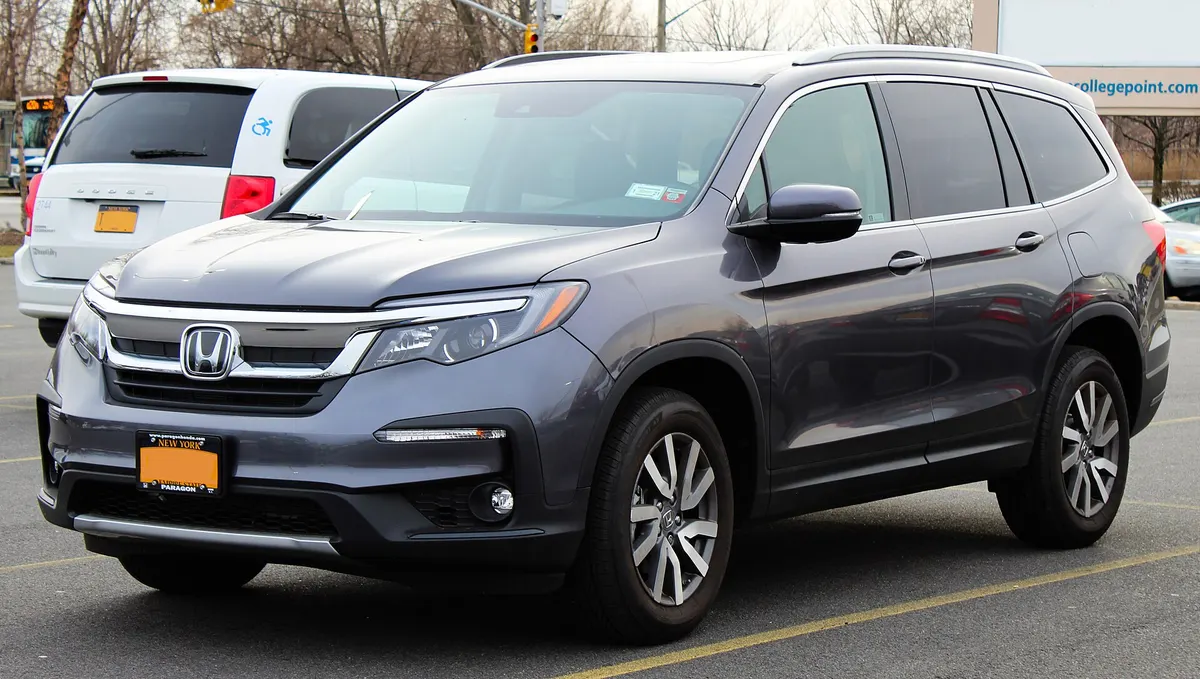
Engines
- J35Y6 · 3.5L gasoline, 280 hp
Transmissions
- automatic , 6-speed
- ZF 9HP48 · automatic, 9-speed
Drivetrain
FWD / AWD
Body
SUV (3-row)
Trims
LX, EX, EX-L, Touring, Elite, Black Edition, Special Edition, Sport, TrailSport
Honda Pilot part-number cross-reference
Start from the OEM number, then pick the brand you trust. Verified equivalents for the Honda Pilot (2016–2022).
Part links go to Amazon, and to eBay where Amazon does not stock the part. Affiliate links, so we may earn a commission if you buy. Your price is unchanged, and a commission never changes a verdict.
Oil filter
Honda
Current genuine number (Honeywell/Fram-made); Honda also lists 15400-RTA-003 (Mahle) for these years - interchangeable genuine part
Find Honda oil filter on AmazonVerified via: HondaPartsNow Pilot oil filter (15400-PLM-A02, all 2016-2022), Oilfilter-crossreference.com Honda 15400-PLM-A02, MLMultipieces Fram XG7317 for 2022 Honda Pilot, Amazon Purolator PL14610 (Pilot application)
Engine air filter
Honda
Shared with 2018+ Odyssey, 2019+ Passport, 2017+ Ridgeline
See Honda engine air filter on AmazonK&N
Washable; do not confuse with 33-5034, which is a different application
Check K&N engine air filterVerified via: Bernardi Parts 17220-5J6-A10 (Odyssey/Passport/Pilot/Ridgeline), Walmart Fram CA12061 (fits 2016-2023 Honda Pilot), PartsGeek Wix WA10339 (2016-2022 Pilot), Amazon K&N 33-5041 (2016+ MDX/Odyssey/Pilot/Passport/Ridgeline)
Cabin air filter
Honda
Current service number covering all 2016-2022; supersedes the factory-installed 80292-TZ5-A41 (shared with 2014-2018 MDX and 2017+ Ridgeline)
See Honda cabin air filter on AmazonVerified via: HondaPartsNow Pilot cabin air filter (80292-SDA-407, 2009-2022), Bernardi Parts 80292-TZ5-A41 cabin pollen filter (Pilot, Ridgeline), PartsGeek Fram CF10134 Honda Pilot cabin filter
Spark plugs
Honda
NGK DILZKR7B11G laser iridium; 6 required; 1.1 mm (0.044 in) gap. Not the same plug as the 2018+ Odyssey (DILKAR8P8SY / 12290-6A0-A01) despite the shared J35 family
Find Honda spark plugs on AmazonNGK
DILZKR7B11G Laser Iridium - same plug as OEM. Near-miss warning: NGK 95710 (DILZKR7B11GS) is widely cross-marketed for this truck but is a different SKU
Look up NGK spark plugsVerified via: HondaPartsNow Pilot spark plug (12290-R9P-A01, 2016-2022), Bernardi Parts 12290-R9P-A01 (DILZKR7B11G, NGK), Amazon NGK 95350 DILZKR7B11G 6-pack (2016-2020 Pilot, MDX/TLX/RLX, Ridgeline, Passport)
Front brake pads
Bosch
QuietCast ceramic with hardware; listed for 2016-2022, covers both OEM numbers
See Bosch front brake padsVerified via: HondaPartsNow Pilot brake pad sets by year (45022-TZ5-A01 = 2016-2018), PartsGeek Bosch BE1723H front pads (2016-2022 Pilot), Amazon Wagner ZD1723 (fits 2016-2022 Honda Pilot)
Front brake pads
Honda
OEM number changed at the 2019 facelift - do not order the 2016-2018 number (45022-TZ5-A01) for a 2019+ truck
Find Honda front brake pads on AmazonBosch
QuietCast ceramic with hardware; listed for 2016-2022, covers both OEM numbers
Look up Bosch front brake padsVerified via: HondaPartsNow Pilot brake pad sets by year (45022-TZ5-A10 = 2019-2022), PartsGeek Bosch BE1723H front pads (2016-2022 Pilot), Amazon Wagner ZD1723 (fits 2016-2022 Honda Pilot)
Wiper blades
Honda
Driver-side assembly, 650 mm (26 in). Passenger is 76630-TG7-A01 (600 mm / 24 in); rear is 76730-TZ5-A01 (350 mm / 14 in)
See Honda wiper blades on AmazonBosch
Passenger side, 24 in - the Pilot takes 26/24, not the 26/21 or 26/22 pairs used by other Hondas
Find Bosch wiper bladesVerified via: HondaPartsNow Pilot wiper blades (76620/76630-TG7-A01, 76730-TZ5-A01, 2016-2022), AutoPadre Honda Pilot wiper sizes (26/24/14 for 2016-2022), Otto 2022 Honda Pilot wiper set (26 in driver + 24 in passenger)
Serpentine belt
Honda
Mitsuboshi-made 6-rib drive belt, shared with 2018+ Odyssey / Passport / Ridgeline 3.5L. Separate from the camshaft timing belt, which is its own ~100k service
Look up Honda serpentine belt on AmazonVerified via: Honda Automotive Parts 31110-RLV-A02 (2016-2022 Pilot fitment), Walmart Gates K060473 (fits 2016-2022 Honda Pilot), FinditParts Gates K060473 cross-reference (31110-RLV-A02)
Battery (BCI group)
Honda
Group 48 (H6) AGM - current genuine service battery, listed for 2016-2025 Pilot. Honda also cataloged a flooded genuine H6 (31500-TZ3-100M) for 2016-2022; on cars with auto idle-stop (the 9-speed cars: Touring/Elite 2016-2020, all trims 2021-2022) replace with AGM/EFB, not standard flooded
See Honda battery on AmazonVerified via: HondaPartsNow genuine Honda H6/AGM battery 31500-TZ7-AGM100M, Honda Automotive Parts flooded H6 battery 31500-TZ3-100M (2016-2022), Interstate Batteries Honda Pilot fitment (MTX-48/H6, MT-48/H6), CarSpecs Honda Pilot battery size (H6, 2016-2020), AutoZone 2022 Honda Pilot battery (H6-AGM 760 CCA)
Should I buy a 2016–2022 Honda Pilot?
Buy it, but the year matters more than usual for a Honda. A 2021 or 2022 Pilot is an easy recommendation: the 9-speed's software had been through years of updates, the injector and electrical gremlins were gone, and complaint counts fell off a cliff (2022 has almost none). The 2016 is the opposite story: the most-complained-about Pilot ever made, with injector failures, a battery-draining keyless module, idle-stop no-restart events, and the 9-speed at its worst. A 2016–2018 car can still be a smart buy at the right price, but only after you run the VIN for the rod-bearing and fuel-pump recalls, confirm the injector warranty-extension history, and test-drive it hard at parking-lot speeds.
Best years
2021, 2022, 2020
Years to avoid
2016 (first model year: injectors, electrical drain, idle-stop, worst 9-speed calibration), 2016–2018 Touring/Elite if the 9-speed's software updates were never done
Pre-Purchase Checklist for Honda Pilot
- ☐Run the VIN at nhtsa.gov/recalls before anything else. This generation has two big ones: connecting-rod-bearing engine damage (23V-751, certain 2016 and 2018–2019 builds) and the Denso low-pressure fuel pump (21V-215 / 23V-858, 2019 among others). On a 2018 or 2019, also check the timing-belt recall (NHTSA 19V-298: belt teeth can separate; it applies by VIN, not to every car). All are fixed free. Confirm they were done.
- ☐On Touring/Elite (any year 2016–2020) and all 2021–2022 cars: drive it in stop-and-go. Harsh 1–2 shifts, delayed engagement when rolling into a gap in traffic, or clunky low-speed downshifts mean the 9-speed needs its software updates, or it's just an early one being an early one.
- ☐On LX/EX/EX-L 6-speed cars: hold a light throttle at 25–45 mph and feel for a shudder or vibration (the torque-converter judder). Ask for proof of the TSB software update and DW-1 fluid services.
- ☐Ask a Honda dealer to check the VIN for the fuel-injector warranty extension (TSB 21-010, 10 years/150k miles) and whether injectors were ever replaced. A check-engine light with misfire codes (P0300–P0306) on a 2016–2018 is the classic sign.
- ☐Let the auto idle-stop engage at a stop and confirm the engine restarts instantly, several times. A slow, labored, or failed restart is the known idle-stop defect, still under an active NHTSA investigation.
- ☐Watch for electrical oddities on 2016–2017 cars: flickering dash, keyless-start errors, or a battery that dies overnight. The keyless access control unit parasitic drain is well documented.
- ☐Check timing-belt service records. The J35 is belt-driven. Honda schedules the belt through the Maintenance Minder as code 4, which Honda's press material puts at about 100,000 miles, and the owner's manual cuts it to 60,000 miles if you regularly drive in temperatures over 110°F or under -20°F. The 2016–2018 manuals add regular trailer towing to that 60,000-mile case, and the 2019–2022 manuals drop it. On a car at or past that point with no record of the job, price $1,150–$1,450 into the offer.
- ☐Cycle the infotainment: black screen, frozen display, or a backup camera that cuts out are known head-unit faults across the run.
Common Honda Pilot problems & repair costs
ZF 9-speed harsh, delayed, unpredictable shifting
$150–$5,000Symptoms: Hard 1–2 and 2–1 shifts, a pause then a lurch when accelerating from a roll, clunks at parking-lot speeds, occasional hesitation before kickdown. Worst on 2016–2018 cars; owners and a class action blamed the transmission and powertrain control software.
Fix: Most cars are dramatically improved by the dealer software updates Honda released across the run, a $150–$250 visit if out of warranty, free if a campaign applies. Actual hardware failure is uncommon; a valve body or replacement 9HP48 is the rare worst case at $3,500–$5,000+. By the 2019 refresh the calibration was largely sorted, which is why late cars barely complain.
Sources: ClassAction.org: Honda 9-speed programming-defect lawsuit (Pilot, Odyssey, Passport, Ridgeline), Piloteers forum: ZF nine-speed problems, recalls and praise (long-running owner thread), CarComplaints: 2016 Pilot transmission jerks
Fuel-injector failure / engine misfires
$800–$1,800Symptoms: Check-engine light with random or single-cylinder misfire codes (P0300–P0306), rough idle, shaking at stops, hesitation. Caused by debris from machining in the direct-injection injectors/high-pressure pump. Honda's TSBs call for replacing all six injectors with an updated part.
Fix: Honda extended injector coverage to 10 years/150,000 miles (TSB 21-010, superseding 20-100 and A18-025). A dealer replaces all six free if the VIN and failure conditions qualify. 2016 cars start aging out of the 10-year window in 2026, so out-of-pocket at an independent shop runs $800–$1,800 for six injectors installed.
Sources: Go-Parts: Honda Pilot/Odyssey/Passport/Ridgeline fuel-injector problems & warranty extension, Piloteers forum: 2017 fuel injector issue, VIN not in extended warranty, CarComplaints: 2016 Pilot fuel system (injector malfunction, ~$1,300 avg)
Auto idle-stop fails to restart the engine
$100–$950Symptoms: The engine shuts off at a light as designed, then won't restart: dash lights up, no crank, car stranded in traffic. Some owners needed a jump start. NHTSA logged hundreds of complaints, opened an investigation on ~195,000 2016–2020 Pilots, and upgraded it in 2025 to cover over 2.2 million Honda/Acura vehicles.
Fix: Honda's TSBs 23-008/23-009 prescribe a fuel-injection software update first, then a starter assembly/relay replacement or valve adjustment if that fails, with a 10-year/unlimited-mileage warranty extension on the component fix. Out of that coverage, a starter replacement at an independent shop is roughly $450–$950. Some owners report failures even after the fix, which is why the federal investigation (EA25004) is still open. Cheap insurance: the idle-stop can be switched off every drive.
Sources: NHTSA: Engineering Analysis EA25004 (idle stop no-restart, opened/expanded 2025), CarComplaints news: Honda Pilot idle-stop issues, 220 complaints, The Drive: Honda Pilot stop-start failures under NHTSA investigation
Rod-bearing / crankshaft defect, engine damage recall
$0–$8,000Symptoms: Engine knock or ticking from the bottom end, oil-pressure warning, stalling, or a no-start. Improperly ground crank pins from the factory accelerate rod-bearing wear; a seized bearing can kill the engine while driving. About 250,000 Honda/Acura V6 vehicles recalled in November 2023.
Fix: Free under recall 23V-751: dealers inspect the crankshaft and repair or replace the engine as needed. Run the VIN to confirm it was done. The catch: NHTSA has since opened a new probe (PE25008) into V6 engine failures outside the recall's scope, so a knocking J35 that isn't VIN-covered is a $5,000–$8,000 used-engine job. Walk away from any example with bottom-end noise.
Sources: NHTSA: Part 573 safety recall report 23V-751, The Autopian: why a million-plus Honda owners could be at risk of engine failure, CBS News: NHTSA probes 1.4 million Honda/Acura vehicles over engine failures
Battery drain from the keyless access control unit
$250–$700Symptoms: Battery dead overnight or after a day or two parked, keyless-start error messages, flickering exterior or dash lights, random warning-light storms. The keyless access control unit stays awake and parasitic-drains the battery; CarComplaints logs 600+ electrical complaints on the 2016 alone.
Fix: Diagnose the parasitic draw properly. The fix that sticks is replacing the keyless access control unit (plus the battery it murdered). Owners who just keep replacing batteries keep getting stranded. An independent shop can do the module and a quality battery for $250–$700 depending on parts pricing.
Sources: CarComplaints: 2016 Pilot electrical problems, CarComplaints: 2016 Pilot electrical system complaints (keyless module reports)
6-speed torque-converter judder (lock-up clutch shudder)
$150–$450Symptoms: A vibration or shudder at steady light throttle between roughly 20 and 60 mph, like driving over mild rumble strips. Honda traced it to transmission fluid that degrades faster than expected under heat, not a failing torque converter.
Fix: TSB 17-014/17-015: a software update to manage fluid temperature plus fluid replacement with genuine Honda DW-1 (a triple drain-and-fill clears it in stubborn cases). Honda covered it 8 years/80,000 miles, now lapsed on these cars, but it's a cheap fix (see repairs below). Note that Honda's 2017–2022 owner's manuals say not to check or change the automatic transmission fluid yourself. Use DW-1 only; aftermarket ATF can bring the shudder back.
Sources: Piloteers forum: TSB 17-014, 2016–17 Pilot torque-converter lock-up judder, Vehicle Service Pros: stopping the Honda Pilot judder
Past the known issues, a 3rd-gen Pilot is ordinary-Honda cheap to run, with two scheduled exceptions. The J35 V6 uses a timing belt, so budget $1,150–$1,450 for the belt/water-pump service when the Maintenance Minder calls code 4 (about 100k miles per Honda, or 60k if you regularly drive in temperatures over 110°F or under -20°F, and on 2016–2018 cars also if you regularly tow a trailer). And treat transmission fluid as a real service item, not a lifetime fill: DW-1 drain-and-fills keep the 6-speed judder away, and the 9-speed likes fresh fluid too. The VCM cylinder-deactivation system is less troublesome on this direct-injection engine than on older Pilots, but watch oil level between changes. A V6 that starts drinking oil deserves shorter intervals and a compression check before you commit to it. Everything else is normal three-row-SUV wear: brakes, tires, and the occasional infotainment head unit that needs a reset or, worst case, replacement.
Cost calculator
What will this Honda Pilot cost you by a given mileage?
Drag to a mileage. We total the documented problems whose typical onset falls at or before it. The same cost ranges listed above, nothing new invented.
$0 estimated repair range
5-Year Maintenance Schedule & Cost to Own
Every scheduled service by mileage, fluid capacities, independent shop ranges, and parts cross-references.
Have a repair quote for this Honda Pilot?
Audit against OEM book times, uncover duplicate pad and rotor labor, and verify parts markups.
How to fix common Honda Pilot problems (DIY)
Transmission fluid drain-and-fill (6-speed, Honda DW-1)
Tools: 3/8-in ratchet (the drain plug takes a square drive), Drain pan, Funnel with long neck, Torque wrench, Ramps or jack + stands (level the car to check the fluid)
- Know first: Honda's 2017–2022 Pilot owner's manuals say not to check or change the automatic transmission fluid yourself. Doing it anyway is your call, and a dealer or shop is the route Honda intends.
- Warm the transmission with a short drive, then park level and remove the drain plug with a 3/8-in square drive; drain into a pan and measure what came out.
- Replace the sealing washer, reinstall the drain plug, and torque to spec.
- Refill through the dipstick/fill point with the same amount of genuine Honda DW-1 you drained (typically ~3–3.5 quarts per drain).
- Run the shifter through all gears with the engine idling, then recheck the level warm on level ground.
- For judder cars, repeat the drain-and-fill two more times with short drives between (the 'triple flush' from Honda's TSB) so mostly-fresh fluid ends up in the converter.
Parts
- Honda DW-1 automatic transmission fluid (4 quarts per pass) · Amazon $10–$14/qt
- Drain plug sealing washer (18mm) · Amazon $5–$10
Cabin & engine air filter change
Tools: None (hands only; maybe a small screwdriver for the airbox clips)
- Open the glovebox, squeeze the sides to release the stops, and swing it down to expose the cabin filter cover.
- Slide the old cabin filter out and insert the new one with the airflow arrow pointing the direction marked on the housing.
- Under the hood, release the airbox clips, lift the lid, and swap in the new engine air filter.
- Re-seat the airbox lid, snap the clips, and reinstall the glovebox.
Parts
- Cabin air filter (2016–2022 Honda Pilot) · Amazon $10–$18
- Engine air filter (2016–2022 Honda Pilot 3.5L) · Amazon $12–$25
12V battery replacement (drain-prone early cars)
Tools: 10mm wrench or socket, Memory saver (optional but avoids radio/window relearns), Battery terminal brush
- With the ignition off, disconnect the negative terminal first, then the positive (10mm nuts).
- Remove the battery hold-down bracket and lift the old battery out.
- Clean both terminal clamps with a terminal brush before installing the new battery.
- Set the new battery, secure the hold-down, connect positive first, negative last, and coat the terminals.
- If your Pilot keeps killing batteries, don't stop here. Have the parasitic draw tested; the keyless access control unit is the usual culprit on 2016–2017 cars.
Parts
- Group 48 / H6 AGM battery (2016–2022 Honda Pilot) · Amazon $180–$280
Some parts links are affiliate links. We may earn a commission at no cost to you. We only list parts that fit this generation.
The short version
The 3rd-gen Pilot is the classic case of a good design shipped a year early. Honda launched it in 2016 with a new direct-injection V6, a new ZF 9-speed on the top trims, auto idle-stop, and a touchscreen-everything interior, and nearly every one of those new pieces generated a known problem. The 2016 model year is the most-complained-about Pilot ever built. Then Honda did what Honda does: TSBs, software updates, warranty extensions, and running changes, year after year, until the 2021–2022 cars came out genuinely well sorted (the 2022 logs almost no complaints at all).
So this file is really about one question: which end of the run are you buying?
What that means when you’re shopping
A 2021 or 2022 Pilot is a buy-on-condition used car. The 9-speed (standard on all trims by then) had years of calibration fixes behind it, the injector and electrical issues were gone, and nothing pattern-worthy has emerged since.
A 2016–2018 car needs homework, in this order. First, the VIN checks: the rod-bearing recall (23V-751) and fuel-pump recall must show as completed, and a Honda dealer can tell you whether the fuel-injector warranty extension (10 years/150k) was ever used. Second, the test drive: stop-and-go driving to judge the 9-speed’s shifts on Touring/Elite, a steady 25–45 mph cruise to feel for the 6-speed’s judder on lower trims, and several idle-stop cycles to confirm the engine restarts instantly. Third, the service items: timing-belt records (Maintenance Minder code 4, about 100k miles per Honda) and any history of overnight battery death, which points to the keyless-module drain.
None of the early-car problems is a reason to walk away by itself (most have cheap or covered fixes), but each one you can’t verify is leverage on price, and an unexplained engine knock is the one absolute walk-away.
The transmission question, honestly
The 9-speed’s reputation is worse than its reality. It shifts badly on early software, genuinely badly, but it rarely breaks. The 6-speed on lower trims is the more durable-feeling unit and its one known flaw (torque-converter judder) is a fluid-and-software fix. Honda’s 2017–2022 manuals tell owners not to change the ATF themselves, so plan on a shop unless you accept that. If a silky drivetrain matters to you, drive both and buy late.
How this file is built: failure modes and cost ranges are compiled from NHTSA recall and investigation records, Honda’s own TSBs and warranty extensions, CarComplaints data, and owner-forum reporting, then sanity-checked against shop-floor experience. Cost figures are independent-shop estimates and vary by region. Spot something off? Tell us.
Viral car myths, checked against this car
- Misleading
Is the "$1 Japanese oil trick" that stops engine wear forever real?
The 'Japanese oil trick' is almost certainly MoS2 (molybdenum disulfide), a real industrial friction modifier. It is German, not Japanese (Liqui Moly popularized it), sold openly at every parts store for $15-20, has real but modest measured friction benefits, and was never buried by anyone.
- Outdated
Does a "$1 mineral" really double car battery life? The Epsom-salt reality.
The mineral is Epsom salt (magnesium sulfate). It was a real desulfation hack for serviceable flooded-cell batteries 40+ years ago. It does not work on modern sealed AGM or EFB batteries, and trying it on yours will void the warranty without helping the battery.
Frequently asked questions
Which 3rd-gen Honda Pilot years should I avoid?
2016 is the year to treat with the most suspicion. It has by far the most complaints of any Pilot: fuel-injector failures, the battery-draining keyless module, idle-stop no-restarts, and the 9-speed at its clunkiest. 2017–2018 are better but share the injector and transmission-calibration issues. 2021 and 2022 are the sorted years; 2020 is a solid middle ground.
What recalls does the 2016–2022 Honda Pilot have?
Two big ones: the rod-bearing engine-damage recall (23V-751, certain 2016 and 2018–2019 builds; dealers inspect the crankshaft and repair or replace the engine free) and the Denso low-pressure fuel pump (21V-215 / 23V-858, 2019 among others). Certain 2018–2019 cars are also in timing-belt recall 19V-298, where the belt teeth can separate and dealers replace suspect belts free. There's also a 10-year warranty extension on the idle-stop starter fix, and NHTSA has an open probe (PE25008) into V6 failures outside the recall's scope. A 2021–2022 car sits largely outside the big recalls, but recall status is VIN-specific, so run any candidate at nhtsa.gov/recalls before money changes hands.
Is the Honda Pilot 9-speed transmission really that bad?
Early ones shift badly (harsh, delayed, sometimes clunky at low speed), and it was bad enough to draw a class action over the control software. But it's mostly a calibration problem, not a grenade: actual hardware failures are uncommon, successive software updates made big improvements, and 2019-and-later cars generate few complaints. Test-drive in stop-and-go and judge the specific car.
Does the idle-stop problem mean the engine can die in traffic?
The failure mode is the engine shutting off at a stop (as designed) and then refusing to restart. You're stationary, not moving, but you can be stranded blocking a lane. Honda issued a software-then-starter fix with a 10-year/unlimited-mileage extension on the component repair, and NHTSA's investigation is still open because some fixed cars failed again. Until yours is confirmed fixed, the idle-stop can simply be switched off each drive.
How long will a 2016–2022 Pilot last?
The J35 V6 is a proven 200,000–250,000-mile engine when it gets oil changes and its timing belt on schedule, the recalled rod-bearing engines being the exception, which is why the VIN check matters. Transmissions go the distance too if the fluid is actually serviced. Most Pilots that die early die of skipped maintenance, not design.
Does the 2016–2022 Pilot have a timing belt or chain?
A timing belt. Honda schedules it through the Maintenance Minder as code 4, which Honda's press material puts at about 100,000 miles. The owner's manual cuts that to 60,000 miles if you regularly drive in temperatures over 110°F or under -20°F, and the 2016–2018 manuals add regular trailer towing to that list (the 2019–2022 manuals drop it). On a 2018 or 2019, also run the VIN for recall 19V-298, which replaces suspect belts free. If the car is at or past the service point with no record of it, put a $1,150–$1,450 belt/water-pump job into your purchase math.
Every Honda Pilot generation
The full case file run, beyond the generation before and after this one.
Cross-shopped rivals
Files on what buyers weigh against the Honda Pilot of this era.