Case file · HYUNDAI-SANTA-FE-2013-2018 · 3rd gen (DM/NC) (DM)
Hyundai Santa Fe 2013–2018Common problems, reliability & repair costs
The 2013–2018 Santa Fe is roomy, well-equipped, and cheap to buy used, but the engine you get decides everything. The Santa Fe Sport's 2.0T and 2.4 Theta II four-cylinders are the ones tied to Hyundai's connecting-rod-bearing failure recall and the Theta II settlement's lifetime short-block warranty. The bigger Santa Fe / XL with the 3.3L V6 is outside that class and is the smarter buy, though certain 2017 V6 engines had their own crankshaft recall (17V-578). Layered on top are separate ABS-module fire recalls covering the 2013-2018 Santa Fe and the 2013-2015 and 2017-2018 Sport (certain vehicles, check by VIN).
2017, 2018, Any 3.3 V6 (Santa Fe / XL) over a Sport
2013–2014 Santa Fe Sport 2.0T/2.4 (worst bearing-failure exp +1 more
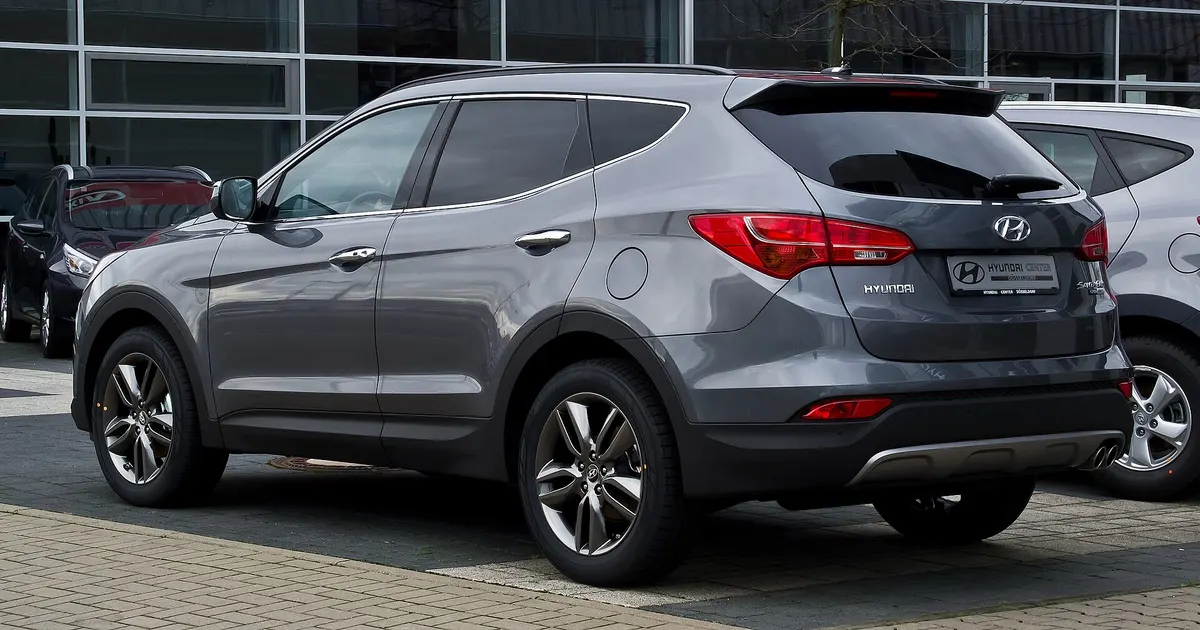
Engines
- Theta II 2.4 GDI · 2.4L gasoline, 190 hp
- Theta II 2.0T GDI · 2.0L turbo gasoline, 240 hp
- Lambda II 3.3 GDI · 3.3L V6 gasoline, 290 hp
Transmissions
- automatic , 6-speed
Drivetrain
FWD / AWD
Body
SUV (5-passenger, Santa Fe Sport), SUV (3-row 7-passenger, Santa Fe / XL)
Trims
Sport 2.4, Sport 2.0T, GLS, Limited, SE, Ultimate
Hyundai Santa Fe part-number cross-reference
Start from the OEM number, then pick the brand you trust. Verified equivalents for the Hyundai Santa Fe (2013–2018).
Part links go to Amazon, and to eBay where Amazon does not stock the part. Affiliate links, so we may earn a commission if you buy. Your price is unchanged, and a commission never changes a verdict.
Oil filter
Hyundai
the universal small Hyundai/Kia spin-on; supersedes 26300-35503 / 35504. Both the 2.4 and 2.0T Sport use it. NOT the cartridge the 3.3 V6 takes.
Find Hyundai oil filter on AmazonVerified via: PaulsTravelPictures: 2013-2016 Santa Fe 2.4L Theta II oil-change guide (OEM 26300-35503 spin-on; Fram XG9688 / Wix 51334 / Purolator PL14459 / Denso 150-2043), zFilters: Wix 51334 cross-reference (Hyundai 26300-35503, Fram PH9688, Purolator L14459), OEM Parts Online: 26300-35505 fitment (2013-2018 Santa Fe Sport 2.0T & 2.4; supersedes 35503/35504)
Oil filter
Hyundai
cartridge/element filter (with 26310-3CAA0 kit cap). Do NOT use the 26300-35505 spin-on the Sport four-cylinders take.
Find Hyundai oil filter on Amazon, 3.3LVerified via: zFilters: Hyundai 26320-3CAA0 cross-reference (Wix 57050, Fram CH10855, Purolator L26127, NAPA 7050), oilfilter-crossreference: Wix 57050 (Fram CH10855, Mahle OX417D, Hastings LF653, Baldwin P7515), RockAuto: Hyundai 263203CAA0 oil filter (Santa Fe 3.3 fitment)
Engine air filter
Hyundai
the sources list it for the 2013-2016 Sport and the 2013-2018 Santa Fe / XL, and for the related Kia Sorento (2011-2015). No source read lists it for the 2017-2018 Sport.
Check Hyundai engine air filter on AmazonVerified via: airfilter-crossreference: Hyundai 28113-2W100 (Wix WA9883, Fram CA11500, Mann C30017; 2.0/2.4/3.3 fitment), Amazon: OEM 28113-2W100 air filter kit (fits 2013-2016 Santa Fe Sport, 2013-2018 Santa Fe, 2013-2019 XL; replaces Fram CA11500)
Cabin air filter
Hyundai
also cataloged as 97133-3SAA0 (interchangeable); both cross to the same Wix WP2120 element
Look up Hyundai cabin air filter on AmazonVerified via: airfilter-crossreference: Hyundai 97133-3SAA0 (Wix WP2120, Mann CU26017/CUK26017, Fram CF11178/CF11819) and 97133-2W000 (Wix WP2120, Mann CU26017), Amazon: OEM 97133-3SAA0 cabin filter kit (fits 2013-2016 Santa Fe Sport, 2013-2018 Santa Fe, 2013-2019 XL; replaces Fram CF11819)
Spark plugs
Hyundai
factory iridium = NGK SILZKR7B11 (stock 9723), gap 0.044 in, heat range 7. This is the 3.3 V6 number; the 2.4 Sport uses the same NGK plug, boxed by Hyundai as 18847-11160 (2013-15) / 18849-11070 (2016-18). Do NOT fit this in the 2.0T.
Find Hyundai spark plugs on AmazonVerified via: sparkplug-crossreference: Hyundai 18846-11070 (NGK SILZKR7B11 / stock 9723, Denso), PlugSpecs, 2013-2018 Santa Fe (3.3 V6: NGK SILZKR7B11, gap 0.044 in), Amazon, NGK SILZKR7B11 fitment: Santa Fe 3.3/3.5 V6 2010-2018 and Santa Fe Sport 2.4L
Spark plugs
Hyundai
factory iridium = NGK SILZKR8E9G (stock 92422), gap 0.036 in (0.9mm), heat range 8. COLDER + smaller gap than the NA engines. Do NOT substitute the 18846-11070 / SILZKR7B11. Late 2016-18 revision no. 18857-09085.
See Hyundai spark plugs on AmazonVerified via: HyundaiForum: 2018 Santa Fe Sport 2.0T plug spec (OEM 18849-09085 = NGK SILZKR8E9G, gap 0.9mm, heat range 8), PlugSpecs: 2013-2018 Santa Fe 2.0T (NGK SILZKR8E9G / stock 92422, gap 0.036 in)
Front brake pads
Hyundai
2013-2016 Sport pad; shared platform pad with Azera 2012-17 / Santa Fe 2010-12 / Kia Sorento 2011-15. Superseded by 58101-4ZA70 at the 2017 refresh (different pad, see next entry).
Find Hyundai front brake pads on AmazonPowerStop
Z17 ceramic; also 16-1432 (Z16). Catalogs over-list it to 2013-18, but OEM changed at 2017.
Check PowerStop front brake padsVerified via: Walmart: Wagner ZD1432 fitment (2011-2014 Kia Sorento, 2013-2016 Hyundai Santa Fe Sport), Hyundai OEM Parts Direct: 58101-4ZA00 front pads (2013-2016 Santa Fe Sport)
Front brake pads
Hyundai
2017-2018 Sport pad; shares FMSI D1815 with Kia Sorento 2015-2020. NOT interchangeable with the 2013-2016 D1432 pad.
See Hyundai front brake pads on AmazonVerified via: Walmart: Wagner ZD1815 fitment (2015-2020 Kia Sorento, 2017-2018 Hyundai Santa Fe Sport), Lethal Performance: EBC UD1815 (FMSI D1815, 2017-2018 Santa Fe DM 2.0 Turbo)
Front brake pads
Hyundai
2013-2015 (3.3 V6); 58101-2WA01 is the 2015-2016 revision. Different, larger pad than the Sport four-cylinders. The 2017-2019 Santa Fe XL 3.3 uses a later pad (PowerStop 17-1917 family). Verify by year.
Check Hyundai front brake pads on AmazonPowerStop
Z17 ceramic; lists Santa Fe 2013-16 (with Entourage / Sedona / older Santa Fe)
Find PowerStop front brake padsVerified via: NewParts: Akebono ACT1202 (cross-references Hyundai 58101-2WA00), OEM Parts Online: 58101-2WA00 front pads (2013-2015 Santa Fe DOHC-GDI / 3.3L)
Wiper blades
Hyundai (factory sizes)
some charts list the passenger blade as 13 in and the rear as 11-13 in depending on blade style
Look up Hyundai wiper blades on AmazonBosch ICON / Rain-X / Trico
select by length; consistent across 2013-2018 Sport / Santa Fe / XL
Check Bosch ICON / Rain-X / wiper bladesVerified via: MyWiperSize: Hyundai Santa Fe Sport (26 in driver / 13-14 in passenger / 12 in rear, 2013-2018), Wiper Blades USA: 2018 Santa Fe Sport wiper size chart
Serpentine belt
Gates
OE-grade 6-rib Micro-V; the 2.4 and 2.0T Sport share it for 2013-2016 build. 2016-2018 Sport revised to a stretch-fit accessory/water-pump belt (Continental 4060397F). Verify by build date/VIN. Hyundai OE belt P/N not separately verified.
See Gates serpentine belt on AmazonVerified via: eBay: Gates K060837 fitment (2013-2016 Santa Fe Sport L4 2.0L and 2.4L), Amazon: Gates stretch-fit serpentine belt for 2016-2018 Santa Fe Sport 2.0L/2.4L (documents the later belt change)
Serpentine belt
Continental
OE-grade 6-rib accessory-drive belt (build from ~11/2013). Different length from the Sport four-cylinder belt. Hyundai OE belt P/N not separately verified.
Find Continental serpentine belt on AmazonVerified via: CarJunky: 2015 Santa Fe XL serpentine belt (Continental 6PK1693, accessory drive), Go-Parts: 2013-2019 Santa Fe XL serpentine belt guide
Battery (BCI group)
Hyundai
factory size for the DM/NC Santa Fe family (both four-cylinder and V6). Some catalogs also list a group 47/H5 fitment, but 124R is the dominant OEM group. Not the H5/47 or H6/48 of the later TM generation.
Look up Hyundai battery on AmazonAny BCI group 124R
e.g. Interstate M-124R / MTP-124R, Duralast/EverStart 124R; match or exceed factory CCA
Check Any BCI group 124R batteryVerified via: Interstate Batteries: MTP-124R for 2016 Hyundai Santa Fe V6 3.3L, AutoZone: Hyundai Santa Fe group 124R batteries
Should I buy a 2013–2018 Hyundai Santa Fe?
Buy the V6, scrutinize the four-cylinder. The three-row Santa Fe / XL with the 3.3L V6 is a genuinely good used-SUV value: comfortable, well-equipped, and outside the Theta II engine recall that defines this generation's reputation, though certain 2017 V6 engines had their own crankshaft recall (17V-578). The Santa Fe Sport (2.4 and 2.0T) carries real risk: those Theta II engines are the ones tied to connecting-rod-bearing failure and engine seizure. They're not all doomed, and the Sport engines carry a limited lifetime short-block warranty (Theta II settlement), for any owner, once KSDS campaign 953 is done, but on a Sport you must confirm the KSDS update is done before you buy. Separately, ABS-module fire recalls cover the 2013-2018 Santa Fe and the 2013-2015 and 2017-2018 Sport (certain vehicles); confirm by VIN that the one for that car is done.
Best years
2017, 2018, Any 3.3 V6 (Santa Fe / XL) over a Sport
Years to avoid
2013–2014 Santa Fe Sport 2.0T/2.4 (worst bearing-failure exposure), Any Sport without a documented KSDS update or warranty status
Pre-Purchase Checklist for Hyundai Santa Fe
- ☐Identify the engine first: Santa Fe Sport = 2.4 or 2.0T Theta II (recall risk); three-row Santa Fe / XL = 3.3 V6 (outside the Theta II class).
- ☐On any Sport, have a Hyundai dealer check the VIN: is KSDS campaign 953 (knock-sensor software) done? The settlement's lifetime short-block warranty depends on it.
- ☐Listen for a deep knock or rod-knock rumble on a cold start and again at light load, the classic precursor to Theta II bearing failure.
- ☐Check the oil level on the dipstick and ask the seller how often they top off; 3–4 quarts burned between changes is a documented Theta II/GDI problem.
- ☐Confirm by VIN that the ABS fire recall for that car is done (23V-651, 21V-303, 22V-056 or 22V-810 depending on year and body).
- ☐On a 2017 3.3 V6, confirm recall 17V-578 (crankshaft) by VIN.
- ☐Turn the wheel lock-to-lock at low speed and listen for clicking/clunking from the steering column, a common complaint.
- ☐Inspect the paint, especially the roof and hood, for clear-coat peeling on white and silver cars.
- ☐Test-drive for harsh or shuddering automatic shifts. Hyundai needs no ATF change on normal duty and every 60,000 mi under severe use (short trips, hills, heat, and towing on the V6). Ask for the record if the car lived that way.
Common Hyundai Santa Fe problems & repair costs
Theta II connecting-rod-bearing failure (engine seizure)
$4,000–$7,500Symptoms: A deep knocking or rod-knock rumble that worsens with miles, a blinking engine light with reduced power (engine protection mode), metal in the oil, and ultimately stalling or a seized engine. The KSDS software triggers code P1326 when it detects the early knock pattern.
Fix: Engine (short-block or full) replacement. The 2013–2018 Santa Fe Sport 2.4 and 2.0T engines carry a limited lifetime short-block warranty (Theta II settlement), for any owner, once KSDS campaign 953 is done, and many engines were replaced free. Get the KSDS knock-sensor software installed. The lifetime warranty depends on it. Out of coverage, a reman engine is the realistic fix.
Sources: NHTSA: 2014 Hyundai Santa Fe Sport vehicle/complaints, Hyundai newsroom: Sonata/Santa Fe Sport engine recall & software update, NHTSA: Sonata/Santa Fe Sport GDI engine inspection recall 17V226, Hyundai Theta Engine Settlement (lifetime short-block warranty)
ABS / HECU module fire risk
$0–$0Symptoms: An internal brake-fluid leak inside the ABS module can cause an electrical short and an engine-compartment fire, even while parked and turned off. There may be no warning before a fire.
Fix: Four recalls cover it, by year and body: 23V-651 (2013-2015 Santa Fe and 2013 Sport, Hyundai Recall 251, dealer replaces the ABS fuse), 21V-303 (2013-2015 Sport, dealer replaces the ABS multi-fuse and inspects and replaces the ABS module as necessary), 22V-056 (2016-2018 Santa Fe and 2017-2018 Sport, ABS multi-fuse replaced as necessary) and 22V-810 (2018 Sport, ABS multi-fuse). Certain vehicles only. Free of charge. Owners were advised to park outside and away from structures until repaired. Verify completion by VIN before buying.
Sources: NHTSA: Safety Recall Report 23V-651 (ABS fire risk), NHTSA, Consumer alert: Hyundai Santa Fe recall fire risk, NHTSA recalls: 2013-2015 Santa Fe Sport (21V-303, ABS multi-fuse), NHTSA recalls: 2016-2018 Santa Fe and 2017-2018 Sport (22V-056, ABS multi-fuse), NHTSA recalls: 2018 Santa Fe Sport (22V-810, ABS multi-fuse, expansion of 22V-056)
Excessive oil consumption (GDI)
$150–$600Symptoms: Burning 3–4 quarts of oil between changes with no obvious external leak. Low oil accelerates bearing wear on the Theta II engines and can foul the catalytic converter over time.
Fix: Confirm consumption with a documented oil-consumption test (often a precursor to warranty engine work on Sport models). Otherwise it becomes an ownership cost: monitor and top off between changes; severe cases need ring/engine work, which on a Sport may fall under the settlement's lifetime short-block warranty.
Sources: TheWeeklyDriver: 2013-2018 Santa Fe engine problems & reliability, Consumer Reports: 2018 Hyundai Santa Fe reliability
Steering column clunk / clicking noise
$300–$900Symptoms: A clicking or loud clunking noise from the steering column when turning, especially at low speed. Owners filed dozens of complaints; most cases are noise-only, but a smaller number report harsher steering-column concerns.
Fix: Diagnosis points most often to the steering U-joint/coupler or the column itself. Many cars were addressed under TSB; out of coverage it's a coupler or column-component replacement plus labor.
Clear-coat / paint peeling
$500–$3,000Symptoms: Clear coat flaking and paint peeling, most reported on white and silver cars and on horizontal panels (roof, hood). Cosmetic, but spreads if ignored.
Fix: Body-shop refinish of the affected panels. A few cars were handled under goodwill; most owners pay out of pocket, and cost scales with how many panels are involved.
Sources: Hyundaiproblems.com: 3rd-gen (2013-2018) Santa Fe problems
Two very different ownership stories live in this generation. A 3.3 V6 Santa Fe / XL is a sensible, moderate-cost SUV: normal brakes, tires, fluids, and a robust V6, with GDI oil consumption the main thing to watch. A Santa Fe Sport carries the Theta II tail risk: if the KSDS campaign was never done, or the lifetime warranty claim is denied for neglect, and the engine goes, you're looking at a $4,000–$7,500 engine on a vehicle that may be worth less than that. Across the board, budget for the recalls being done (they're free) and routine wear; the financial swing is almost entirely about which engine you bought and whether the Sport's warranty coverage is intact.
Cost calculator
What will this Hyundai Santa Fe cost you by a given mileage?
Drag to a mileage. We total the documented problems whose typical onset falls at or before it. The same cost ranges listed above, nothing new invented.
$0 estimated repair range
5-Year Maintenance Schedule & Cost to Own
Every scheduled service by mileage, fluid capacities, independent shop ranges, and parts cross-references.
Have a repair quote for this Hyundai Santa Fe?
Audit against OEM book times, uncover duplicate pad and rotor labor, and verify parts markups.
How to fix common Hyundai Santa Fe problems (DIY)
Engine + cabin air filter replacement
Tools: No tools for the airbox (clips), Screwdriver for the glovebox stops if needed
- Unclip the airbox lid, lift it, and note how the old panel filter sits.
- Drop in the new engine air filter the same way and re-clip the lid.
- Open the glovebox, release the side stops so it drops fully, and pull the cabin-filter cover.
- Slide out the old cabin filter; insert the new one with the airflow arrow pointing down.
- Close everything up and confirm airflow at the vents.
Front brake pads & rotors
Tools: Floor jack + jack stands, Lug + caliper socket set, C-clamp or caliper piston tool, Torque wrench, Brake cleaner
- Loosen lug nuts, raise the front, support on stands, and remove the wheels.
- Unbolt the caliper, hang it from the suspension (don't stress the hose), and remove the old pads and bracket.
- Slide off the old rotor; clean the new rotor's surface with brake cleaner.
- Compress the caliper piston, fit the new rotor and pads, and reassemble with the bracket and caliper torqued to spec.
- Reinstall wheels, lower the car, and pump the brake pedal firm before driving; bed in the pads gently.
Parts
Some parts links are affiliate links. We may earn a commission at no cost to you. We only list parts that fit this generation.
The short version
The 2013–2018 Hyundai Santa Fe is two stories wearing one badge. Get the engine identification right and you’ll understand almost everything about the risk.
The Santa Fe Sport is the five-seat version with Hyundai’s Theta II four-cylinders, the 2.4 GDI or the 2.0T. Those are the engines at the center of Hyundai’s enormous connecting-rod-bearing failure problem: bearings wear early, the engine knocks, then it can seize or stall. Hyundai rolled out knock-sensor (KSDS) software that throws code P1326 when it hears the early failure pattern, and a class-action settlement put a limited lifetime short-block warranty on these engines, for any owner, once KSDS campaign 953 is done.
The three-row Santa Fe / Santa Fe XL uses the 3.3L V6, which is not part of that recall and is the durable choice in this generation. Certain 2017 V6 engines had their own crankshaft recall (17V-578), so check a 2017 by VIN.
What that means when you’re shopping
If you’re looking at a Sport, treat the engine as the first thing to clear. Have a Hyundai dealer check the VIN: is KSDS campaign 953 done, so the lifetime short-block warranty applies? A documented Sport with the campaign done is a reasonable buy; one with no campaign record and an unknown engine history is a gamble, because a replacement engine can cost more than the car.
If you’re looking at a 3.3 V6 Santa Fe / XL, you’re outside the Theta II risk. On a 2017, confirm crankshaft recall 17V-578 by VIN. Buy it on condition and maintenance like any used SUV, just keep an eye on oil consumption, which the GDI engines are prone to.
One thing applies to almost the whole lineup: the ABS-module fire recalls (23V-651, 21V-303, 22V-056 or 22V-810, by year and body, certain vehicles). None of the four lists the 2016 Sport. The fix is a free ABS fuse or multi-fuse, but until it’s done Hyundai literally tells owners to park outside. Confirm it’s been performed. The rest (steering-column clunks, clear-coat peeling, the occasional harsh shift) is ordinary used-Hyundai stuff and shouldn’t scare you off a sound car.
How this file is built: failure modes and cost ranges are compiled from NHTSA complaint and recall data, Hyundai’s own recall and warranty-extension actions, owner reporting, and reliability sources, then sanity-checked against shop-floor experience. Cost figures are independent-shop estimates and vary by region. Spot something off? Tell us.
Viral car myths, checked against this car
- Dangerous
Is the "$2 liquid that destroys engine sludge forever" real? Our shop-floor verdict.
An aggressive solvent flush on a high-mileage engine is a textbook way to spin a bearing. The viral 'kitchen-cabinet flush' is folklore that real shops spend money cleaning up after.
- Misleading
Is the "$1 Japanese oil trick" that stops engine wear forever real?
The 'Japanese oil trick' is almost certainly MoS2 (molybdenum disulfide), a real industrial friction modifier. It is German, not Japanese (Liqui Moly popularized it), sold openly at every parts store for $15-20, has real but modest measured friction benefits, and was never buried by anyone.
Frequently asked questions
Which Hyundai Santa Fe years and engines should I avoid?
Be most careful with the 2013–2014 Santa Fe Sport (2.0T and 2.4 Theta II), which has the worst exposure to connecting-rod-bearing failure. The three-row Santa Fe / XL with the 3.3L V6 is not part of that recall and is the safer used buy across all these years. On a 2017 V6, confirm crankshaft recall 17V-578 by VIN.
Is the Theta II engine failure covered by Hyundai?
Yes, for the Sport's 2.4 and 2.0T. The 2013–2018 Santa Fe Sport engines carry a limited lifetime short-block warranty (Theta II settlement), for any owner, once KSDS campaign 953 is done. It covers the short block (block, crankshaft, rods, bearings, pistons) for bearing damage. Verify the VIN's status with a Hyundai dealer before buying a Sport.
What is the Santa Fe fire recall about?
Four recalls cover an ABS module that can short out and start an engine-compartment fire, even while parked, each on certain vehicles: 23V-651 (2013-2015 Santa Fe, 2013 Sport), 21V-303 (2013-2015 Sport), 22V-056 (2016-2018 Santa Fe, 2017-2018 Sport) and 22V-810 (2018 Sport). The 23V-651 fix is a new ABS fuse. The other three replace the ABS multi-fuse, and 21V-303 also replaces the module as necessary. All free. Until it's done, Hyundai advises parking outside and away from buildings. Confirm the recall is complete by VIN.
Is the Santa Fe Sport or the regular Santa Fe better?
For reliability, the regular three-row Santa Fe / XL with the 3.3 V6 is the stronger pick. It avoids the Theta II bearing recall, though certain 2017 V6 engines had a crankshaft recall (17V-578). The Sport drives a bit tighter and the 2.0T is quicker, but it carries the engine risk that defines this generation. Buy the Sport only with documented KSDS software and warranty status.
Does the Santa Fe burn oil?
The direct-injection engines in these years are known for it. Some owners burn 3–4 quarts between changes. On a Sport, document the consumption, since it can tie into the engine warranty. On any of them, check the oil regularly; running low accelerates bearing wear.
Every Hyundai Santa Fe generation
The full case file run, beyond the generation before and after this one.
Cross-shopped rivals
Files on what buyers weigh against the Hyundai Santa Fe of this era.