Case file · TOYOTA-TACOMA-1995-2004 · 1st gen
Toyota Tacoma 1995–2004Common problems, reliability & repair costs
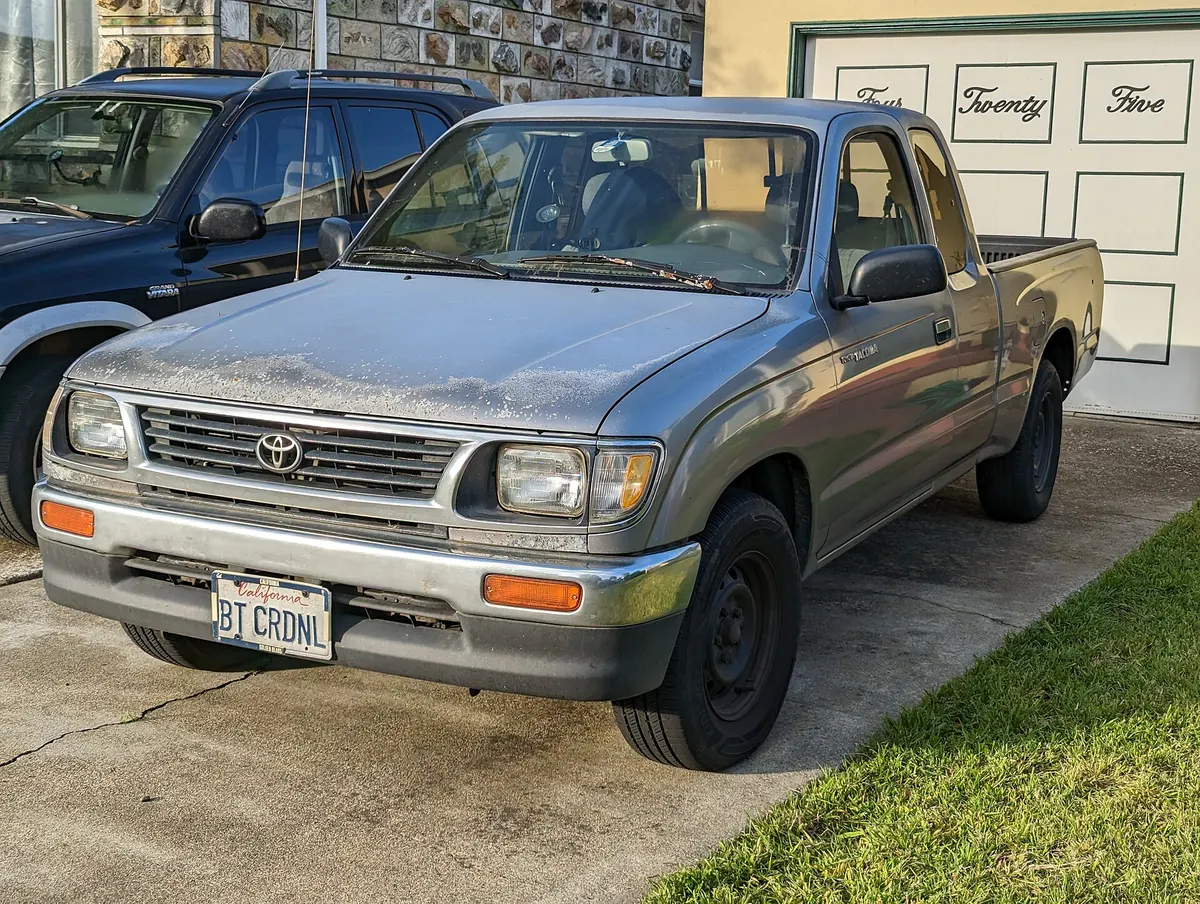
The 1st-gen Tacoma has one of the most bulletproof drivetrains ever put in a compact truck, and a frame that can quietly rot out from under it. Toyota's rust problem got bad enough that it bought trucks back at 150% of book value and replaced frames outright. Those programs are long expired, so today the frame IS the purchase decision: a clean-frame Tacoma runs 300,000 miles; a perforated one is scrap with a good engine.
2001, 2002, 2003
No year is mechanically bad. Avoid any truck with an unverif +1 more
Engines
- 2RZ-FE · 2.4L gasoline, 142 hp
- 3RZ-FE · 2.7L gasoline, 150 hp
- 5VZ-FE · 3.4L gasoline, 190 hp
Transmissions
- A340 · automatic, 4-speed
- manual , 5-speed
Drivetrain
RWD / 4WD
Body
regular cab, xtracab, double cab
Trims
Base, SR5, PreRunner, TRD Off-Road, S-Runner, Limited
Toyota Tacoma part-number cross-reference
Start from the OEM number, then pick the brand you trust. Verified equivalents for the Toyota Tacoma (1995–2004).
Part links go to Amazon, and to eBay where Amazon does not stock the part. Affiliate links, so we may earn a commission if you buy. Your price is unchanged, and a commission never changes a verdict.
Engine oil filter (spin-on)
Verified via: Toyota Genuine Oil Filters application chart (Tacoma 1995-2004 = 90915-YZZG2), RockAuto: 2000 Tacoma 3.4L V6 oil filters, RockAuto: 2000 Tacoma 2.4L L4 oil filters, Oil filter cross reference: Toyota 90915-YZZG2
Engine air filter (3.4L 5VZ-FE V6)
Verified via: RockAuto: 2000 Tacoma 3.4L V6 air filters, Air filter cross reference: Wix 46109 (crosses to Toyota 17801-07020), ToyotaPartsDeal: Tacoma OEM air filters (17801-07020, 1995-2004)
Engine air filter (2.4L 2RZ-FE)
Verified via: RockAuto: 2000 Tacoma 2.4L L4 air filters, Air filter cross reference: Wix 46162 (crosses to Toyota 17801-08010 / 17801-35020), ToyotaPartsDeal: Tacoma OEM air filters (17801-08010, 1995-2004)
Cabin air filter: NOT EQUIPPED
Verified via: Tacoma World: Gen 1 cabin air filter location (confirms none fitted), ToyotaPartsDeal: Tacoma cabin air filters (no 1995-2004 application listed)
Should I buy a 1995–2004 Toyota Tacoma?
Buy the frame, not the truck. Mechanically, a 1st-gen Tacoma with the 2.7L four or 3.4L V6 is about as safe a 20-plus-year-old vehicle purchase as exists. These drivetrains routinely clear 300,000 miles. But the frames were under-protected from the factory and rust from the inside out, badly enough that Toyota ran a buyback program (1995–2000) and a frame-replacement program (2001–2004). Both are expired. That means any truck that spent its life in a road-salt state needs a crawl-under inspection with a screwdriver and a hammer before money changes hands. Surface rust is normal, flaking scale and perforation are a walk-away. A dry-climate truck with maintenance history is worth paying up for. On 2001–2004 4WD/PreRunner trucks, also confirm the lower ball joint recall was performed.
Best years
2001, 2002, 2003, 2004
Years to avoid
No year is mechanically bad. Avoid any truck with an unverified frame from a rust-belt state, 2001–2004 4WD/PreRunner with the ball joint recall never performed
Pre-Purchase Checklist for Toyota Tacoma
- ☐Put the truck on a lift or crawl under it. Tap the frame rails (especially over the rear axle, near the leaf spring hangers, and at the cab mounts) with a hammer or stab with a screwdriver. Flaking scale, soft spots, or holes = walk away. This check outranks everything else on this truck.
- ☐Ask a Toyota dealer to run the VIN for open recalls and whether the lower ball joint recall (2001–mid-2004 4WD/PreRunner) and frame-program inspections were performed.
- ☐While under the truck, follow the brake and fuel lines along the frame. Rust takes those out too, and a leaf spring that shifts on a rotten frame can sever them.
- ☐On the 3.4L V6: get proof of timing belt service. The interval is 90,000 miles or 72 months; a belt of unknown age goes on the to-do list the day you buy it.
- ☐Drive it at highway speed. Constant small steering corrections and a wandering front end usually mean worn steering rack bushings, a cheap fix but a bargaining chip.
- ☐On manuals: pump the clutch pedal and hold it down. A pedal that sinks, sticks to the floor, or needs pumping points to a failing clutch master or slave cylinder.
- ☐Check the spare tire carrier under the bed. The carrier itself rusts and was recalled in 2012 on 2001–2004 trucks; a corroded one can drop the spare on the road.
- ☐Look for a frame that's suspiciously freshly undercoated on an otherwise crusty truck. Undercoating over rot hides the one problem that totals these.
Common Toyota Tacoma problems & repair costs
Frame rust perforation (and everything bolted to it)
$3,000–$8,000Symptoms: Flaking, scaling rust on the frame rails, worst over the rear axle, at leaf spring hangers, and cab/bed mounts. Advanced cases: holes you can put a finger through, sagging bed, leaf spring hangers tearing loose, and rusted-through brake or fuel lines. Trucks have failed state inspections and broken in half in extreme cases.
Fix: There is no cheap fix for a perforated frame. Welded plate repairs on structural sections are a band-aid, and a proper used- or new-frame swap runs well into four figures at an independent shop. Toyota's response: in 2008 it launched a customer support program for 1995–2000 trucks. That was 15 years unlimited mileage from first use, and if the frame was perforated, Toyota bought the truck back at 150% of KBB excellent-condition retail. 2001–2004 trucks got a separate 15-year program that replaced the frame instead of buying the truck. Every 1995–2004 Tacoma has now aged out of both. A related 2012 NHTSA recall covered rusting spare tire carriers on 2001–2004 trucks. Today the only move is prevention: buy a clean frame and keep it washed and oil/wax undercoated.
Sources: Toyota 1995–2000 Tacoma Customer Support Program letter (Center for Auto Safety), Center for Auto Safety: Toyota extends Tacoma frame rust warranty to 15 years, Tacoma World: frame rust buyback owner reports, NHTSA: Toyota Tacoma recalls & complaints by VIN/year
Front lower ball joint wear / separation (recall 05V-225)
$400–$900Symptoms: Increased steering effort, poor self-centering after turns, clunking or squeaking from the front suspension. In the worst case the joint separates from the knuckle and you lose steering on that wheel.
Fix: Toyota recalled roughly 775,000 2001–mid-2004 Tacoma 4WD/PreRunner trucks in 2005 (NHTSA 05V-225) because ball studs could be scratched in manufacturing and wear prematurely. Dealers replaced the joints free. Recall work has no expiration, so an unrepaired VIN can still be done by Toyota today. If the recall was performed decades ago, the replacement joints are now normal wear items anyway: both lower ball joints with an alignment is a routine independent-shop job.
Sources: NHTSA recall 05V-225: Toyota owner notification letter, RepairPal: Toyota lower ball joint recall summary
Timing belt & water pump due on the 3.4L V6
$700–$1,400Symptoms: Usually none. That's the trap. A neglected belt announces itself by snapping; a failing water pump weeps coolant from the timing cover area or whines. Many of these trucks are on 25-year-old second or third belts of unknown age.
Fix: Scheduled replacement of the belt, plus water pump, thermostat, and seals while the front of the engine is apart. The 5VZ-FE is widely documented as non-interference, so a snapped belt strands you rather than destroying the engine, but a roadside tow and an emergency job cost more than doing it on schedule. The 2.4L and 2.7L fours use timing chains and skip this entirely.
Sources: AdventureTaco: step-by-step 5VZ-FE timing belt replacement, YotaTech: 3.4L timing belt & water pump how-to
Worn steering rack bushings (highway wander)
$150–$450Symptoms: Vague, wandering steering that needs constant small corrections at highway speed; a clunk over bumps; visible movement of the rack in its mounts when a helper saws the wheel with the engine off.
Fix: The three rubber rack bushings age out and let the whole steering rack shift on the crossmember. Replacement with new OEM rubber or a polyurethane kit (Energy Suspension and others make one specific to this truck) tightens the steering right back up. Parts are cheap; most of the cost is labor. If the rack itself is leaking, a reman rack swap runs $600–$1,200 instead.
Sources: AdventureTaco: steering rack bushing replacement guide (1st-gen Tacoma), Tacoma World, how-to: steering rack bushing replacement
Clutch master / slave cylinder failure (manuals)
$250–$700Symptoms: Clutch pedal slowly sinks under foot, sticks to the floor, or needs a pump before it disengages; hard shifts into first and reverse; fluid loss from the clutch reservoir or a wet spot at the slave on the bellhousing.
Fix: The hydraulic cylinders wear out long before the clutch itself, a well-covered failure on 1st-gen owner forums. Replace the failed cylinder (many shops do master and slave together on trucks this old) and bleed the system. The transmissions and clutches themselves are strong; if the clutch disc is actually worn, a full clutch job runs $1,200–$2,000.
Sources: Tacoma World: 1st gen slave and clutch master cylinder, Tacoma World: clutch slave cylinder losing pressure
Head gasket failure on the 3.4L V6 (uncommon but real)
$1,800–$3,500Symptoms: Coolant loss with no external leak, white exhaust smoke, milky oil, overheating, bubbles in the coolant reservoir. Often triggered by a prior overheat (failed water pump or clogged radiator) rather than the gasket letting go on its own.
Fix: Head gasket replacement on the 5VZ-FE is a big labor job at an independent shop. Important context: this engine was Toyota's fix for the older 3.0L 3VZ-E (used in the pre-1995 Pickup/4Runner), whose head gasket failures were bad enough to trigger a Toyota replacement campaign. The 3.4L is dramatically better. Failures show up in owner forums but are the exception, not the pattern. Keep the cooling system healthy and this rarely becomes your problem.
Sources: MotorReviewer: Toyota 5VZ-FE 3.4L problems & reliability, Tacoma World: head gasket issues with the 3.4L?, YotaTech: the 3VZ-E head gasket problem (context on the older 3.0L)
Away from the frame, a 1st-gen Tacoma is one of the cheapest old trucks to keep alive: the fours need almost nothing beyond fluids and normal wear items, parts availability is excellent, and the aftermarket is enormous. Budget the V6's $700–$1,400 timing belt service every 90k as real scheduled maintenance, expect age-related hydraulics (clutch cylinders, maybe a rack reseal) somewhere past 150k, and put your actual money into rust prevention. An annual oil/fluid-film undercoat costs $150–$300 and protects the one component that determines whether this truck lives another 20 years.
Cost calculator
What will this Toyota Tacoma cost you by a given mileage?
Drag to a mileage. We total the documented problems whose typical onset falls at or before it. The same cost ranges listed above, nothing new invented.
$0 estimated repair range
Have a repair quote for this Toyota Tacoma?
Audit against OEM book times, uncover duplicate pad and rotor labor, and verify parts markups.
How to fix common Toyota Tacoma problems (DIY)
Timing belt & water pump (3.4L V6)
Tools: Socket set + breaker bar, Harmonic balancer puller, Crank pulley holding tool (or impact wrench), Torque wrench, Coolant drain pan
- Drain the coolant, remove the fan shroud, fan, drive belts, and crank pulley (the crank bolt is the hardest part of the whole job).
- Remove the timing covers and set the engine to TDC, verifying cam and crank timing marks.
- Release the tensioner and remove the old belt; replace the water pump, thermostat, and tensioner/idler pulleys while everything is exposed.
- Install the new belt with all timing marks aligned, then rotate the engine two full turns by hand and re-verify the marks.
- Reassemble the covers, pulley, fan, and belts; refill and burp the cooling system.
- Start it, check for leaks, and recheck coolant level after a heat cycle.
Parts
- Timing belt kit with water pump (Aisin, 5VZ-FE) · Amazon $180–$280
- Toyota red coolant (2 gallons) · Amazon $40–$60
Steering rack bushing replacement
Tools: Floor jack + jack stands, Socket set (14–19mm), Breaker bar, Pry bar, Penetrating oil
- Jack the front of the truck, support it on stands, and soak the rack mounting bolts with penetrating oil.
- Support the rack, then remove the two rack mounting brackets and bolts (no need to disconnect tie rods or hydraulic lines).
- Pry the rack away from the crossmember enough to slip the old bushings out. Note their orientation.
- Install the new bushings (grease polyurethane bushings on their inner sleeves) and seat the rack back into place.
- Reinstall the brackets, torque the bolts, and test-drive. The wander should be gone immediately.
Parts
- Polyurethane steering rack bushing kit (1st-gen Tacoma) · Amazon $25–$60
Clutch slave cylinder replacement (manual trucks)
Tools: Socket set (12–14mm), Flare nut wrench (10mm), Brake fluid (DOT 3), Clear hose + catch bottle for bleeding, A helper for the pedal
- Locate the slave cylinder on the side of the bellhousing and crack the hydraulic line loose with a flare nut wrench (not an open-end, the fitting rounds easily).
- Remove the two mounting bolts and swap in the new slave cylinder.
- Reconnect the line and top up the clutch reservoir with fresh DOT 3.
- Bleed the system: helper pumps and holds the pedal while you open and close the bleeder until no air comes out.
- Confirm a firm pedal and clean engagement into first and reverse with the engine running.
Parts
- Clutch slave cylinder (Aisin, 1st-gen Tacoma) · Amazon $25–$55
- DOT 3 brake fluid · Amazon $8–$15
Some parts links are affiliate links. We may earn a commission at no cost to you. We only list parts that fit this generation.
The short version
The 1995–2004 Tacoma is the truck that built Toyota’s small-pickup legend, and the mechanical reputation is deserved: the 2.7L four and 3.4L V6 are two of the most durable engines Toyota ever sold here, and 300,000-mile drivetrains are routine. The problem was never the machinery. It was the frame under it.
These frames left the factory with inadequate rustproofing and corrode from the inside out. It got bad enough that in 2008 Toyota did something almost unheard of: for 1995–2000 trucks with perforated frames, it bought the truck back at 150% of KBB excellent-condition value. 2001–2004 trucks got complete frame replacements instead. Both programs ran 15 years from each truck’s first use, and every 1st-gen Tacoma has now aged out. Related rot took out spare tire carriers (recalled in 2012 on 2001–2004 trucks) and, on the worst frames, brake and fuel lines.
What that means when you’re shopping
The frame inspection is the entire purchase decision. Get under the truck with a flashlight, a hammer, and a screwdriver. Tap and probe the rails: over the rear axle, at the leaf spring hangers, at the cab and bed mounts. Surface rust is normal on a 25-year-old truck; flaking scale, soft metal, or holes mean you walk, no matter how good the engine sounds. Be suspicious of thick fresh undercoating on an otherwise crusty truck. It’s how rot gets hidden. A dry-state truck with an honest frame is worth a premium over a cheaper rust-belt example every single time, because an out-of-pocket frame swap runs $3,000–$8,000 and usually isn’t worth it.
Second check, on 2001–mid-2004 4WD and PreRunner trucks: the front lower ball joint recall (NHTSA 05V-225, roughly 775,000 trucks). The joints could wear prematurely and, in extreme cases, separate and take your steering with them. Recall work never expires; a dealer can check the VIN in minutes.
The stuff that’s just old-truck stuff
Everything else is manageable and well documented by the huge 1st-gen community: steering rack bushings that make the front end wander (a sub-$60 parts fix), clutch master/slave cylinders that age out on manuals, and the V6’s 90k-mile timing belt that previous owners loved to skip, forgivable only because the 5VZ-FE is non-interference. Head gaskets on the 3.4L fail occasionally, but this engine was the cure for Toyota’s earlier 3.0L head gasket saga, not a continuation of it.
How this file is built: failure modes and program details are compiled from NHTSA recall documents, Toyota’s own customer support program letters (via the Center for Auto Safety), and sustained owner reporting on Tacoma World and YotaTech, then sanity-checked against shop-floor experience. Cost figures are independent-shop estimates and vary by region. Spot something off? Tell us.
Viral car myths, checked against this car
- Misleading
Is the "$2 liquid that stops any leak" really banned in 11 states?
Automotive stop-leak products are not banned in any US state. The products are real (Bar's Leaks, BlueDevil), they work in specific narrow situations, and they can permanently damage your cooling or oiling system if applied to the wrong leak.
- Mostly False
Does a "$3 liquid" really kill car rust permanently? The phosphoric-acid reality.
The $3 liquid is almost certainly phosphoric acid (sold as Ospho or Naval Jelly). It converts surface rust to iron phosphate. It does not kill rust 'permanently,' does not restore perforated steel, and was never buried by anyone. It has been on hardware store shelves continuously since the 1940s.
Frequently asked questions
Is the Toyota frame buyback still available for 1995–2004 Tacomas?
No. Toyota's 2008 customer support program gave 1995–2000 trucks 15 years of frame-perforation coverage from first use (with a buyback at 150% of KBB excellent-condition value), and 2001–2004 trucks a 15-year frame-replacement program. Every truck in this generation has aged out of both. A rusted-through frame today is entirely on you, which is why the pre-purchase frame inspection is non-negotiable.
Which 1st-gen Tacoma engine is the best?
The 3.4L 5VZ-FE V6 is the one people pay extra for: strong, smooth, and it fixed the head-gasket reputation of the older 3.0L used in pre-1995 Toyota pickups. But the 2.7L 3RZ-FE four is arguably the reliability pick: timing chain instead of a belt, dead simple, and known for 300,000-mile lives. The base 2.4L is slow but equally tough. There is no bad engine in this truck.
Will a snapped timing belt destroy the 3.4L V6?
Almost certainly not. The 5VZ-FE is widely documented as a non-interference engine, so a broken belt strands you rather than bending valves. Don't use that as permission to skip the 90,000-mile service: you'll still pay for a tow plus the same job at emergency prices, and the water pump that gets replaced with the belt is what usually fails first.
How many miles will a 1st-gen Tacoma last?
The drivetrain will do 300,000+ miles with basic maintenance. That part of the truck's legend is earned. What actually kills these trucks is the frame. A southern or west-coast truck can genuinely outlast its owner's interest; a rust-belt truck can be structurally dead at 120,000 miles with a perfect engine.
How do I know if the ball joint recall was done on a 2001–2004 truck?
Any Toyota dealer can run the VIN and tell you whether recall 05V-225 (front lower ball joints, 2001–mid-2004 4WD and PreRunner) was performed. Safety recall repairs don't expire, so if it was never done, Toyota will still replace the joints free. If it was done back in the 2000s, treat the joints as normal 20-year-old wear parts and have them checked at the pre-purchase inspection anyway.
Every Toyota Tacoma generation
The full case file run, beyond the generation before and after this one.
Cross-shopped rivals
Files on what buyers weigh against the Toyota Tacoma of this era.