Case file · KIA-OPTIMA-2006-2010 · 2nd gen (MG) (MG)
Kia Optima 2006–2010Common problems, reliability & repair costs
The MG-generation Optima (launched mid-2006 as a '2006.5') is a quiet, low-drama used midsize with genuinely low complaint volume, but it isn't spotless. The port-injected 2.4L Theta has a documented pattern of rod-bearing failures with no warranty program behind it, and the passenger-airbag occupant sensor is flaky enough that Kia extended its warranty to 15 years. Know those two things and the rest is cheap, ordinary upkeep.
2009, 2010
2006.5–2008 (bulk of the 2.4 rod-bearing failures, plus the
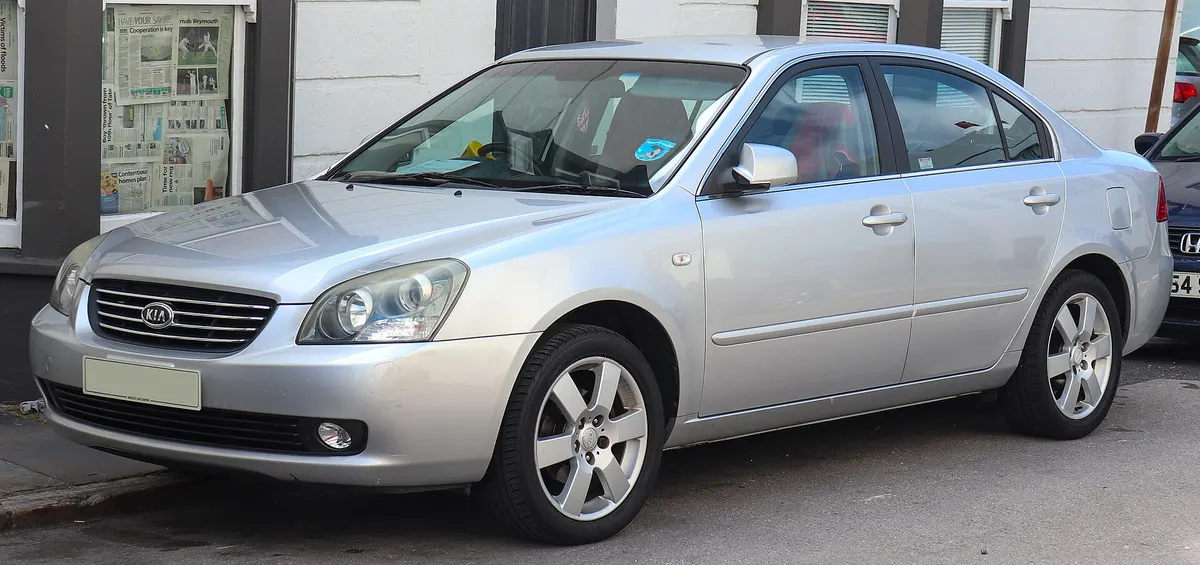
Engines
- G4KC · 2.4L gasoline, 162 hp
- G6EA · 2.7L gasoline, 185 hp
Transmissions
- automatic , 5-speed
- manual , 5-speed
Drivetrain
FWD
Body
sedan
Trims
LX, EX, SX (2009–2010)
Kia Optima part-number cross-reference
Start from the OEM number, then pick the brand you trust. Verified equivalents for the Kia Optima (2006–2010).
Part links go to Amazon, and to eBay where Amazon does not stock the part. Affiliate links, so we may earn a commission if you buy. Your price is unchanged, and a commission never changes a verdict.
Oil filter
Kia
supersedes 26300-35503 / 26300-35504; small spin-on shared across the Hyundai/Kia 4-cyl range
Find Kia oil filter on AmazonWix
51334XP is the synthetic-media version. Corrected 09-17-2026: this card read 57092 'also cataloged as 51334 / 51348', and that was wrong twice. Wix 51348 is a 3/4-16 filter and cannot thread onto this M20x1.5 engine at all, and Wix does not cross this OEM number to 57092. Wix's own OEM lookup returns 51334 and 51334XP for both Kia and Hyundai 26300-35505, which is also what the Sonata 2015-2017 card carries for the same filter.
Check Wix oil filterVerified via: FinditParts: Fram PH9688 cross-reference & fitment (Kia Optima 2001-2020), oilfilter-crossreference: Kia 26300-35503 equivalents, kiapartsnow: genuine Optima oil filter by year/engine, WIX OEM cross-reference: Kia/Hyundai 26300-35505 returns 51334 and 51334XP, and returns no 57092 or 51348
Oil filter
Kia
V6-specific; do NOT use the 2.4's 26300-35505 small filter on the 2.7
Look up Kia oil filter on AmazonVerified via: FinditParts: Kia 26300-3E010, confirmed 2.7L V6 Optima 2006-2010 + crosses, oilfilter-crossreference: Kia 26300-3E010 equivalents
Engine air filter
Verified via: airfilter-crossreference: Kia 28113-2G000 equivalents (Fram CA10191, Wix 49175, Purolator A35671), Walmart: Fram CA10191 fits 2006-2010 Kia Optima, 2007-2010 Rondo
Cabin air filter
Kia
2006-2008 number; 2009-2010 renumbered to 97133-2G000; early alt 08790-3K000, all the same physical filter (shared with Sonata NF / Azera TG)
Compare Kia cabin air filter on AmazonVerified via: airfilter-crossreference: Kia 97133-2B010 = Fram CF10381, Amazon: EPAuto CP381 (Fram CF10381) fits Kia Optima 2006-2010, kiapartsnow: genuine Optima cabin filter by year (2B010 2006-08 / 2G000 2009-10)
Spark plugs
Verified via: NGK.com: LFR5A-11 (6376) V-Power spark plug, newparts: NGK LFR5A-11 fits Hyundai Sonata / Kia Optima, kiapartsnow: genuine Optima spark plug (27410-25000, 2.4L 2006-2008)
Spark plugs
Kia
genuine plug IS NGK ILFR5B11 (Laser Iridium); replaces older 27410-3F100
Look up Kia spark plugs on AmazonVerified via: Amazon: NGK Laser Iridium ILFR5B11 (6-pack) for Kia Optima 2006-2010 2.7L, ShowMeTheParts: NGK ILFR5B11 Hyundai/Kia application, kiapartsnow: genuine Optima spark plug (18840-11051 = iridium, 2.7L 2006-2010)
Front brake pads
Kia
interchangeable OE variants: 58101-2GA00 and 58101-3CA70, all FMSI D924
See Kia front brake pads on AmazonVerified via: FinditParts: Akebono ACT924B fitment (Kia Optima 2002-2010) + crosses incl. Bosch BC924, OE 58101-2GA00/2GA01/3CA70, NAPA: Akebono AKEACT924B (Copper-Compliant OE-equivalent ceramic), Amazon, Bosch BC1095 is a REAR pad for Ford/Jaguar/Mazda/Volvo (EXCLUDED: does not fit Optima)
Wiper blades
OE size
2007-2010 sizing; the 2006 MY used a 20" passenger blade
Check OE size wiper blades on AmazonVerified via: OttoBlades: 2008 Kia Optima wiper set 24" driver + 18" passenger, NTXGlow: 2001-2011 Kia Optima wiper blade sizes
Serpentine belt
Kia
single accessory-drive belt (supersedes to 25212-25020); 2006-2010 dropped the older separate V-belts
See Kia serpentine belt on AmazonVerified via: kiapartsnow: genuine Optima drive belt (2.4L = 25212-25000), FinditParts: Gates K060988 cross-reference (Kia 25212-25020)
Serpentine belt
Verified via: kiapartsnow: genuine Optima drive belt (2.7L = 25212-3E000), eBay: Gates 160KN98 serpentine belt, 2007-2010 Kia Optima 2.7L
Battery
BCI group
most-listed OE fitment (AutoZone, O'Reilly), ~550-620 CCA top-post. Catalogs disagree: some list Group 124R (notably 2009) or the larger Group 24, so measure the tray before buying
Check BCI group battery on AmazonVerified via: O'Reilly: Group 35 550 CCA battery listed for 2007 Kia Optima, AutoZone: 2007 Kia Optima battery (Group 35 / 124R options), AutoPadre: Kia Optima battery size table (lists 24 / 124R for 2006-2010; catalog disagreement)
Should I buy a 2006–2010 Kia Optima?
A sleeper value if you buy the right one. Complaint volume on this generation is genuinely low, a fraction of what the same-era Camry and Altima log, and most of the car is cheap, simple, and easy to fix. The two things that matter: the 2.4L Theta four has a real, documented rod-bearing failure pattern (worst on 2006.5–2008 cars) that turns into a $3,000+ engine, and the passenger-airbag occupant sensor fails often enough that Kia quietly extended its warranty to 15 years, a window that has now closed on most of these cars. A 2009–2010 facelift car with maintenance records, no bottom-end noise, and the airbag system behaving is an honest, unexciting way to spend very little money on transportation.
Best years
2009, 2010
Years to avoid
2006.5–2008 (bulk of the 2.4 rod-bearing failures, plus the shift-cable recall years)
Pre-Purchase Checklist for Kia Optima
- ☐Cold-start the 2.4 and listen at the bottom of the engine for knocking or deep rattle. Rod-bearing failure is this generation's engine killer and it announces itself first as a knock.
- ☐Check the oil level and condition on the dipstick; ask for oil-change receipts. Neglected oil is the common thread in the reported Theta bottom-end failures.
- ☐Sit an adult in the front passenger seat and confirm the airbag indicator shows the bag ON. If it reads OFF with an adult seated, the OCS sensor mat is failing, and the 15-year warranty extension has expired on most of these cars.
- ☐Run the VIN through NHTSA or a Kia dealer for open recalls, especially the 2006–2008 shift-cable recall (11V-153).
- ☐On a V6 car, get proof of a timing belt job. No receipt within the last ~60k miles means you budget $400–$700 for one immediately.
- ☐Run every window up and down twice; listen for grinding or a window that hesitates mid-travel. The cable-style regulators in these doors are a known weak point.
- ☐Test-drive at night if you can, or at least check headlight output and look for chronically replaced bulbs. Dim and short-lived exterior lighting is a common gripe on the early cars.
Common Kia Optima problems & repair costs
Engine failure / rod-bearing knock (2.4L Theta)
$3,000–$6,000Symptoms: Knocking or rattling from the bottom of the engine, sometimes for only a short time before the engine seizes; metal debris in the oil; in several NHTSA reports the engine simply quit while driving. Reported on well-maintained cars too, though poor oil history is the recurring theme.
Fix: Once a rod bearing knocks, the honest fix is a used or remanufactured engine. Bearing-only rescues on a knocking Theta have a poor track record (one CarComplaints owner had bearings replaced and the engine died 30 miles later). Unlike the 2011+ Theta II GDI engines, this port-injected Theta was never covered by a recall or lifetime warranty program, so the bill is yours. Walk away from any example with bottom-end noise.
Sources: CarComplaints: 2007 Optima engine failure, CarComplaints: 2007 Optima overview (engine = worst category), NHTSA complaints: 2007 Kia Optima
Passenger airbag deactivates with an adult in the seat (OCS sensor mat)
$400–$1,000Symptoms: The passenger airbag OFF light stays on with a full-size adult seated; sometimes an airbag warning light. The occupant classification sensor mat inside the seat cushion fails and the system stops recognizing the passenger, which means the front airbag will not deploy for them in a crash. This drew roughly 70 NHTSA reports on the 2007 model year alone.
Fix: Replace the OCS sensor mat / seat cushion sensor assembly and recalibrate. Kia acknowledged the failure pattern and extended the OCS sensor mat warranty on 2006–2010 Optimas to 15 years unlimited mileage from first service, but that clock started in 2006–2010, so the window has closed or is closing on essentially every car by now. Priced at an independent shop or with a used seat assembly it's a moderate bill; do not ignore it, because it is the one true safety item on this list.
Sources: Kia OCS sensor mat warranty extension bulletin (NHTSA archive), CarComplaints: 2007 Optima airbag complaints
Crankshaft position sensor failure: stalling / no-start (2.4L)
$200–$450Symptoms: Random stalling (often once the engine is fully warm), long cranking, or a crank-no-start; code P0335 is the classic tell. The car frequently restarts after cooling down, which sends owners chasing fuel pumps before finding the sensor.
Fix: Replace the crankshaft position sensor. Forum experience on this generation strongly favors the genuine Kia sensor. Cheap aftermarket units are repeatedly reported to fail out of the box or shortly after. A stall at speed takes power assist with it, so fix it promptly rather than living with it.
Sources: RepairPal: Kia Optima crankshaft position sensor replacement cost, Kia Forum: 2006.5 2.4L Optima stalling, P0335, Kia Optima Forums: crankshaft position sensor going out
Shift cable detaches: can't shift or can't remove key (recall)
$0–$300Symptoms: Automatic shifter suddenly won't move the transmission out of gear (or into Park), key won't release, or the shifter feels disconnected. Caused by a shift cable that was installed under tension at the factory and can pop off the shifter's dowel pin.
Fix: This is NHTSA recall 11V-153. Kia dealers reposition/secure the shift cable free of charge. Run the VIN before buying; on a car that somehow missed the recall and is now out of the system, an independent shop can re-secure or replace the cable cheaply.
Sources: NHTSA recall 11V153000: 2006–2008 Optima shift cable, Cars.com: Kia Optima recall history
Power window regulator failure
$150–$450Symptoms: Window grinds, moves slowly, sticks partway, or drops into the door. The cable-and-plastic-pulley regulators wear out, heat accelerates it, and the early plastic gear sets in the motors are known to disintegrate.
Fix: Replace the regulator (aftermarket units for this exact 2006–2010 body are plentiful and cheap; forum wisdom prefers the updated OEM gear set if buying from Kia). Very DIY-able with the door panel off. See the repair section below.
Sources: Kia Optima Forums: window regulator failures, Kia Forum: rear window regulator broken again
Dim and short-lived exterior lighting
$20–$300Symptoms: Headlights owners describe as dangerously dim at night regardless of bulb, plus headlight and brake-light bulbs that burn out every few months. The 2007 model year alone logged 25+ exterior-lighting complaints and 27 NHTSA reports of inadequate headlights.
Fix: Fresh quality bulbs and cleaning/checking the bulb connectors and grounds solves the burnout churn for most owners; hazy lenses make the dimness worse, so polish or replace aged housings. Unlike the 2011–2013 cars, this generation never got a headlamp recall or warranty extension, so it's on you, but it's cheap.
Sources: CarComplaints: 2007 Optima exterior lighting, ClassAction.org: Kia headlight problem overview (2011+ recalls exclude this gen)
Day-to-day this is one of the cheapest midsize sedans of its era to keep: parts are inexpensive, the layout is simple, and complaint volume is low across the board. Budget items are ordinary: brakes, mounts, the odd window regulator. Two engine-specific notes: the 2.4's timing chain is lifetime, but its bottom end lives and dies by oil changes, so treat 5k-mile intervals as insurance against the rod-bearing failure above; the 2.7 V6 has a timing belt that needs replacing roughly every 60k–80k miles ($400–$700 at an independent shop). Skip it and a snapped belt takes the crank sensor and potentially the engine with it.
Cost calculator
What will this Kia Optima cost you by a given mileage?
Drag to a mileage. We total the documented problems whose typical onset falls at or before it. The same cost ranges listed above, nothing new invented.
$0 estimated repair range
Have a repair quote for this Kia Optima?
Audit against OEM book times, uncover duplicate pad and rotor labor, and verify parts markups.
How to fix common Kia Optima problems (DIY)
Replace the crankshaft position sensor (2.4L)
Tools: Socket set (10mm), Ratchet extensions, Jack + jack stands (easier access from below), OBD-II code reader (to confirm P0335 and clear it)
- Confirm the diagnosis first: pull codes and look for P0335 with the stalling-when-warm pattern.
- Disconnect the battery negative terminal.
- Locate the sensor low on the engine block near the transmission bellhousing; access is easier with the car safely raised.
- Unplug the connector, remove the single retaining bolt, and pull the old sensor straight out.
- Seat the new sensor (genuine Kia strongly recommended, since aftermarket units have a bad reputation on this engine), torque the bolt, reconnect the plug and battery.
- Clear codes and test drive until fully warm to confirm the stall is gone.
Parts
- Crankshaft position sensor (2006–2010 Optima 2.4) · Kia OEM / Amazon $30–$90
Replace a front window regulator
Tools: Trim panel pry tool, Phillips screwdriver, Socket set (10mm), Painter's tape (to hold the glass up)
- Remove the door panel: pry the switch bezel, remove the hidden screws behind the handle trim, pop the clips, and unplug the switch harness.
- Peel back the vapor barrier carefully so it can be resealed.
- Raise the glass to align the regulator-to-glass bolts with the access holes, then tape the glass to the door frame so it can't drop.
- Unbolt the glass clamps, unbolt the regulator and motor assembly, and maneuver it out of the door shell.
- Install the new regulator, bolt the glass back in, and test full up/down travel BEFORE reinstalling the vapor barrier and panel.
Parts
- Front window regulator with motor (2006–2010 Optima) · Amazon $40–$90
Cabin & engine air filter change
Tools: Screwdriver (airbox clips, if stubborn)
- Open the glovebox, squeeze the sides to drop it past its stops, and remove the cabin filter cover behind it.
- Swap the cabin filter, noting the airflow arrow direction.
- Unclip the engine airbox lid, drop in the new panel filter, and re-clip.
Parts
- Cabin air filter (2006–2010 Optima) · Amazon $8–$15
- Engine air filter (2006–2010 Optima) · Amazon $10–$20
Some parts links are affiliate links. We may earn a commission at no cost to you. We only list parts that fit this generation.
The short version
The 2006–2010 Optima (the “MG” generation, launched mid-2006 as a 2006.5 model) is the forgotten middle child between the forgettable first Optima and the handsome 2011 car, and that’s exactly why it’s cheap. Complaint volume is genuinely low: 14–25 complaints per model year on CarComplaints, versus hundreds for the popular midsize rivals.
Two things keep it from being a slam-dunk. First, the 2.4L Theta four has a documented rod-bearing failure pattern concentrated in the 2006.5–2008 cars: knocking, then a dead engine, averaging around $3,600 to put right. And unlike the notorious Theta II failures on the 2011+ generation, there is no recall and no warranty program covering this engine. Second, the passenger-airbag occupant sensor fails often enough that Kia extended its warranty to 15 years, a window that has quietly expired on most of these cars.
What that means when you’re shopping
Buy with your ears and the paperwork. Cold-start the engine and listen underneath for knock. Any bottom-end noise on a 2.4 is a walk-away, not a negotiation. Ask for oil-change receipts; neglected oil is the thread running through the failure reports. Then put an adult in the passenger seat and confirm the airbag light reads ON. A stuck OFF light is a real safety defect and now a few-hundred-dollar repair on your dime.
A 2009–2010 car checks the most boxes: facelift styling, more power, the recall years behind it, and the lowest complaint counts of the run. On any 2006–2008 car, run the VIN for the shift-cable recall (11V-153) before you hand over money.
The stuff that’s just annoying
Window regulators grind and die, early cars eat headlight bulbs and never had great headlights to begin with, and the 2.4 can develop a warm-stall from a $50 crankshaft position sensor. None of it is expensive; all of it is well documented on the owner forums, with fixes an average DIYer can do in a driveway.
How this file is built: failure modes and cost ranges are compiled from NHTSA complaint and recall data, Kia’s own warranty-extension bulletin, CarComplaints records, and owner-forum reporting on this specific generation, then sanity-checked against shop-floor experience. Cost figures are independent-shop estimates and vary by region. Spot something off? Tell us.
Viral car myths, checked against this car
- Misleading
Is the "$1 Japanese oil trick" that stops engine wear forever real?
The 'Japanese oil trick' is almost certainly MoS2 (molybdenum disulfide), a real industrial friction modifier. It is German, not Japanese (Liqui Moly popularized it), sold openly at every parts store for $15-20, has real but modest measured friction benefits, and was never buried by anyone.
Frequently asked questions
Is this the Kia Optima with the big engine recall?
No, and this matters. The famous Theta II engine failures, recalls, and lifetime warranty coverage apply to the direct-injected 2011+ Optima (the next generation). The 2006–2010 MG uses the earlier port-injected Theta, which was never recalled, but it has its own documented rod-bearing failure pattern, and because there's no program behind it, a failed engine on this car is entirely your bill. Same family, different engine, different (worse) safety net.
Which 2006–2010 Optima years are the best buy?
2009 and 2010. The facelift brought more power (175 hp four / 194 hp V6), the shift-cable recall years were behind it, and complaint counts on those years are the lowest of the run. The 2006.5–2008 cars aren't automatic write-offs, but they carry the bulk of the reported engine failures, so buy one only with strong oil-change history and a quiet bottom end.
Why does the passenger airbag light say OFF with an adult in the seat?
The occupant classification sensor mat inside the seat cushion has likely failed, a known defect on this generation that drew dozens of NHTSA reports. It means the airbag won't protect your passenger in a crash. Kia extended the sensor mat warranty to 15 years from first service, but on a 2006–2010 car that window has now closed or nearly closed, so expect to pay a few hundred dollars to fix it. Do fix it.
Does the V6 have a timing belt?
Yes. The 2.7L Mu V6 uses a timing belt that needs replacing roughly every 60k–80k miles. Budget $400–$700. The 2.4L four uses a maintenance-free timing chain, but its bottom end is the fragile part, so it needs religious oil changes instead. Either way, the engine bay isn't a place to defer maintenance on this car.
How many miles will an MG Optima last?
A cared-for one goes 200,000+ miles without drama. The platform is simple and understressed. The cars that die young are almost all 2.4s with neglected oil that spun a rod bearing, or cars where a cheap fix (crank sensor, regulator) was ignored until it stranded someone. Maintenance history matters more than the badge here.
Every Kia Optima generation
The full case file run, beyond the generation before and after this one.
Cross-shopped rivals
Files on what buyers weigh against the Kia Optima of this era.