Case file · KIA-OPTIMA-2016-2020 · 4th gen (JF)
Kia Optima 2016–2020Common problems, reliability & repair costs
The last Optima before the K5 is a lot of midsize sedan for the money, but two of its four powertrains carry known engine or transmission baggage. The 2.4L and 2.0T Theta II engines are covered by the Hyundai/Kia rod-bearing class settlement (lifetime short-block warranty if the knock-sensor update is installed), and the 1.6T's 7-speed dual-clutch can judder at low speed. Buy one with the software updates done and clean oil history and it's a solid, cheap-to-run car.
2019, 2020
2016 (highest-complaint year of this generation: window regu +1 more
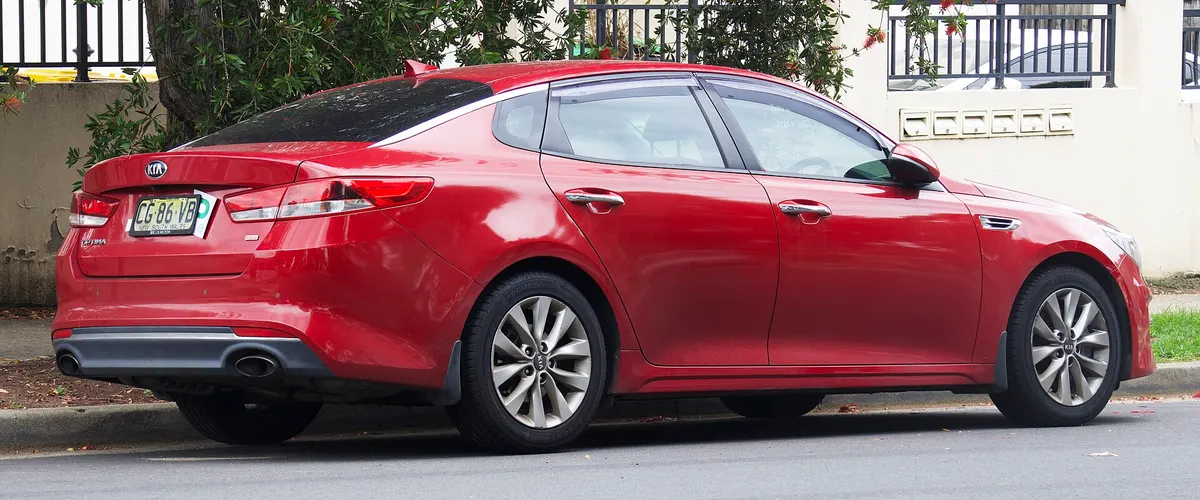
Engines
- G4KJ (Theta II) · 2.4L gasoline, 185 hp
- G4FJ (Gamma) · 1.6L turbo gasoline, 178 hp
- G4KH (Theta II) · 2.0L turbo gasoline, 245 hp
- Nu 2.0 GDI (hybrid) · 2.0L hybrid, 192 hp
- Nu 2.0 GDI (PHEV) · 2.0L phev, 202 hp
Transmissions
- automatic , 6-speed
- dct , 7-speed
Drivetrain
FWD
Body
sedan
Trims
LX, LX 1.6T, S, EX, SX, SX Limited, Hybrid, Plug-In Hybrid
Kia Optima part-number cross-reference
Start from the OEM number, then pick the brand you trust. Verified equivalents for the Kia Optima (2016–2020).
Part links go to Amazon, and to eBay where Amazon does not stock the part. Affiliate links, so we may earn a commission if you buy. Your price is unchanged, and a commission never changes a verdict.
Oil filter
Kia/Mobis
Universal Hyundai/Kia spin-on; supersedes 26300-35504 / -35503. NOTE: cartridge 26320-3CAA0 does NOT fit this car. That is a diesel/other-platform element
Find Kia/Mobis oil filter on AmazonVerified via: KiaPartsNow OEM catalog: 26300-35504/35505 fits 2016-2020 Optima 1.6 Gamma / 2.0 & 2.4 Theta II, EngineOilDB: 2017 Optima 2.4/1.6T/2.0T all use Kia 26300-35505 (Wix 51334), OilFilter-CrossReference: Kia 26300-35505 = Fram PH9688, Paul's Travel Pictures: 2016-2020 Optima 2.4 GDI oil change guide (spin-on, front of engine)
Engine air filter
Verified via: KiaPartsNow OEM catalog: 28113-C1100 fits 2.4 Theta II (2016-2020 Optima), AirFilter-CrossReference: Kia 28113-C1100 = Mann C28036 / Wix, Fram CA11942 fitment: Kia Optima 2016-2020 2.4L & Optima Hybrid 2.0L (Amazon)
Engine air filter
Verified via: KiaPartsNow OEM catalog: 28113-C1500 fits 1.6 Gamma & 2.0 Theta II (2016-2020 Optima), AirFilter-CrossReference: 28113-C1500 = Fram CA11941 / Wix WA10301 / Purolator A59181, Kia.Parts OEM: 28113-C1500 Air Filter, 2016-2020 Optima 1.6L/2.0L
Cabin air filter
Kia/Mobis
Superseded to D5C79-AC000 (same filter). NOTE: 97133-D4000 is a common wrong cross-list. The correct JF Optima number is 97133-C1010 (2011-2015 TF Optima used 97133-3SAA0)
Check Kia/Mobis cabin air filter on AmazonVerified via: KiaPartsNow OEM catalog: 97133-C1010 fits 2016-2020 Optima (all engines); TF used 97133-3SAA0, Fram CF12159 fitment: Kia Optima 2016-2020, OE 97133-C1010 (Amazon)
Spark plugs
Kia/Mobis
= NGK SILZKR7E11 (heat range 7). TRAP: SILZKR7B11 / Kia 18846-11070 is the 2011-2015 TF plug, a different number
Find Kia/Mobis spark plugs on AmazonVerified via: KiaPartsNow OEM catalog: 18849-11070 spark plug, 2.4 Theta II Optima, Kia.Parts OEM 18849-11070 = NGK SILZKR7E11 (2016+ Kia/Hyundai)
Spark plugs
Kia/Mobis
= NGK SILZKR8E8G (NGK stock 97080/94595, heat range 8, gap .028-.031)
Check Kia/Mobis spark plugs on AmazonVerified via: KiaPartsNow OEM catalog: 18849-08080 spark plug, 1.6 Gamma Optima, NGK SILZKR8E8G = OEM 18849-08080, Kia Optima 1.6 (Amazon)
Spark plugs
Kia/Mobis
= NGK SILZKR8E9G (heat range 8). 18849-09085 on 2016-2018; superseded to 18857-09085 on 2019-2020. Different from the 1.6T (8E8G) and 2.4 (7E11) plugs. Match to engine
Compare Kia/Mobis spark plugs on AmazonVerified via: KiaPartsNow OEM catalog: 18857-09085 spark plug, 2.0 Theta II turbo (2019-2020 Optima), NGK SILZKR8E9G = OEM 18849-09085 / 1885709085, G4KH 2.0T (Amazon), Kia.Parts OEM: 18857-09085 spark plug (2018-2022 Kia)
Front brake pads
Kia/Mobis
Standard front pad set (fits 1.6 Gamma & 2.4 Theta II; NOT the 2.0T). 2019-2020 2.4 also lists 58101-D4A10
Look up Kia/Mobis front brake pads on AmazonAkebono
ProACT ceramic; shared with 300mm-brake Sonata/Elantra GT/Veloster
Check Akebono front brake padsVerified via: KiaPartsNow OEM catalog: 58101-D5A10 (1.6/2.4) & 58101-D4A10 (2019-2020 2.4), RockAuto: Akebono ACT1813 fits 2016-2020 Optima (standard brakes)
Front brake pads
Kia/Mobis
The only OEM front pad number that lists the 2.0T application. The JF Optima shipped in 300 / 305 / 320 mm front-brake sizes, so pads split by trim. Confirm your caliper/rotor
See Kia/Mobis front brake pads on AmazonVerified via: KiaPartsNow OEM catalog: 58101-D4A20 front pads (incl. 2.0T), FRSport: Akebono ACT1826 front pad, Sonata 15-19 / Optima 16-19, AllRotors: 2016 Optima front rotor sizes (300/305/320 mm split by trim)
Wiper blades
OE size
Beam-style. A minority of retailers mis-list the driver blade as 24 in. The correct front pair is 26 in + 18 in
Find OE size wiper blades on AmazonVerified via: WindshieldWipers.com: 2016 Optima wiper set 26 in + 18 in, WiperBladesUSA: 2016 Kia Optima wiper size chart (26/18)
Serpentine / accessory drive belt
Kia/Mobis
Also listed as 25212-2GGA1. 1.6T Gamma uses a DIFFERENT belt, 25212-2B720
Check Kia/Mobis serpentine / accessory drive belt on AmazonGates
Theta II water-pump belt is a stretch-fit design, with no clean single aftermarket main-belt number; match by engine
See Gates serpentine / accessory drive beltVerified via: KiaPartsNow OEM catalog: 25212-2GGB0/2GGA1 (2.0/2.4) vs 25212-2B720 (1.6T), Gates Water-Pump Stretch-Fit Micro-V: Kia Optima 2.0/2.4L 2016-2019 (Amazon)
Battery (BCI group)
BCI group
OE ~800 CCA / 80 Ah AGM. IMPORTANT: this is NOT a Group 47/H5 car (common wrong cross-list). Early JF Optima uses the large 94R/H7 case
Compare BCI group battery on AmazonVerified via: AutoZone: 2016 Kia Optima battery (Group 94R/H7), AutoPadre: Kia Optima battery size (H7 2016-2018, H6 2019-2020)
Battery (BCI group)
BCI group
~760 CCA. Changeover: 94R/H7 (2016-2018) -> 48/H6 (2019-2020). Still NOT Group 47/H5. Hybrid/PHEV use a separate AGM 12V aux battery. Verify that one independently
Look up BCI group battery on AmazonVerified via: AutoZone: 2019 Kia Optima battery (Group 48/H6), CarSpecs: Kia Optima battery group by year
Should I buy a 2016–2020 Kia Optima?
Buy it with the paperwork, not on faith. The 2016–2020 Optima is roomy, well-equipped, and cheap to buy used precisely because the Theta II engine saga wrecked the badge's reputation, but this generation's exposure is smaller than the 2011–2015 car's, and the class settlement turned the worst-case scenario into a warranty claim: a 2.4 or 2.0T with the knock-sensor (KSDS) update installed carries a lifetime short-block warranty for rod-bearing failure. So the buying rule is simple. Verify the KSDS update and recall history by VIN, listen for any bottom-end knock cold, and demand oil-change receipts. Prefer 2019–2020 cars. On the 1.6T, test-drive specifically for dual-clutch judder in stop-and-go. A clean, updated car is a genuinely good value; an unknown-history 2.4 is a gamble on someone else's oil changes.
Best years
2019, 2020
Years to avoid
2016 (highest-complaint year of this generation: window regulators, engine issues), Any 2.4/2.0T with no KSDS update and no oil-change records
Pre-Purchase Checklist for Kia Optima
- ☐Run the VIN at kia.com/us/en/recall (or NHTSA) and confirm every open recall is closed, especially the knock-sensor (KSDS) software on 2.4/2.0T cars and SC218 on 2017–2018 Hybrids/PHEVs.
- ☐Ask a Kia dealer to confirm by VIN that the KSDS update is installed. It's the condition for the lifetime short-block warranty under the Theta II class settlement.
- ☐Cold-start the engine yourself and listen for a rhythmic metallic knock from the bottom end at idle and on light throttle, the classic early rod-bearing symptom. Walk away from any knocker.
- ☐Check the dipstick and ask directly about oil consumption; on a test drive after full warm-up, watch for the oil-pressure light flickering at hot idle.
- ☐On the 1.6T, creep through a parking lot and crawl in stop-and-go both forward and in reverse. Shudder, grabby engagement, or a long pause off the line means the dual-clutch needs work.
- ☐Cycle all four windows fully down and up a few times. Slow, crooked, or dropping glass is the known regulator failure, most common on 2016s.
- ☐If the engine was ever replaced (common on these), confirm recall 18V-907 (fuel-pipe inspection after engine replacement) shows closed, and sniff for fuel smell in the engine bay.
- ☐Buy on maintenance records: a GDI Theta II that got 5k-mile oil changes is a different car from one that got 10k-mile ones.
Common Kia Optima problems & repair costs
Theta II rod-bearing wear and engine failure (2.4 GDI / 2.0T)
$4,500–$8,500Symptoms: Rhythmic metallic knocking that worsens with load, oil-pressure light flicker, sudden stall, sometimes with little warning. Root cause traces to manufacturing debris restricting oil flow to the connecting-rod bearings; a failed rod can punch through the block and start a fire. This generation's exposure is real but smaller than the 2011–2015 car's, which took the headline recalls.
Fix: Engine (short-block or complete) replacement. The critical mitigation: under the Hyundai/Kia Theta II class settlement, 2011–2018 and certain 2019 Optimas with the 2.4 GDI or 2.0T get a LIFETIME short-block warranty for rod-bearing failure, but only once the free Knock Sensor Detection System (KSDS) software is installed. KSDS listens for early bearing knock and forces reduced-power limp mode before catastrophic failure; some owners report false-positive limp modes after the update, which Kia handles under the same program. An updated car with warranty coverage turns this from a $6k+ disaster into an inconvenience. An un-updated car with no records leaves you holding the bill.
Sources: Kia Engine Settlement: official FAQ (class vehicles, KSDS, lifetime warranty), Center for Auto Safety: 2011–2019 Kia/Hyundai 2.0 & 2.4L GDI settlements, CarComplaints: Kia Optima engine problems, Safety Research & Strategies: Hyundai-Kia Theta II engine defect history
Excessive oil consumption (2.4 GDI)
$100–$5,500Symptoms: Oil level drops a quart or more between changes with no visible leak and no blue smoke you'd notice day to day. Left unchecked it feeds directly into the rod-bearing failure above. Low oil is exactly what these bearings can't tolerate.
Fix: Start with a documented oil-consumption test at a Kia dealer (they measure usage over ~1,000-mile intervals). Excessive consumption on a car with the KSDS update installed can qualify for engine work under the extended/lifetime warranty programs; paying out of pocket, a piston-ring job or used engine runs into the thousands. The cheap insurance is a strict 3k–5k oil-change habit and checking the dipstick monthly.
Sources: CarComplaints: 2016 Kia Optima (oil consumption complaints), CarComplaints: Kia Optima engine problems
7-speed dual-clutch judder and hesitation (1.6T only)
$1,800–$2,800Symptoms: Shudder or judder creeping from a stop and in reverse, a one-beat hesitation off the line, grabby low-speed engagement, occasionally a high-transmission-temperature warning in heavy traffic. It's a dry dual-clutch with no torque converter. Stop-and-go crawling builds clutch heat, and heat makes all of it worse.
Fix: Kia TSB TRA083 covers judder inspection: confirmed cases get a dual-clutch assembly replacement plus a TCU software update. Some hesitation off the line is inherent DCT behavior and no fix will fully erase it, but rhythmic shudder is a defect, not a personality trait. Out of warranty, a clutch-pack job at an independent shop is a four-figure bill, so test-drive for it before buying.
Sources: Kia TSB TRA083: DCT judder inspection & dual-clutch replacement (NHTSA copy), Kia Optima Forums: DCT clutch issue, 2016 1.6T LX, Kia Optima Forums: 2018 1.6T shuddering
Window regulator failure
$250–$650Symptoms: Window moves slowly, goes up crooked, grinds, or drops into the door and won't come back up. It's the single most-reported 2016 Optima problem on CarComplaints, more complaints than any engine category for that year, with an average reported repair around $600 at shops.
Fix: Replace the regulator (usually with motor) in the affected door. Aftermarket parts are inexpensive and it's a very achievable DIY, see the repair guide below. Nuisance-level, but budget for more than one door over a long ownership.
Sources: CarComplaints: 2016 Kia Optima (window regulator = worst problem)
Hybrid/PHEV rod-bearing failure: recall SC218 (Nu 2.0 engine)
$0–$7,500Symptoms: Same script as the Theta II: abnormal knock, oil-pressure warning light, stall risk, and in the worst case a rod through the block and an oil fire. The JF Hybrid's Nu 2.0 GDI engine turned out to have its own version of the bearing problem. About 10,730 US cars were recalled in late 2021 (NHTSA 21V-844).
Fix: Recall remedy is free: dealers run a bearing-damage test, replace the engine if it fails, and install KSDS software. Completion also extends engine long-block warranty to 15 years/150,000 miles for rod-bearing damage, and the 2021 expanded class settlement wraps 2017–2020 Optima Hybrids/PHEVs into similar 15-yr/150k coverage. The high-end cost above is what an out-of-warranty engine would run if you skip the free recall, so don't. Verify SC218 completion by VIN before buying any JF hybrid.
Sources: NHTSA Part 573 Safety Recall Report 21V-844, Kia SC218 recall notice: 2017–2018 Optima Hybrid & Plug-In Hybrid, ClassAction.org: expanded Hyundai/Kia engine settlement (2017–2020 Optima Hybrid/PHEV)
Fuel-pipe leak after engine replacement: recall 18V-907
$0–$0Symptoms: Fuel smell in the engine bay or visible fuel seepage near the high-pressure pump. During the wave of Theta II engine swaps, some high-pressure fuel pipes were damaged, misaligned, or under-torqued on reinstallation. A leak onto a hot engine is a fire risk.
Fix: Free recall inspection and repair at any Kia dealer. Only relevant if the car has had an engine replaced, which, on this platform, plenty have. If the seller mentions a replacement engine, checking this recall's status is non-negotiable.
Sources: NHTSA campaign 18V-907: 2017 Kia Optima fuel lines (Justia recall record)
Day to day, a JF Optima is inexpensive: parts are plentiful, routine service is simple, and the 6-speed automatic behind the 2.4 and 2.0T is genuinely durable. The money risks are concentrated, not spread out: a neglected Theta II bottom end (avoidable via KSDS + warranty + oil discipline), a 1.6T clutch pack, and nickel-and-dime items like window regulators. Feed the 2.4 oil changes on a 3k–5k schedule and check the level monthly; that single habit protects you from the only truly expensive failure this car has.
Cost calculator
What will this Kia Optima cost you by a given mileage?
Drag to a mileage. We total the documented problems whose typical onset falls at or before it. The same cost ranges listed above, nothing new invented.
$0 estimated repair range
Have a repair quote for this Kia Optima?
Audit against OEM book times, uncover duplicate pad and rotor labor, and verify parts markups.
How to fix common Kia Optima problems (DIY)
Replace a failed front window regulator
Tools: Trim panel pry tools, Socket set + Phillips screwdriver, Painter's tape (to hold the glass up), Torx bits (door hardware varies by year)
- Remove the inner door handle screw and armrest screw, pry the door panel free of its clips, and unplug the switch harness.
- Peel back the vapor barrier carefully so it can be resealed.
- Raise the glass to access its clamp bolts through the door holes, tape the glass to the top of the frame, and unbolt it from the regulator.
- Unbolt the regulator and motor assembly and feed it out through the large door opening.
- Install the new regulator, bolt the glass back to the carriers, and test full up/down travel BEFORE resealing.
- Reseal the vapor barrier, clip the panel back on, and reinitialize auto-up by holding the switch up for a few seconds after full close.
Parts
- Window regulator with motor (2016–2020 Kia Optima) · Amazon $45–$110
Oil change + oil-level habit (2.4 GDI survival kit)
Tools: Floor jack + jack stands or ramps, 17mm socket (drain plug), Oil filter cup/band wrench (spin-on canister), Drain pan + funnel
- Warm the engine briefly, lift the car, and drain the oil via the 17mm drain plug.
- Unscrew the old spin-on oil filter and hand-tighten the new one (the blue canister sits low on the front of the block, not up top).
- Refill with 5.1 quarts of 5W-30 (2.4 GDI spec), start, check for leaks, then verify level on flat ground.
- Log the date and mileage. On a Theta II, oil records are literally warranty evidence.
- Between changes, check the dipstick monthly; if it drops a quart in under 1,000 miles, start a dealer oil-consumption test.
Parts
- Oil filter for 2.4 Theta II (2016–2020 Optima) · Amazon $6–$12
- 5W-30 full synthetic, 5 qt · Amazon $25–$40
Cabin & engine air filter change
Tools: None (hand tools optional for airbox clips)
- Open the glovebox, release the side damper and stops, and drop it down to expose the cabin filter cover.
- Swap the cabin filter with the airflow arrow pointing the right way, and reinstall the glovebox.
- Unclip the engine airbox lid, swap the panel filter, and re-clip.
Parts
- Cabin air filter (2016–2020 Kia Optima) · Amazon $10–$18
- Engine air filter (2016–2020 Kia Optima) · Amazon $12–$20
Some parts links are affiliate links. We may earn a commission at no cost to you. We only list parts that fit this generation.
The short version
The 2016–2020 Optima (the JF, Kia’s last before the K5) sells cheap used for one reason: the Theta II engine scandal torched Kia’s reputation. Here’s the honest picture. The catastrophic-failure headlines (the 2017 rod-bearing recall, the HECU fire recalls, the “park outside” notices) belong mostly to the 2011–2015 generation. This generation still uses the same 2.4L and 2.0T Theta II engines, and they can still spin a rod bearing, but Kia’s class-action settlement gives 2.4/2.0T cars a lifetime short-block warranty for exactly that failure, on one condition: the free Knock Sensor Detection System (KSDS) software update must be installed.
That flips the usual used-car math. A JF Optima with the update installed and oil-change receipts is one of the better midsize-sedan values on the market. One without either is a lottery ticket.
What that means when you’re shopping
First stop, before you even drive it: run the VIN for open recalls and have a Kia dealer confirm the KSDS update. Then cold-start it yourself and listen for bottom-end knock, a rhythmic metallic tap that builds with throttle. Any knock, walk away; the warranty exists, but you don’t want to start ownership with an engine claim.
Pick your powertrain deliberately. The 2.4 and 2.0T use a conventional, durable 6-speed automatic. These are the safe transmissions with the watched engine. The 1.6T flips it: unremarkable engine, but a dry 7-speed dual-clutch that’s known to judder and hesitate in stop-and-go (Kia’s TSB TRA083 replaces the clutch pack when it’s confirmed). The 2017–2020 Hybrid/PHEV had its own rod-bearing recall (SC218) and carries 15-year/150,000-mile engine coverage. Verify completion by VIN and it’s a reasonable buy.
Year-wise, 2019–2020 cars are the pick. Fewer complaints and standard driver-assist tech from 2019. The 2016 is the generation’s rough draft: it leads on the JF’s signature nuisance issue, window regulators that fail around $600 a door at a shop (a cheap DIY, see above).
The one habit that protects you
Everything expensive on this car traces to oil. The 2.4 GDI can consume it, and low oil is what kills Theta II bearings. Change it every 3,000–5,000 miles, check the dipstick monthly, and keep every receipt. On this engine, oil records are warranty evidence.
How this file is built: failure modes and cost ranges are compiled from NHTSA recall and complaint records, the Kia engine class-action settlement terms, Kia TSBs, CarComplaints data, and owner-forum reporting, then sanity-checked against shop-floor experience. Cost figures are independent-shop estimates and vary by region. Spot something off? Tell us.
Viral car myths, checked against this car
- Misleading
Is the "$1 Japanese oil trick" that stops engine wear forever real?
The 'Japanese oil trick' is almost certainly MoS2 (molybdenum disulfide), a real industrial friction modifier. It is German, not Japanese (Liqui Moly popularized it), sold openly at every parts store for $15-20, has real but modest measured friction benefits, and was never buried by anyone.
- Dangerous
Is the "$2 liquid that destroys engine sludge forever" real? Our shop-floor verdict.
An aggressive solvent flush on a high-mileage engine is a textbook way to spin a bearing. The viral 'kitchen-cabinet flush' is folklore that real shops spend money cleaning up after.
Frequently asked questions
Which 2016–2020 Kia Optima years should I avoid?
2016 is the highest-complaint year of this generation. It leads on window regulator failures and has the most engine complaints of the JF run. 2019–2020 cars are the safest picks: later production, a refresh, and standard driver-assist tech. More important than the year, though, is the paperwork: a 2016 with the KSDS update installed and clean oil records beats a 2019 with neither.
Does the Kia engine recall / lifetime warranty cover the 2016–2020 Optima?
Largely yes, with nuance. The Theta II class settlement covers 2011–2018 and certain 2019 Optimas with the 2.4 GDI or 2.0T: once the free Knock Sensor Detection System (KSDS) software is installed, the short block (block, crank, rods, bearings, pistons) is covered for the life of the car against rod-bearing failure. The 2017–2020 Hybrid/PHEV got its own coverage: recall SC218 plus a 15-year/150,000-mile engine warranty. The headline 'engine recall' (SC147) and the HECU fire recalls applied to the 2011–2015 generation, not this one. Always confirm your specific VIN's status with a Kia dealer.
Is the Optima 1.6T with the dual-clutch transmission reliable?
The engine is fine. It's not a Theta II and isn't part of the settlement. The 7-speed dry dual-clutch is the question mark: low-speed judder and hesitation are well documented, and Kia's TSB TRA083 prescribes a clutch-assembly replacement when judder is confirmed. If you mostly drive highway, it's a non-issue and the 1.6T gets the best gas-engine fuel economy of the lineup. If your life is stop-and-go traffic, get the 2.4 or 2.0T with the conventional automatic instead.
How bad is the oil consumption on the 2.4?
Reported often enough to take seriously. It was the #2 complaint category on the 2016 Optima. The real danger isn't the cost of top-off oil; it's that running low on oil is exactly what kills Theta II rod bearings. Check the dipstick monthly, and if you're losing a quart in under 1,000 miles, get a documented dealer oil-consumption test on file. That's your path to warranty engine work rather than an out-of-pocket bill.
How many miles will a 2016–2020 Optima last?
A 2.4 or 2.0T with the KSDS update, warranty coverage intact, and disciplined oil changes is a legitimate 200,000-mile car. The platform, transmission (6-speed auto), and suspension have no systemic weaknesses. The cars that die young are almost all bottom-end engine failures on neglected oil, which is exactly the failure the settlement warranty exists to cover.
Every Kia Optima generation
The full case file run, beyond the generation before and after this one.
Cross-shopped rivals
Files on what buyers weigh against the Kia Optima of this era.