Case file · MAZDA-CX-5-2026-2026 · 3rd gen
Mazda CX-5 2026–2026Common problems, reliability & repair costs
The all-new third-generation CX-5 (revealed July 10, 2025, on sale in early 2026) is bigger, roomier, and built around a giant touchscreen with Google built-in. Mechanically it's the opposite of a gamble: the 187-hp 2.5 and 6-speed automatic carry over from a proven generation, the turbo is gone, and a Skyactiv-Z hybrid arrives in 2027. What's actually new is the electronics, and that's exactly where the first-year problems showed up. Zero safety recalls so far; the complaint file is almost entirely telematics errors, SOS beeps, and screens going black.
Too early to call: 2026 is the only model year so far
None proven bad, but earliest-delivered 2026 builds carry th
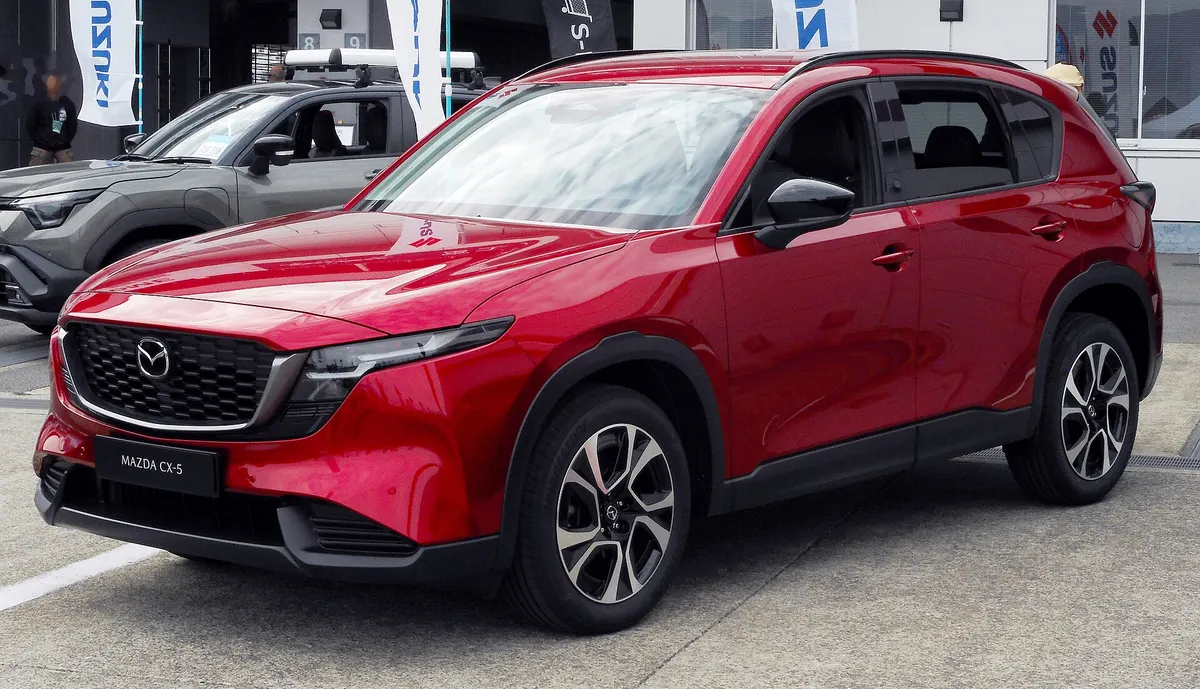
Engines
- Skyactiv-G 2.5 · 2.5L gasoline, 187 hp
Transmissions
- SKYACTIV-Drive · automatic, 6-speed
Drivetrain
AWD
Body
suv
Trims
2.5 S, 2.5 S Select, 2.5 S Preferred, 2.5 S Premium, 2.5 S Premium Plus
Should I buy a 2026–2026 Mazda CX-5?
This score is provisional by definition. The car has been on sale for months, not years. The mechanical bet is unusually safe for a first-year vehicle: the engine and transmission are carryover units from a generation with a strong record, which removes the classic all-new-powertrain risk. The bet you ARE making is on the new electronics. The documented first-months issue is the connected-car stack: telematics malfunction warnings, SOS (eCall) errors with loud startup beeps, and infotainment screens freezing or going black, sometimes within days of delivery. Because nearly every cabin control lives on that screen, a dead screen is a bigger deal here than in the old car. Mazda has acknowledged it and started rolling out software fixes in July 2026, with over-the-air updates promised for late summer. Zero NHTSA safety recalls as of August 2026. If you want the new car, buy it with the current software update installed and everything demonstrated working before you sign. If you want zero drama, a discounted leftover 2025 (the last KF) or a later-build 2026 after the OTA rollout is the calmer play.
Best years
Too early to call: 2026 is the only model year so far
Years to avoid
None proven bad, but earliest-delivered 2026 builds carry the software-teething exposure; insist on the July 2026 update
Pre-Purchase Checklist for Mazda CX-5
- ☐Ask the dealer to confirm the infotainment/telematics software update (released early July 2026) is installed before delivery. It targets the black-screen and connectivity failures. Over-the-air update capability was promised for late summer 2026.
- ☐On the test drive, watch for the documented first-year cluster: a yellow 'Telematics Malfunction' warning, SOS/eCall errors, or three loud beeps at startup. Owners report these within days, one at 150 miles.
- ☐Work the touchscreen hard for ten minutes. Screens freezing or going black is the top early complaint, and climate controls and the backup camera live on that screen.
- ☐Set up the MyMazda app and demonstrate remote lock/unlock before you take delivery. One NHTSA complaint reports app functions dead across multiple updates.
- ☐Run the VIN on NHTSA. Zero recalls as of August 2026, but first-year vehicles accumulate recalls later. Recheck close to purchase.
- ☐Inspect the windshield and know that glass replacement now involves ADAS camera recalibration. The prior generation cracked windshields easily, and one early 2026 complaint reports a fracture without impact. That is one report, not a pattern, but worth an extra look.
- ☐Decide whether you can live with touchscreen-first controls: the rotary commander knob is gone, and the 12.9-inch screen is standard with 15.6 inches only on Premium Plus.
- ☐Cross-shop a leftover 2025 CX-5, the final, most-debugged year of the outgoing generation, mechanically proven, with physical controls.
Common Mazda CX-5 problems & repair costs
Telematics / eCall (SOS) malfunction warnings and startup beeps
Symptoms: Yellow triangle with a 'Telematics Malfunction' or 'Network Malfunction' message, SOS / Emergency Call Unit errors, and three loud beeps at startup. MyMazda app remote functions (lock/unlock, vehicle status) stop working. Because the eCall system is an emergency feature, a malfunction means automatic crash notification may not work.
Fix: Software. Dealers acknowledged it as a known problem, and Mazda released an infotainment/telematics update in early July 2026 (dealer-installed) targeting battery drain, black screens, and connectivity, with over-the-air update capability promised for late summer 2026 and further fixes in subsequent releases. No parts, no cost, but you want the update confirmed on any car you buy.
Sources: NHTSA complaints: 2026 Mazda CX-5, Mazdas247: 2026 CX-5 must-read issues (owner reports, dealer responses), Mazdas247: 2026 CX-5 infotainment update (July 2026 release, OTA timing)
Infotainment screen freezes and blackouts
Symptoms: The center touchscreen freezes, goes black, or fails to start. Owners report it within hours to days of ownership. When it happens, climate control access and the backup camera display go with it, and some complaints report the instrument cluster blacking out too. NHTSA complaints and owner-forum threads describe the same cluster.
Fix: Same software campaign as the telematics issue: the July 2026 dealer-installed update specifically targets black-screen elimination, with OTA updates to follow. All of it is warranty/software work. No repair-cost data exists, and none should be needed. If a car on the lot still shows these symptoms after the update, walk.
Sources: NHTSA complaints: 2026 Mazda CX-5 (8 of 11 complaints involve screens, telematics, or connected services), Mazdas247: 2026 CX-5 must-read issues
No real-world repair-cost data exists yet. The oldest cars have been on the road only since early 2026, and every documented issue so far is software fixed free under warranty (Mazda's standard coverage is 3-year/36,000-mile basic and 5-year/60,000-mile powertrain). The running-cost picture is predictable because the powertrain isn't new: the naturally aspirated 2.5 and 6-speed have a long, cheap service history in the prior generation, and EPA rates every 2026 trim at 24/30/26 mpg with the standard AWD. Budget normally; the open question is electronics longevity, not mechanical cost.
Cost calculator
What will this Mazda CX-5 cost you by a given mileage?
Drag to a mileage. We total the documented problems whose typical onset falls at or before it. The same cost ranges listed above, nothing new invented.
$0 estimated repair range
Have a repair quote for this Mazda CX-5?
Audit against OEM book times, uncover duplicate pad and rotor labor, and verify parts markups.
The short version
This file is deliberately thin, because the honest file on a months-old car is thin. Mazda revealed the all-new third-generation CX-5 on July 10, 2025 and put it on sale in early 2026, with US pricing announced January 13, 2026 ($29,990–$38,990 plus destination) and Canadian sales starting in spring 2026. Nobody, including us, knows its long-term reliability yet. What’s below is what’s actually verifiable today.
What changed from the last CX-5
The new car is 4.5 inches longer overall on a 4.5-inch-longer wheelbase, slightly wider, with more rear-seat room and a longer cargo floor. Every trim gets the 187-hp / 186 lb-ft naturally aspirated 2.5, a 6-speed automatic, and standard AWD. The turbo is gone, and EPA figures are 24/30/26 mpg across the board. The cabin went screen-first: Google built-in (Maps, Play Store, Gemini assistant) on a 12.9-inch touchscreen (15.6 inches on Premium Plus, the largest Mazda has fitted), and the rotary commander knob is gone. A Skyactiv-Z hybrid joins in 2027, per Mazda.
The early complaint file
As of August 2026, NHTSA shows zero safety recalls and 11 complaints, and 8 of the 11 describe the same thing: telematics malfunction warnings, SOS/eCall errors with loud startup beeps, MyMazda app functions dying, and touchscreens freezing or going black, sometimes within days of delivery. Owner forums corroborate it, dealers have called it a known problem, and Mazda shipped a dealer-installed software update in early July 2026 with over-the-air updates promised for late summer. The remaining three complaints are one-offs, not patterns: a false automatic-emergency-braking event, a stall after dealer service, and a windshield that cracked without impact. That last one is worth noting only because the previous generation was known for fragile windshields. CarComplaints has no 2026 CX-5 page at all yet. No mechanical failure pattern has appeared.
Buy the first year, or wait?
The usual reason to skip a first-year vehicle, an unproven powertrain, mostly doesn’t apply: the engine and transmission are the outgoing car’s proven units. The genuinely new surfaces are the body, the platform, and above all the electronics, and the electronics are where the first-year problems landed, exactly as you’d predict. That’s fixable-with-software territory, not engine-replacement territory. Buy one with the current update installed and everything demonstrated working, or wait out the software churn with a later build, or a discounted leftover 2025, the most-debugged year of the old car.
How this file is built: launch facts come from Mazda’s own announcements (July 10, 2025 reveal; January 13, 2026 pricing), EPA data from fueleconomy.gov, and early-ownership reporting from NHTSA complaint records and owner forums. A new generation means no long-term data exists, so none is claimed. This file will grow as the record does. Spot something off? Tell us.
Viral car myths, checked against this car
- Mostly False
Do shops lose money on cheap oil changes? We opened a real shop's books to find out.
A quick lube's true all-in cost is roughly $16–40 per car. Even a $59 special turns a gross profit before the upsells start. The 'below cost' story is only true at full-service shops doing far more work per visit, which is a different product wearing the same name.
- Misleading
Is the "$1 Japanese oil trick" that stops engine wear forever real?
The 'Japanese oil trick' is almost certainly MoS2 (molybdenum disulfide), a real industrial friction modifier. It is German, not Japanese (Liqui Moly popularized it), sold openly at every parts store for $15-20, has real but modest measured friction benefits, and was never buried by anyone.
- Outdated
Does a "$1 mineral" really double car battery life? The Epsom-salt reality.
The mineral is Epsom salt (magnesium sulfate). It was a real desulfation hack for serviceable flooded-cell batteries 40+ years ago. It does not work on modern sealed AGM or EFB batteries, and trying it on yours will void the warranty without helping the battery.
- Dangerous
Is the "$2 liquid that destroys engine sludge forever" real? Our shop-floor verdict.
An aggressive solvent flush on a high-mileage engine is a textbook way to spin a bearing. The viral 'kitchen-cabinet flush' is folklore that real shops spend money cleaning up after.
Frequently asked questions
Is the 2026 Mazda CX-5 reliable?
Honest answer: nobody knows yet. The third-generation car has only been on sale since early 2026. What the early data shows is zero safety recalls and 11 NHTSA complaints, almost all software: telematics errors, SOS beeps, and screens going black, which Mazda is fixing with updates. The encouraging part is what ISN'T new: the 187-hp 2.5 and 6-speed automatic carry over from a generation with a strong reliability record.
Should I buy the first year of the new CX-5 or wait?
The classic first-year risk, an unproven engine or transmission, mostly doesn't apply here, because the powertrain is carried over. The real first-year friction is the new connected-electronics stack, and it showed up on schedule: telematics and screen failures within days of early deliveries. If you buy now, insist on the July 2026 software update and demonstrate everything working before signing. If you'd rather skip the teething entirely, wait for post-OTA builds late in 2026 or cross-shop a leftover 2025.
Does the 2026 Mazda CX-5 have a turbo?
No. The 2.5 Turbo (256 hp in the old car) was dropped for the new generation. Mazda said the non-turbo was the overwhelming buyer choice. Every 2026 CX-5 has the 187-hp naturally aspirated 2.5 with a 6-speed automatic and standard AWD. If you want more power in this body, the answer is the hybrid coming in 2027, not a turbo.
When is the Mazda CX-5 hybrid coming out?
Mazda says 2027. The reveal announcement confirmed a new Skyactiv-Z engine paired with Mazda's hybrid system technology will join the CX-5 lineup in 2027, promising more performance and better fuel efficiency than the current 187-hp 2.5. Mazda has not published final specs or pricing for it yet.
How much does the 2026 Mazda CX-5 cost?
Per Mazda's January 2026 pricing announcement: 2.5 S $29,990, Select $31,990, Preferred $34,250, Premium $36,900, and Premium Plus $38,990, plus $1,495 destination, all with standard AWD. There's no meaningful used market yet, so there's no honest 'used price' to quote; leftover 2025 (previous-generation) cars are the value play.
What are the common problems with the 2026 Mazda CX-5?
So far, one cluster: the connected electronics. Owners report telematics malfunction warnings, SOS/eCall errors with loud startup beeps, dead MyMazda app functions, and touchscreens freezing or going black, and 8 of the first 11 NHTSA complaints describe some version of it. Mazda released a dealer-installed software update in July 2026 and promised over-the-air updates for late summer. No mechanical problem pattern has appeared, and there are zero safety recalls as of August 2026.
How many miles will a 2026 Mazda CX-5 last?
There's no data on this generation and won't be for years. What you can lean on: the engine and transmission are carryover units from the 2017–2025 CX-5, which built a strong durability record with the same basic 2.5 and 6-speed. The honest unknown is the new electronics (screens and modules), not the drivetrain.
Every Mazda CX-5 generation
The full case file run, beyond the generation before and after this one.
Cross-shopped rivals
Files on what buyers weigh against the Mazda CX-5 of this era.