Case file · FORD-ESCAPE-2020-2024 · 4th gen (CX482)
Ford Escape 2020–2024Common problems, reliability & repair costs
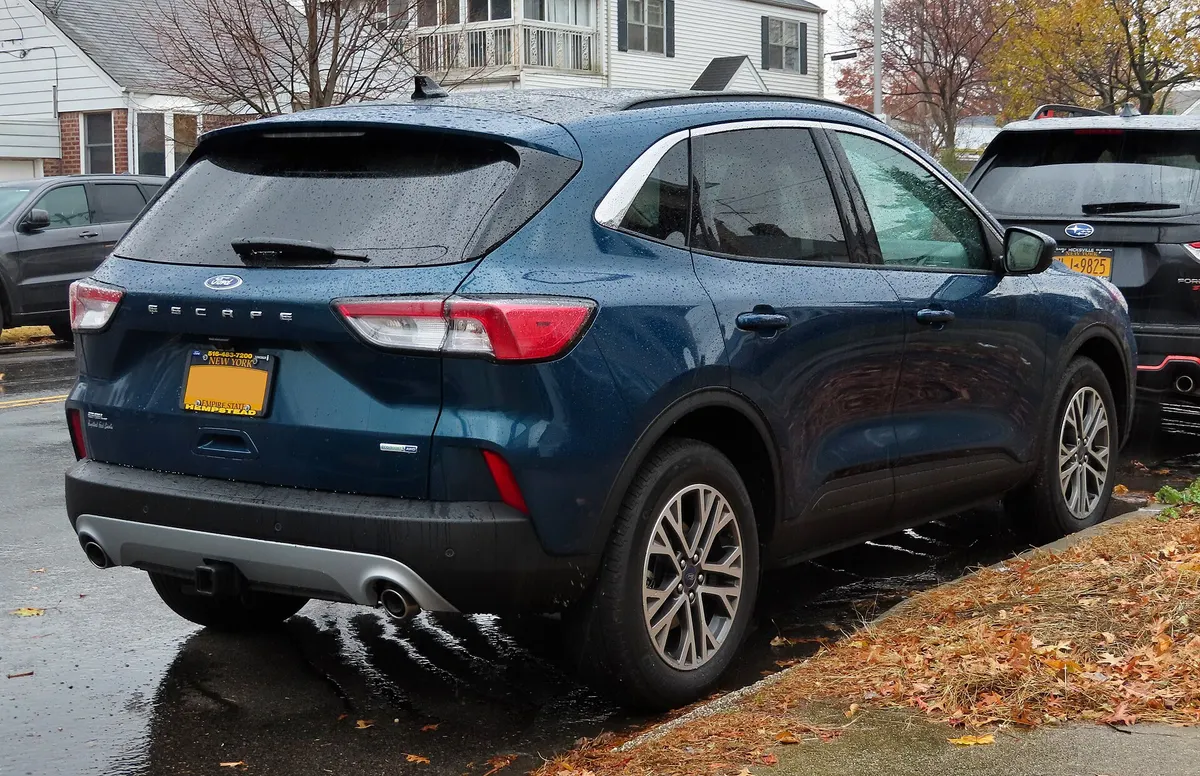
The 4th-gen Escape is a comfortable, efficient compact SUV dragged down by one of the heaviest recall records of its class. The 1.5L EcoBoost three-cylinder has a cracked-fuel-injector fire-risk recall spanning nearly the whole run, the 2.5L hybrid and plug-in hybrid carry their own engine-failure and battery fire-risk recalls, and early cars stack up powertrain and electronics complaints. Buy one with every recall closed out and it's a solid family hauler; buy blind and you inherit Ford's homework.
2023, 2024
2020 (first model year, most complaints and recalls) +2 more
Engines
- 1.5L EcoBoost (Dragon) · 1.5L gasoline, 181 hp
- 2.0L EcoBoost · 2.0L gasoline, 250 hp
- 2.5L iVCT hybrid · 2.5L hybrid, 200 hp
- 2.5L PHEV · 2.5L phev, 221 hp
Transmissions
- 8F24 · automatic, 8-speed
- 8F35 · automatic, 8-speed
- cvt
Drivetrain
FWD / AWD
Body
suv
Trims
S, SE, SEL, Titanium, Active (2023+), ST-Line (2023+), Platinum (2023+)
Ford Escape part-number cross-reference
Start from the OEM number, then pick the brand you trust. Verified equivalents for the Ford Escape (2020–2024).
Part links go to Amazon, and to eBay where Amazon does not stock the part. Affiliate links, so we may earn a commission if you buy. Your price is unchanged, and a commission never changes a verdict.
Oil filter
Verified via: MaverickTruckClub - 2.5L hybrid (same engine as Escape hybrid) uses FL-910-S, EngineHungry - 2020 Escape 1.5L/2.0L/2.5L all use Motorcraft FL-910-S, Oil filter cross-reference - FL910S = Fram PH3614, Ford 2020 Escape owner's manual, Motorcraft parts tables (printed p378-380)
Oil filter
Motorcraft
See Motorcraft oil filter on AmazonVerified via: Ford 2024 Escape owner's manual, Motorcraft parts, 2.0L (printed p415)
Engine air filter
Verified via: Levittown Ford - JX6Z-9601-A listed for Escape 2.0L/1.5L, PartsGeek - 2020-2022 Escape engine air filter = Wix WA10981 (Ford JX6Z-9601-A)
Engine air filter
Motorcraft
Check Motorcraft engine air filter on AmazonVerified via: Ford 2024 Escape owner's manual, Motorcraft parts, 1.5L (printed p415)
Engine air filter
Motorcraft
See Motorcraft engine air filter on AmazonVerified via: Ford 2024 Escape owner's manual, Motorcraft parts, 2.0L (printed p415)
Engine air filter
Verified via: Levittown Ford - LX6Z-9601-A listed for Escape 2.5L, FinditParts - Motorcraft FA1948 = Ford LX6Z9601A; Fram CA12813; Wix WA10981/WA11407
Cabin air filter
Motorcraft
See Motorcraft cabin air filter on AmazonVerified via: OEMPartsOnline - Motorcraft FP-100-A, 2020-2026 Ford Escape, Fram CF12772 - fits 2020-2024 Escape (and Bronco Sport/Explorer/Corsair/Aviator)
Spark plugs
Verified via: Ford 2020 Escape owner's manual, 1.5L specs and Motorcraft parts (printed p377-380), Ford 2021 Escape owner's manual, Motorcraft parts (printed p394-395), Ford 2022 Escape owner's manual, Motorcraft parts (printed p390-391)
Spark plugs
Verified via: Ford 2020 Escape owner's manual, 2.0L specs and Motorcraft parts (printed p377-380), Ford 2021 Escape owner's manual, Motorcraft parts (printed p394-395), Ford 2022 Escape owner's manual, Motorcraft parts (printed p390-391)
Spark plugs
Motorcraft
Gap 0.051 in (1.3 mm) in the 2020 book, 0.049-0.053 in (1.25-1.35 mm) in 2021-2022
Check Motorcraft spark plugs on AmazonVerified via: Ford 2020 Escape owner's manual, 2.5L specs and Motorcraft parts (printed p377-380), Ford 2021 Escape owner's manual, Motorcraft parts (printed p394-395), Ford 2022 Escape owner's manual, Motorcraft parts (printed p390-391)
Spark plugs
Verified via: Ford 2024 Escape owner's manual, Motorcraft parts (printed p415-416)
Spark plugs
Verified via: Ford 2024 Escape owner's manual, Motorcraft parts (printed p415-416)
Front brake pads
Motorcraft
Find Motorcraft front brake pads on AmazonVerified via: OEMPartsOnline - Motorcraft BRF-2013 disc brake pad set, 2020-2025 Ford Escape, Ford Escape Forum - Motorcraft brake pad numbers (BRF = factory-spec front set)
Wiper blades
OEM size spec
Look up OEM size spec wiper blades on AmazonVerified via: WiperSized - Ford Escape blade sizes chart, Otto Blades - 2024 Escape 24 in driver + 20 in passenger
Serpentine / accessory belt
Verified via: FordPartsGiant belts diagram - KX7Z-8620-B = 1.5L main belt, LX6Z-8620-B = 2.0L main belt, K2GZ-8620-CA = 2.0L A/C belt, Lakeland Ford - 2022 Escape 2.5L hybrid/PHEV serpentine belt = K2GZ-8620-A
Battery (12V)
Motorcraft
Gas 1.5L/2.0L in Ford's 2021, 2022 and 2024 books, and the hybrid in the 2021 book. Ford's 2020 book lists BHEF-48H6 for both gas engines
Compare Motorcraft battery on AmazonVerified via: PartsGeek - 2017-2026 Escape Motorcraft BAGM-48H6-760, Group 48/H6, 760 CCA, Ford Escape Forum - hybrid 12V auxiliary battery (smaller ~45Ah) discussion, Ford 2020 Escape owner's manual, Motorcraft parts: BHEF-48H6 for 1.5L and 2.0L (printed p378-379)
Should I buy a 2020–2024 Ford Escape?
Buy on paperwork, not on the test drive. Mechanically this generation is decent. The real risk is unfinished recall work. Before money changes hands, run the VIN through the NHTSA recall lookup: 1.5L cars need the fuel-injector recall closed out, hybrids need the 2.5L engine-failure recall inspection, and PHEVs need every high-voltage battery recall done. The 2.0L EcoBoost is the cleanest pick of the lineup, the hybrid is the value pick once recalls are verified, and a 2023–2024 facelift car sidesteps most first-year gremlins. A 2020 with open recalls and a spotty dealer history is the one to walk away from.
Best years
2023, 2024
Years to avoid
2020 (first model year, most complaints and recalls), 2020–2022 1.5L until the fuel-injector recall is verified complete by VIN, PHEV (any year) unless every high-voltage battery recall shows closed
Pre-Purchase Checklist for Ford Escape
- ☐Run the VIN at nhtsa.gov/recalls and require proof every recall is closed. This generation has some of the highest recall counts in the class (the 2021 alone has ~20).
- ☐On 1.5L cars: confirm the cracked-fuel-injector recall (22S73/24S16/25S76) was performed, then check for any fuel smell under the hood after a warm test drive.
- ☐On 1.5L cars: watch the temp gauge and check for coolant loss or white exhaust smoke. Cylinder-head coolant problems (code P1285) are documented on this engine.
- ☐On hybrids/PHEVs: verify the 2.5L engine-failure recall (23S27) inspection was done, and listen for knocking or unusual engine noise on the drive.
- ☐On PHEVs: confirm the high-voltage battery recalls are complete and ask whether the car has been living under a reduced-charge restriction.
- ☐On 1.5L/2.0L cars: feel for harsh 2–4 gear shifts, shudder under light acceleration around 20–35 mph, or clunks from the 8-speed, worst on 2020s.
- ☐Shift into reverse and confirm the backup camera shows a live image immediately and drops it when you shift out. Blank/frozen camera displays were recalled.
- ☐Test both front windows fully up and down several times; front window motor failures are a common complaint on early cars.
Common Ford Escape problems & repair costs
Cracked fuel injectors, fuel leak / fire risk (1.5L EcoBoost)
$0–$900Symptoms: Fuel odor in or around the engine bay, check-engine light, in the worst cases smoke or fire under the hood. Ford has documented injectors cracking and leaking fuel onto hot engine surfaces, with at least 8 underhood fires reported.
Fix: Recall work is free: Ford first installed a drain tube plus detection software (22S73, NHTSA 22V-859), later expanded coverage (24S16), then announced a hardware injector replacement under 25S76 in 2025 covering roughly 694,000–858,000 Escapes and Bronco Sports. Out of recall context, a shop-replaced injector set runs a few hundred to about $900. Verify by VIN that the latest remedy is done.
Sources: Ford recall 25S76: cracked fuel injector / underhood fire risk, NHTSA recall 22V-859 notice (2020–2023 Escape 1.5L), Consumer Reports: Ford fuel injector recall
2.5L hybrid/PHEV engine failure and underhood fire risk
$5,000–$9,000Symptoms: Sudden knocking or grinding, loss of power, oil smell or smoke from the engine bay. Isolated manufacturing defects can let a connecting rod breach the block or oil pan; escaping oil and fuel vapor can ignite on hot exhaust components.
Fix: Recall 23S27 (expanding earlier 22S43) covers 2020–2023 Escape hybrids/PHEVs: dealers modify the under-hood shielding and drainage so a failure can't feed a fire, free of charge. The recall does not replace the engine. An actual out-of-warranty engine failure is a $5,000–$9,000 replacement, which is why you listen hard on the test drive.
Sources: Ford recall 23S27: Escape (2020–2023) engine failure recall, NHTSA consumer alert: Ford/Lincoln hybrid fire-risk recall
PHEV high-voltage battery cell short-circuit (fire risk)
$0–$500Symptoms: Loss of drive power, warning lights, and in rare cases battery fire. Battery cells (Samsung SDI supplied) can develop internal short circuits.
Fix: Ford first pushed a battery ECM software update (24S79) to detect shorts, then recalled about 20,500 Escape PHEVs again in late 2025 after determining software may not catch every failure, with interim charge-limit instructions until the hardware remedy. All recall work is free; the cost range here is incidentals like rental/diagnostic time. Do not buy a PHEV without confirming these recalls are closed, because an out-of-warranty pack replacement runs five figures.
Sources: Ford recall 24S79: Escape PHEV battery ECM software update, Kelley Blue Book: Escape/Corsair PHEV battery recall
8-speed automatic (8F24/8F35) harsh shifting, shudder, and failures
$300–$6,500Symptoms: Hard or delayed 2–4 shifts, shudder or vibration under light acceleration around 20–35 mph, clunks when slowing to a stop; a smaller number of cars have needed valve bodies or complete transmissions. CarComplaints logs transmission failure and acceleration shudder as the 2020 Escape's leading drivetrain gripes.
Fix: Start cheap: many complaints resolve with a transmission software reflash and a fluid service. Persistent shudder or slipping escalates to a valve body ($1,500–$3,000) or full replacement ($4,500–$6,500 at an independent shop). On a test drive, insist on a cold start and a 20–40 mph light-throttle cruise.
Sources: CarComplaints: 2020 Escape transmission problems, CarComplaints: 2020 Escape powertrain complaints
1.5L cylinder-head coolant problems / overheat (P1285)
$2,500–$4,500Symptoms: Coolant level dropping with no visible leak, white exhaust smoke, rough running, or a P1285 cylinder-head-over-temperature code. The infamous prior-generation coolant-intrusion design was revised for 2020, but this engine family still generates documented head trouble, including a Ford service bulletin (SSM 54114) for debris blocking a head coolant passage on newer builds, and owner-reported engine failures on early 2020 cars.
Fix: Per the bulletin, the first step is a specific cooling-system flush; if the over-temp condition returns, the cylinder head gets replaced. Out of warranty that's a $2,500–$4,500 job at an independent shop. Any 1.5L candidate car gets a cold-start check, a long warm-up, and a coolant-level look.
Sources: Go-Parts: P1285 on 2023–2025 Escape 1.5L (TSB SSM 54114), FordEscape.org: 2020 1.5L 3-cylinder coolant/block failure thread
Backup camera blank or frozen image (SYNC 3 software)
$0–$500Symptoms: Rearview camera shows a blank screen in reverse, or the camera image stays frozen on the display after shifting out of reverse.
Fix: Recalled in 2025 (NHTSA 25V-442, ~200,000 vehicles including 2018–2024 Escapes): dealers update the rearview camera / SYNC 3 software free. If the camera itself has failed outside recall coverage, a replacement camera runs a few hundred dollars installed. Confirm the recall shows closed on the VIN.
Sources: WardsAuto: Ford recalls 200K vehicles for backup camera display fault, NHTSA vehicle page: 2021 Ford Escape recalls/complaints
Day-to-day, a 4th-gen Escape is cheap to run. The hybrid returns real-world 38–40 mpg and the eCVT has no conventional clutches or shift hardware to wear. The money risks are concentrated, not constant: an out-of-warranty 8-speed repair, a 1.5L cylinder head, or (rare but real) a hybrid engine failure are four-figure-plus events, while the recall-related fire risks cost nothing if the work is actually done. Budget for normal wear (brakes, tires, the odd window motor) and treat the recall printout as part of the purchase price. Early cars also rack up interior-trim, paint, and electrical annoyances (the 2020's most-complained categories), which are cheap but frequent.
Cost calculator
What will this Ford Escape cost you by a given mileage?
Drag to a mileage. We total the documented problems whose typical onset falls at or before it. The same cost ranges listed above, nothing new invented.
$0 estimated repair range
5-Year Maintenance Schedule & Cost to Own
Every scheduled service by mileage, fluid capacities, independent shop ranges, and parts cross-references.
Have a repair quote for this Ford Escape?
Audit against OEM book times, uncover duplicate pad and rotor labor, and verify parts markups.
How to fix common Ford Escape problems (DIY)
Engine & cabin air filter change
Tools: None required (screwdriver optional for airbox clips)
- Unclip the airbox lid in the engine bay, lift it, and swap in the new engine air filter with the seal seated flat.
- Open the glovebox and squeeze the sides to release the stops so it swings down.
- Remove the cabin filter cover behind the glovebox and slide the old filter out.
- Insert the new cabin filter with the airflow arrow pointing the correct way (marked on the housing), then reassemble.
Parts
- Engine air filter (2020–2024 Ford Escape) · Amazon $12–$25
- Cabin air filter (2020–2024 Ford Escape) · Amazon $10–$20
Front brake pad replacement
Tools: Floor jack + jack stands, Lug wrench / breaker bar, Socket set (13–18mm) + C-clamp or piston tool, Torque wrench, Brake cleaner + caliper grease
- Loosen the lugs, jack the front up onto stands, and remove the wheel.
- Remove the two caliper slide bolts and hang the caliper with a hook or wire, never by the brake hose.
- Pull the old pads and clips; compress the caliper piston slowly with a C-clamp (crack the reservoir cap first).
- Fit new clips and pads with a light film of caliper grease on the contact points.
- Reinstall the caliper, torque the slide bolts and lugs to spec, and pump the pedal firm before moving the car.
- Repeat on the other side, then bed the pads with several moderate stops from 40 mph.
Parts
- Front brake pads (2020–2024 Ford Escape) · Amazon $40–$90
- Front rotors (pair, if worn or grooved) · Amazon $80–$160
Some parts links are affiliate links. We may earn a commission at no cost to you. We only list parts that fit this generation.
The short version
The 2020–2024 Escape is a competent, efficient compact SUV with an uncomfortable distinction: it is one of the most-recalled vehicles in its segment. The 1.5-liter EcoBoost three-cylinder, the engine in most of them, has been recalled three times for fuel injectors that can crack, leak fuel onto hot engine parts, and start fires. The 2.5-liter hybrid and plug-in hybrid have their own fire-risk recall for engine failures that can breach the block, and the PHEV’s high-voltage battery has been recalled repeatedly for cells that can short-circuit.
None of that makes the Escape a bad used car. It makes it a car you buy with a recall printout in hand.
What that means when you’re shopping
Run the VIN through the NHTSA recall lookup before you do anything else. A 2021 Escape has roughly twenty recalls against it; the question isn’t whether the car had recalls, it’s whether every one shows closed. A car with all recall work documented is arguably safer than a low-mile example that never saw a dealer.
Then match your inspection to the engine. On a 1.5L: sniff for fuel under a warm hood, watch the temp gauge, and check the coolant level. Cylinder-head coolant trouble is documented on this engine family even after Ford fixed the previous generation’s design. On the 8-speed cars, drive at light throttle between 20 and 40 mph and feel for shudder. On hybrids, listen for knocking; on PHEVs, make the battery recalls a hard condition of sale.
Gas, hybrid, or plug-in?
The quiet winner is the 2.0L EcoBoost: quick, AWD, and the engine least entangled in this generation’s recalls. The hybrid is the value pick once its recall work is verified: 38–40 mpg real-world and the more durable eCVT transmission. The PHEV only makes sense with every battery recall closed and a price that reflects its history. Among model years, 2023–2024 facelift cars are the safest; the 2020 carries the most first-year baggage.
How this file is built: failure modes and cost ranges are compiled from NHTSA recall and complaint records, Ford’s own recall bulletins (22S73/25S76, 23S27, 24S79), CarComplaints data, and owner reporting, then sanity-checked against shop-floor experience. Cost figures are independent-shop estimates and vary by region. Spot something off? Tell us.
Viral car myths, checked against this car
- Misleading
Is the "$2 liquid that stops any leak" really banned in 11 states?
Automotive stop-leak products are not banned in any US state. The products are real (Bar's Leaks, BlueDevil), they work in specific narrow situations, and they can permanently damage your cooling or oiling system if applied to the wrong leak.
- Misleading
Is the "$1 Japanese oil trick" that stops engine wear forever real?
The 'Japanese oil trick' is almost certainly MoS2 (molybdenum disulfide), a real industrial friction modifier. It is German, not Japanese (Liqui Moly popularized it), sold openly at every parts store for $15-20, has real but modest measured friction benefits, and was never buried by anyone.
Frequently asked questions
Which 2020–2024 Ford Escape years should I avoid?
The 2020 is the riskiest: first year of the platform, the most complaints, and the most recall exposure. 2023–2024 facelift cars are the safest bet. More important than the year is the VIN check: any 1.5L car needs the fuel-injector recall done, and any hybrid/PHEV needs its engine and battery recalls closed before you buy.
Is the Ford Escape fuel injector recall serious?
Yes. It's a fire-risk recall covering hundreds of thousands of 1.5L Escapes, with Ford aware of at least 8 underhood fires. The good news: the fix is free, and Ford moved from a software-plus-drain-tube remedy to actual injector hardware replacement under recall 25S76. Run the VIN at nhtsa.gov/recalls and don't buy until it shows closed.
Is the Escape Hybrid reliable and safe to buy used?
The hybrid powertrain is genuinely efficient and the eCVT is the more durable transmission in the lineup, but 2020–2023 hybrids carry the 2.5L engine-failure fire-risk recall (23S27), and PHEVs add repeated high-voltage battery recalls on top. With all recall work verified complete and no engine noise on the test drive, a hybrid is arguably the best value in this generation.
Does the 2020–2024 Escape have transmission problems?
The 8-speed automatic behind the 1.5L and 2.0L draws steady complaints for harsh shifts, low-speed shudder, and occasional outright failure, concentrated on 2020 builds. Many cases are fixed with a software reflash and fluid service, but a bad one can mean a $4,500+ replacement. The hybrid's eCVT largely avoids all of this.
How long will a 4th-gen Escape last?
There's no inherent reason a well-maintained one won't reach 150,000–200,000+ miles. The platform's problems are mostly specific, recall-addressed defects rather than general wear-out. The cars that die early are the ones where a known issue (injector, hybrid engine, transmission shudder) was ignored instead of fixed.
Cross-shopped rivals
Files on what buyers weigh against the Ford Escape of this era.