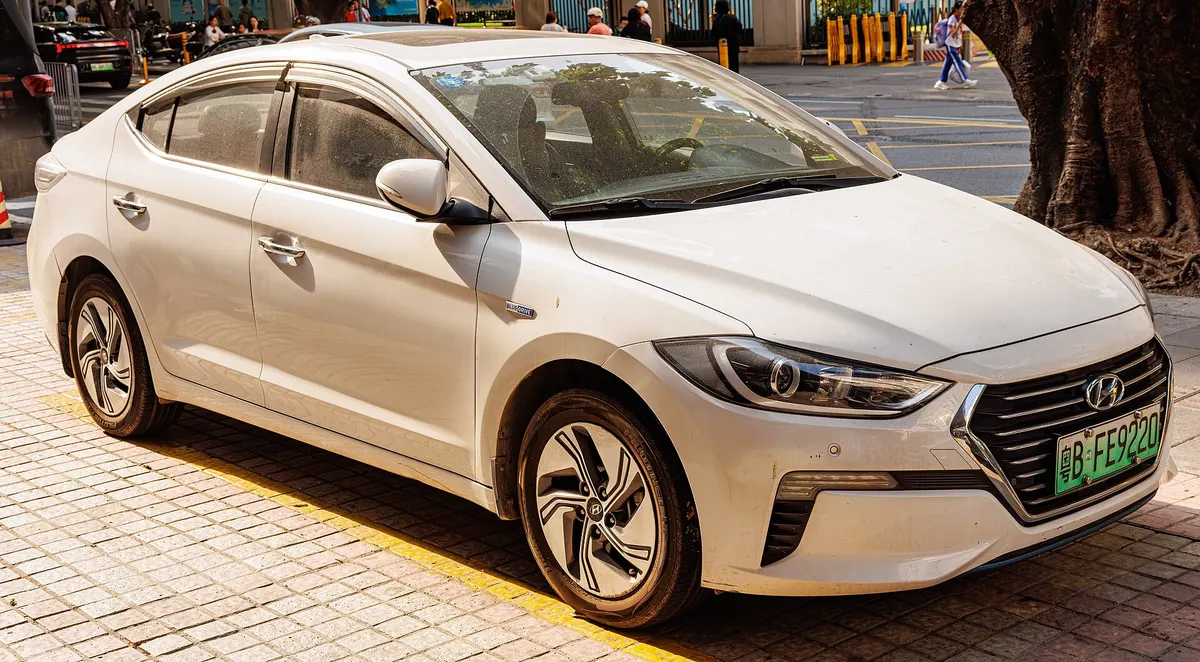
Case file · HYUNDAI-ELANTRA-2017-2020 · 6th gen (AD)
Hyundai Elantra 2017–2020Common problems, reliability & repair costs
The 6th-gen Elantra is a lot of car for the money with two real asterisks. The volume 2.0L Nu engine has a documented ticking / rod-knock failure pattern. 2019–2020 cars got a piston-oil-ring recall with free engine replacement, while 2017–2018 owners are largely on their own. And every key-start car left the factory without an engine immobilizer, which made this generation a prime 'Kia Boys' theft target until a free software fix arrived.
2019, 2020
2017–2018 2.0L with no maintenance records (engine-failure r
Engines
- Nu 2.0 MPI · 2.0L gasoline, 147 hp
- Kappa 1.4T (G4LD) · 1.4L turbo gasoline, 128 hp
- Gamma 1.6T (G4FJ) · 1.6L turbo gasoline, 201 hp
Transmissions
- automatic , 6-speed
- cvt
- manual , 6-speed
- dct , 7-speed
Drivetrain
FWD
Body
sedan
Trims
SE, SEL, Value Edition, Eco, Limited, Sport
Hyundai Elantra part-number cross-reference
Start from the OEM number, then pick the brand you trust. Verified equivalents for the Hyundai Elantra (2017–2020).
Part links go to Amazon, and to eBay where Amazon does not stock the part. Affiliate links, so we may earn a commission if you buy. Your price is unchanged, and a commission never changes a verdict.
Oil filter
Verified via: OEM 26300-35505 listing: replaces 26300-35504/-35503, Wix 51334/51334XP, Baldwin B7243, Fram TG9688/PH9688: spin-on, fits 1999-2020 Elantra, OEM cross 26300-35505 + Wix 51334, AMSOIL/Wix per-engine guide: Wix 51334 for 2019 Elantra 2.0L, Wix 51334 labeled 'Oil Filter-Turbo': confirms turbo (1.6T) uses the same spin-on
Motor oil
Hyundai Genuine
dealer parts counter, sold by the single quart at roughly $6-8, so five quarts costs more than a jug off the shelf. Hyundai's US genuine oil is blended by Quaker State. The older number for the same product, 00232-FSYN5-20WAR, now shows as discontinued.
Find Hyundai Genuine motor oil on AmazonValvoline
API SP and newer API SQ / ILSAC GF-7A; store brands carrying the same API SP starburst are equally fine here
See Valvoline motor oilVerified via: Generation-specific oil-change guide quoting the manual, 2017-2020 Elantra 2.0L: SAE 5W-20, 4.23 U.S. quarts with filter, Hyundai dealer oil table, 2017-2020 Elantra 2.0L: 5W-20 / 5W-30, ~4.2 qt with filter, Hyundai genuine full synthetic 5W-20, part 00232-SYN52-0FWAR (older 00232-FSYN5-20WAR listed as Quaker full synthetic, discontinued), Mobil 1 Extended Performance 5W-20: meets API SP, ILSAC GF-6A, PQIA lab report: Pennzoil Platinum Full Synthetic SAE 5W-20 labeled API SP / ILSAC GF-6A, Valvoline Advanced Protection Full Synthetic SAE 5W-20: API SP and preceding categories
Motor oil
Hyundai Genuine
dealer counter, sold by the quart (~$6-8 each)
Compare Hyundai Genuine motor oil on AmazonVerified via: Hyundai dealer oil table, 2017-2020 Elantra 1.4L turbo: 5W-30 synthetic, ~4.2 qt with filter (dealer table, not a figure quoted from the manual; this generation's manual carries no Kappa 1.4 T-GDI schedule), Oil capacity reference: 2018 Elantra 1.4L turbo, 4.4 qt with filter, Hyundai genuine full synthetic 5W-30, part 00232-FSYN5-30WAR, Mobil 1 Extended Performance 5W-30: meets API SP, PQIA lab report: Pennzoil Platinum Full Synthetic SAE 5W-30 labeled API SP / ILSAC GF-6A, Valvoline Advanced Protection Full Synthetic SAE 5W-30: API SP and preceding categories, Why API SP matters on a small turbo: GF-6/API SP oils are formulated to protect against low-speed pre-ignition in turbocharged direct-injection engines, and are backward compatible with older API categories
Motor oil
Hyundai Genuine
dealer counter, sold by the quart (~$6-8 each); five quarts at the dealer runs well past a shelf jug
See Hyundai Genuine motor oil on AmazonVerified via: European service data: 2018 Elantra 1.6 T-GDI: 0W-30 / 5W-30, 4.5 L (about 4.8 qt) per oil change, Oil capacity reference: 2018 Elantra 1.6L turbo, 4.8 qt with filter (cited for capacity only; this page's 5W-40 headline is a warm-climate chart option, not Hyundai's primary grade), Hyundai genuine full synthetic 5W-30, part 00232-FSYN5-30WAR, Mobil 1 Extended Performance 5W-30: meets API SP, PQIA lab report: Pennzoil Platinum Full Synthetic SAE 5W-30 labeled API SP / ILSAC GF-6A, PQIA: API SP / ILSAC GF-6A oils were reformulated specifically to reduce low-speed pre-ignition in turbocharged direct-injection engines
Engine air filter
Verified via: Fram CA12057: fits 2017-2020 Hyundai Elantra (Walmart fitment), ECOGARD XA10578: explicitly fits 2017-2020 Elantra 1.4L, 1.6L, 2.0L, PartsGeek: Wix WA10420 for 2017-2020 Elantra; OEM 28113-F2000
Cabin air filter
Verified via: Fram CF12058: fits 2017-2020 Hyundai Elantra (Walmart fitment), PartsGeek: Wix WP10319 for 2017-2020 Elantra, OEM 97133-F2000 fitment: 2017-2020 Elantra, Accent, Elantra GT, Kia Forte
Spark plugs
Verified via: OEM 18867-09095: fits 2016-2020 Elantra 2.0L MPI, OEM 18867-09095 sold as NGK Iridium for 2017-2020 Elantra 2.0L (cross NGK SILZKR7B11 / 90909)
Spark plugs
NGK
NGK stock no. 97080; colder (heat range 8) iridium for the turbo GDI engines
See NGK spark plugsVerified via: HyundaiPartsDeal: 18849-08080 for 2016-2020 Elantra DOHC TCI/GDI (turbo), OEM 18849-08080 (SILZKR8E8G): fits Elantra 17-20, Veloster 15-21, Sonata, Tucson, Kona
Front brake pads
Verified via: OEM 58101-F2A00: 2017-2020 Elantra front pads (SE/SEL sedan, non-Sport), 58101-F2A00 cross-reference (PowerStop 17-1912 / Bosch BC1912 / NAPA AD9143 / Kia 58101-G2A00 / Hyundai 58101-F3A00)
Front brake pads
Akebono
Sport pad shares the Tucson/Sportage front pad, not the base Elantra pad
Find Akebono front brake padsVerified via: OEM 58101-F2A50: 2017-2020 Elantra front disc brake pad kit (turbo/Sport), Akebono ACT1847: Elantra/Tucson/Sportage front pads (cross to 58101-F2A50)
Wiper blades (front pair)
Any beam/conventional blade (Bosch, Rain-X, Trico, Michelin)
sizes consistent across sellers; ignore 24 in / rear-12 in listings. Those are the Elantra GT hatchback
Check Any beam/conventional wiper bladesVerified via: USA Wipers: 2017-2020 Elantra requires 26 in driver + 16 in passenger, Michelin Stealth Ultra 26 & 16 in for 2017-2020 Elantra
Serpentine (drive) belt
Hyundai
See Hyundai serpentine on AmazonVerified via: OEM 25212-2E300: serpentine belt, 2.0L application (2014-2020 Elantra), OEM 25212-2E300 fitment listing
Serpentine (drive) belt
Verified via: OEM 25212-03821: 2017-2020 Elantra 1.4L drive belt, QuirkParts: 25212-03821 for 2017-2020 Elantra
Serpentine (drive) belt
Verified via: OEM 25212-2B720: 1.6L Elantra Sport drive belt (also Elantra GT/Sonata/Tucson/Veloster), OEM 25212-2B720 fitment (2013-2023 Hyundai, 1.6T applications)
Battery
BCI group size
Look up BCI group size battery on AmazonAlternate fitment
widely cross-referenced and used as an upsized replacement; cited for some trims/markets
Check Alternate fitment batteryVerified via: Open Labor Project: 2018 Elantra battery Group 124R, AutoZone: 2018 Elantra battery fitment (Duralast 124R)
Should I buy a 2017–2020 Hyundai Elantra?
Buy the right one. A 2019–2020 2.0L car with the piston-ring recall (21V-301) inspection done and the anti-theft software update installed is a cheap, comfortable, well-equipped commuter that should go 180,000+ miles. A 2017–2018 2.0L is the riskier pick: the same engine family has documented ticking-to-rod-knock failures, but no recall or class-settlement coverage applies to these sedans. A blown engine is your bill. Listen for ticking on a cold start, verify oil-change history, and walk away from any car that knocks. On any key-start car, confirm the free anti-theft software update was installed and expect slightly higher insurance quotes in theft-heavy cities.
Best years
2019, 2020
Years to avoid
2017–2018 2.0L with no maintenance records (engine-failure reports, no recall or settlement coverage)
Pre-Purchase Checklist for Hyundai Elantra
- ☐Cold-start the engine and listen for ticking or knocking from the bottom end. A rhythmic metallic knock that rises with RPM is rod bearing. Walk away.
- ☐On 2019–2020 2.0L cars, run the VIN at nhtsa.gov/recalls and confirm recall 21V-301 (piston oil rings) was completed. An engine already replaced under this recall is a plus, not a minus.
- ☐Check the oil level and ask about oil consumption between changes. The failure pattern starts with the engine quietly burning oil.
- ☐On key-start cars, confirm the free Hyundai anti-theft software update was installed (dealer can verify by VIN; updated cars got a window decal). Budget for a steering-wheel lock either way.
- ☐Inspect the paint closely on the hood, roof, and bumper edges for peeling, bubbling, or mismatched respray, especially on white cars.
- ☐Look at the windshield in good light for chips and cracks; this glass is notoriously fragile, and prior glass replacement is worth asking about.
- ☐On Eco and Sport DCT cars, test-drive in stop-and-go traffic: light-throttle creep, hill starts, and low-speed shifts. Some hesitation is normal DCT behavior; shuddering or slamming is a worn clutch pack.
Common Hyundai Elantra problems & repair costs
Engine ticking and rod-bearing failure (2.0L Nu MPI)
$3,500–$6,500Symptoms: Ticking or knocking that starts faint and grows louder, often with rising oil consumption; oil-pressure light; loss of power or a sudden stall when a bearing lets go. Many owners report failure with full maintenance history and no warning light until the end.
Fix: Once a rod knocks, it's an engine. Used or reman swap at an independent shop. Coverage splits sharply by year: 2019–2020 sedans are under NHTSA recall 21V-301 (improperly heat-treated piston oil rings), which gets a free inspection, Piston-ring Noise Sensing System software, and engine replacement if damage is found. 2017–2018 sedans are NOT in that recall, and the Hyundai/Kia connecting-rod-bearing class settlement covered the Nu 2.0 GDI (2014–16 Elantra, Elantra GT), not this sedan's MPI engine. Out of powertrain warranty, a 2017–2018 failure is out of pocket; some owners have won goodwill assistance from Hyundai by escalating with full records.
Sources: NHTSA recall 21V-301: improperly heat-treated piston oil rings (2019–2020 Elantra), CarComplaints: 2017 Elantra engine problems, Elantra Forum: 2017 Elantra SE 2.0 Nu MPI engine failure, CarComplaints news: Elantra engine ticking lawsuit
No engine immobilizer: 'Kia Boys' theft vulnerability
$0–$1,500Symptoms: The car itself shows nothing until it's stolen or the steering column is torn open in an attempt. Key-start Elantras can be started with a USB cable once the column shroud is broken. Push-button-start cars have an immobilizer and are not affected.
Fix: Hyundai released a free anti-theft software update in February 2023 that adds an ignition-kill armed by locking with the fob. The 2017–2020 Elantra was in the very first wave. The update is free; the real-world costs are repairing a torn-up column and ignition after an attempt ($300–$1,500) and higher insurance premiums in theft-heavy metros. Get the update, use a wheel lock, and keep the window decal.
Sources: NHTSA: Hyundai/Kia anti-theft software campaign, Hyundai newsroom: free anti-theft upgrade, starting with 2017–2020 Elantra
Windshield chips and cracks unusually easily
$250–$600Symptoms: Chips from small road debris that would bounce off other cars, and cracks that spread from the edge of the glass, sometimes within the first months of ownership. Owners report multiple chips in quick succession.
Fix: Windshield replacement. Hyundai routinely denies these as warranty claims by pointing to an impact point, and owners filed suit over it. When replacing, ask the glass shop about brand. Some owners report aftermarket glass on this car is even more fragile than OEM. Carry glass coverage on your insurance; on this car it will pay for itself.
Sources: CarComplaints: 2017 Elantra complaints, Torque News: Hyundai windshield cracking lawsuit, Elantra Sport Forum: Cracked Windshield Club
Paint peeling and chipping
$500–$3,000Symptoms: Paint peeling in sheets from the hood, roof, and around panel edges. Most reports are on white cars. Starts as small chips or bubbles, then spreads. Cosmetic, but it invites rust and kills resale.
Fix: Body-shop respray of affected panels; a hood-and-roof job runs toward the top of the range. It's CarComplaints' worst-rated 2017 Elantra problem category by cost outside the engine. Hyundai has handled some cases as goodwill within ~5–6 years, so push with photos before paying. Out-of-warranty owners usually eat this one.
7-speed DCT hesitation and judder (Eco and Sport)
$150–$2,500Symptoms: Hesitation or a dead pause pulling away from a stop, lurching on hills, shuddering under light throttle at low speed. Worse in hot weather and stop-and-go traffic. Distinct from the smooth-but-delayed engagement that is normal dry-DCT behavior.
Fix: First step is a TCM software update and clutch-touchpoint relearn at a dealer (cheap). True shudder usually means a worn clutch pack, a $1,200–$2,500 job out of warranty. Hyundai's DCT drew a class action over exactly this hesitation behavior. If you can't live with dual-clutch manners in traffic, buy a 6-speed auto 2.0L car instead.
Sources: Hyundai Forums: Elantra Eco 1.4T DCT thread, Elantra Sport Forum: hesitation at acceleration, Norman Taylor & Assoc.: Hyundai DCT defects overview
Day to day, the AD Elantra is genuinely cheap to run: 33–38 mpg, inexpensive consumables, simple suspension, and a conventional 6-speed auto (through 2019) with no exotic service needs. The budget-wreckers are concentrated, not spread out: a 2.0L bottom-end failure outside coverage ($3,500–$6,500), a multi-panel respray, or a DCT clutch pack. Insurance can also run higher than rivals on key-start cars because of the theft record. Get a quote before you buy, not after.
Cost calculator
What will this Hyundai Elantra cost you by a given mileage?
Drag to a mileage. We total the documented problems whose typical onset falls at or before it. The same cost ranges listed above, nothing new invented.
$0 estimated repair range
5-Year Maintenance Schedule & Cost to Own
Every scheduled service by mileage, fluid capacities, independent shop ranges, and parts cross-references.
Have a repair quote for this Hyundai Elantra?
Audit against OEM book times, uncover duplicate pad and rotor labor, and verify parts markups.
How to fix common Hyundai Elantra problems (DIY)
Cabin & engine air filter change
Tools: None (hands only); small screwdriver helps on the airbox clips
- Open the glovebox, pop the damper arm off the side, and squeeze the stops to drop it down.
- Slide out the cabin filter tray and insert the new filter with the airflow arrow pointing down.
- Under the hood, unclip the airbox lid, swap in the new engine filter, and re-clip.
- Cycle the blower on high and check for whistles or flapping. That means the cabin filter is seated wrong.
Parts
- Cabin air filter (2017–2020 Elantra) · Amazon $8–$15
- Engine air filter (2017–2020 Elantra 2.0) · Amazon $10–$20
Front brake pads and rotors
Tools: Floor jack + jack stands, Socket set (14/17mm) and breaker bar, C-clamp or caliper piston tool, Torque wrench, Brake cleaner + silicone paste
- Loosen the lugs, jack the front, set it on stands, and pull the wheels.
- Remove the two caliper slide bolts, hang the caliper on a hook, never by the hose, and slide out the old pads.
- Remove the caliper bracket, pull the rotor (it may need a tap with a mallet), and clean the hub face.
- Install the new rotor and bracket, compress the piston with the clamp, and fit the new pads with a smear of paste on the ears and slide pins.
- Reinstall the caliper, torque everything to spec, and pump the pedal firm before moving the car.
- Bed the pads: 6–8 moderate stops from 35 mph without coming to a complete halt.
Parts
- Front pads + rotors kit (2017–2020 Elantra) · Amazon $80–$160
Spark plug replacement (2.0L Nu)
Tools: 3/8" ratchet with 14mm thin-wall magnetic spark plug socket, 6" extension, 10mm socket (coil bolts), Torque wrench
- With the engine cold, remove the plastic engine cover and unplug the four ignition coil connectors.
- Remove each coil hold-down bolt and pull the coils straight up.
- Blow debris out of the plug wells, then remove the old plugs with the thin-wall socket.
- Thread the new plugs in by hand first, because the aluminum head cross-threads easily, then torque to spec. Do not gap-check iridium plugs against the porcelain.
- Reinstall coils and connectors, start the engine, and confirm smooth idle with no misfire codes.
Parts
- Iridium spark plugs, set of 4 (2017–2020 Elantra 2.0) · Amazon $25–$50
Some parts links are affiliate links. We may earn a commission at no cost to you. We only list parts that fit this generation.
The short version
The 2017–2020 Elantra (the “AD” generation) is one of the best-value used compacts on the lot: roomy, efficient, loaded with equipment. Two issues decide whether yours is a bargain or a headache.
First, the engine. The volume 2.0-liter Nu has a documented pattern: ticking, then oil consumption, then a rod bearing lets go. Hyundai recalled the 2019–2020 cars (NHTSA 21V-301) for improperly heat-treated piston oil rings: free inspection, monitoring software, and a new engine if damage is found. The 2017–2018 cars report the same kind of failures but sit outside both that recall and the Hyundai rod-bearing class settlement, which covered the older GDI version of this engine, not this one.
Second, theft. Key-start cars shipped without an engine immobilizer, which made this generation a headline “Kia Boys” target. Hyundai’s free software fix rolled out to 2017–2020 Elantras first. Verify it’s installed on any car you’re considering.
What that means when you’re shopping
A 2019–2020 car with the recall inspection done and the anti-theft update installed is the pick. You get the facelift, more standard safety gear, and Hyundai on the hook for the engine’s known weak point.
On a 2017–2018 car, the cold-start listen is everything. A quiet, well-documented engine at a meaningfully lower price is a fine buy; any knock, oil-consumption story, or missing records and you should walk. A replacement engine costs more than these cars are worth.
The rest is livable: glass that chips easily, paint that can peel (especially white), and dual-clutch manners on Eco/Sport models that some drivers never warm up to. Annoying, cheap-ish, and well understood.
The theft problem, honestly
The software update genuinely works. It kills the ignition when the car is locked with the fob. Insurance companies still price the model’s theft history anyway. Quote your insurance before buying, and budget $30 for a steering-wheel lock as a visible deterrent. Push-button-start cars were never vulnerable to the USB method.
How this file is built: failure modes and cost ranges are compiled from NHTSA recall and complaint data, CarComplaints.com reporting, Hyundai’s own recall and anti-theft campaigns, and owner-forum reporting, then sanity-checked against shop-floor experience. Cost figures are independent-shop estimates and vary by region. Spot something off? Tell us.
Viral car myths, checked against this car
- Misleading
Is the "$1 Japanese oil trick" that stops engine wear forever real?
The 'Japanese oil trick' is almost certainly MoS2 (molybdenum disulfide), a real industrial friction modifier. It is German, not Japanese (Liqui Moly popularized it), sold openly at every parts store for $15-20, has real but modest measured friction benefits, and was never buried by anyone.
- Dangerous
Is the "$2 liquid that destroys engine sludge forever" real? Our shop-floor verdict.
An aggressive solvent flush on a high-mileage engine is a textbook way to spin a bearing. The viral 'kitchen-cabinet flush' is folklore that real shops spend money cleaning up after.
Frequently asked questions
Does the Hyundai Theta II engine settlement cover the 2017–2020 Elantra?
No. The Theta II settlement covers Sonata, Santa Fe Sport, and Tucson models with the 2.0/2.4 Theta II GDI engine. The Elantra never used that engine. The separate connecting-rod-bearing settlement covered the Nu 2.0 GDI in the 2014–2016 Elantra and Elantra GT, not this sedan's Nu 2.0 MPI. What this generation has instead is recall 21V-301 for 2019–2020 cars; 2017–2018 sedans have no comparable engine coverage.
Is the 2017–2020 Elantra one of the 'Kia Boys' theft cars?
If it's a key-start (twist-the-key) car, yes. These left the factory without an engine immobilizer and were a top theft target. Hyundai's free anti-theft software update rolled out to 2017–2020 Elantras first, in February 2023; any dealer can install it and verify it by VIN. Push-button-start cars have an immobilizer and were never vulnerable to this method.
My Elantra's engine is ticking. Is that normal?
Don't write it off. A faint injector tick at idle is normal; a metallic knock that grows with RPM or a new tick paired with rising oil consumption is the documented bearing-failure pattern on the 2.0L Nu. Get it documented at a Hyundai dealer immediately. On 2019–2020 cars that starts the recall 21V-301 process, and on any car a paper trail is your best shot at goodwill coverage.
Which years of this Elantra are the best buy?
2019 and 2020. They got the facelift and more standard safety equipment. Critically, the 2.0L engines are covered by the piston-oil-ring recall, so a bottom-end failure becomes Hyundai's problem instead of yours. A 2017–2018 car is only a good buy notably cheaper, with full service records and a quiet engine.
Should I avoid the Eco and Sport because of the DCT?
Not avoid. Understand. The 7-speed dual-clutch pauses and creeps differently from a normal automatic at parking-lot speeds; that's inherent to the design and was the subject of complaints and legal action, but it isn't failure. Shuddering or banging into gear is failure. If your driving is mostly stop-and-go, the 2.0L with the conventional 6-speed auto is the lower-stress choice.
Every Hyundai Elantra generation
The full case file run, beyond the generation before and after this one.
Cross-shopped rivals
Files on what buyers weigh against the Hyundai Elantra of this era.