Case file · TOYOTA-RAV4-2013-2018 · 4th gen (XA40) (XA40)
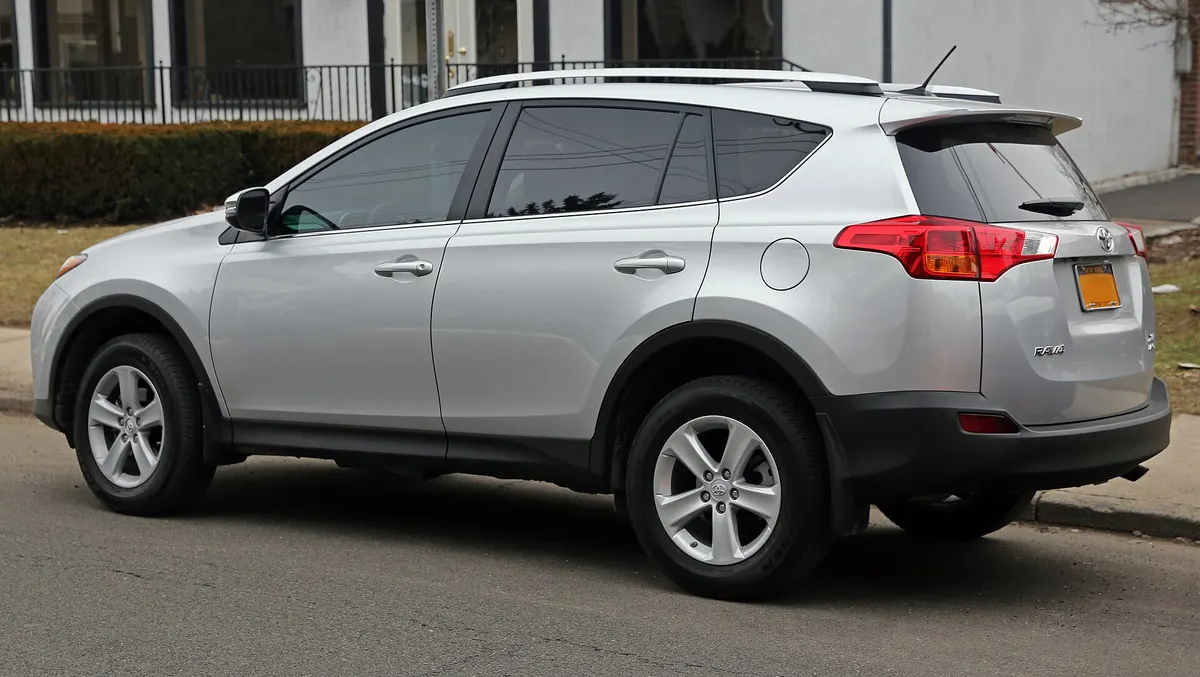
Toyota RAV4 2013–2018Common problems, reliability & repair costs
The 4th-gen RAV4 is a genuinely dependable compact SUV with one well-documented sore spot: a torque-converter shudder on 2013–2015 cars that Toyota eventually covered with a warranty extension (now expired on most). Beyond that, watch the power liftgate, an early-year appetite for oil, and a big 12-volt battery recall. The 2016–2018 cars, including the excellent Hybrid, are among the safest used-SUV buys of the decade.
2016, 2017, 2018
2013 (first year: most complaints, highest torque-converter +1 more
Engines
- 2AR-FE · 2.5L gasoline, 176 hp
- 2AR-FXE (hybrid) · 2.5L hybrid, 194 hp
Transmissions
- U760E/U760F · automatic, 6-speed
- cvt
Drivetrain
FWD / AWD
Body
suv
Trims
LE, XLE, SE, Limited, Platinum, Hybrid XLE, Hybrid SE, Hybrid Limited
Toyota RAV4 part-number cross-reference
Start from the OEM number, then pick the brand you trust. Verified equivalents for the Toyota RAV4 (2013–2018).
Part links go to Amazon, and to eBay where Amazon does not stock the part. Affiliate links, so we may earn a commission if you buy. Your price is unchanged, and a commission never changes a verdict.
Oil filter
Verified via: ToyotaPartsDeal: 04152-YZZA1 OEM fitment (RAV4 2006-2018 2.5L), oilfilter-crossreference.com: 04152-YZZA1 alternatives, zFilters: 04152-YZZA1 cross reference
Engine air filter
Verified via: ToyotaPartsDeal: 17801-0V020 OEM fitment (RAV4 2013-2018 2.5L), airfilter-crossreference.com: 17801-0V020 alternatives, CarKart, EPAuto GP677 (CA10677) fitment: RAV4 gas 2.5L 2013-2018
Cabin air filter
Verified via: ToyotaPartsDeal: RAV4 cabin air filter (87139-07020, 2012-2018), airfilter-crossreference.com: 87139-07020 alternatives, CarKart, EPAuto CP285 (CF10285) fitment: RAV4 2006-2018
Spark plugs
Denso
Denso stock #3417, Iridium Long-Life, the aftermarket box of the OEM plug
Find Denso spark plugsVerified via: ToyotaPartsDeal: RAV4 spark plug catalog (90919-01233, 2.5L 2AR-FE), Sixity Auto: Denso 3417 (SK16HR11) cross-reference incl. 90919-01233 / 90919-A1003, O'Reilly: Denso SK16HR11 (3417) listed for 2014 RAV4, Sixity Auto: NGK Laser Iridium plugs for 2009-2018 RAV4 2.5L, NGK: 4912 ILKAR7B11 Laser Iridium
Front brake pads
Verified via: Toyota (autoparts.toyota.com): 04465-0R010 front pad kit, ToyotaPartsDeal: 04465-0R010 genuine front pad kit, PartsGeek: Akebono ACT1211A, 2006-2018 RAV4 front, Amazon: Akebono ACT1211A ProACT front pads, Amazon: PowerStop Z23-1211 front pads (RAV4 fitment)
Wiper blades
Verified via: WiperSizeChart, 2015 Toyota RAV4: 26" driver / 16" passenger, Otto Blades: 2015 RAV4 wiper set, 26" driver + 16" passenger, PartCatalog: Bosch ICON 26A (RAV4 fitment), Amazon: Trico Force 25-260 (fits select Toyota), Home Depot: Rain-X Latitude 26" (5079281), Home Depot: Rain-X Latitude 16" (5079274)
Serpentine belt
Verified via: ToyotaPartsDeal: RAV4 drive belt catalog (90916-A2021 / 90916-02667 / 90916-02668, 2.5L), Walmart: Gates K060494, fits 2009-2018 RAV4 / 2012-2017 Camry, AutoZone: Gates K060494 Micro-V, Walmart: Dayco 5060495, fits 2009-2018 RAV4 / 2012-2017 Camry, RAV4World: OEM serpentine belt part number thread (90916-A2021 Bando / 90916-02668 Mitsuboshi)
Battery
Verified via: Interstate Batteries: MTP-35 for 2014 Toyota RAV4 2.5L, Optima Batteries: What battery does a RAV4 take (Group 35), Advance Auto Parts: 2014 RAV4 batteries (DieHard Gold/Platinum Group 35)
Should I buy a 2013–2018 Toyota RAV4?
Buy it, and if the budget allows, buy 2016–2018. This generation is fundamentally a 200,000-mile vehicle, but the years are not equal. The 2013–2015 cars carry the torque-converter shudder issue; Toyota's warranty enhancement (ZH1, 8 years/150k miles) covered replacement, and that window has closed or is closing on every affected car, so you want proof the converter was replaced, or a shudder-free test drive between 25 and 50 mph. The 2016–2018 facelift cars have far fewer complaints, added standard safety gear (Toyota Safety Sense on 2017+), and introduced the Hybrid, which is arguably the best version of this car. On any of them, confirm the 12-volt battery recall (23V-734) has been performed.
Best years
2016, 2017, 2018
Years to avoid
2013 (first year: most complaints, highest torque-converter shudder rate), 2014–2015 unless the torque converter was already replaced or the car drives shudder-free
Pre-Purchase Checklist for Toyota RAV4
- ☐Test drive at steady light throttle between 25 and 50 mph. The classic torque-converter shudder feels like driving over rumble strips. On 2013–2015 cars, ask a Toyota dealer to check by VIN whether the ZH1 torque-converter replacement was performed.
- ☐Run the VIN through NHTSA's recall lookup and confirm the 12-volt battery hold-down recall (23V-734, 2013–2018) has been completed. It's free and it's a fire-risk item.
- ☐Check the oil level against the service history. On higher-mileage 2013–2015 cars especially, ask if it needs oil between changes. A quart every 1,200 miles or less is the red flag.
- ☐Cycle the power liftgate (XLE and up) several times: it should open fully and hold. A gate that stops partway, drifts down, or slams shut means tired gas struts or a failing hinge/actuator.
- ☐Listen for clunks from the front end over speed bumps. Worn sway-bar end links and strut mounts are the usual suspects and are cheap, but use them to negotiate.
- ☐Let the infotainment run your whole test drive with your phone paired over Bluetooth. Random reboots and freezes are a known Entune quirk; make sure you can live with this unit or budget for an aftermarket head unit.
- ☐On Hybrids, verify the 12-volt auxiliary battery age and watch for warning lights on startup. Most 'hybrid problems' on these trace back to a weak 12-volt battery, not the traction pack.
Common Toyota RAV4 problems & repair costs
Torque-converter shudder (6-speed automatic)
$1,800–$4,000Symptoms: Brief rumble-strip-like vibration at steady light throttle between roughly 25 and 50 mph, when the torque converter locks up. Comes and goes; often worse when warm. Not a slipping or failing transmission by itself, but ignored long enough the converter can shed clutch material into the fluid.
Fix: Toyota's fix (T-SB-0023-15) is torque-converter replacement plus updated transmission software and new pan magnets. It was covered under Warranty Enhancement Program ZH1 (8 years / 150,000 miles), which has now expired or nearly expired on every affected car, so today it's a paid job. A fluid exchange and software update alone sometimes helps mild cases, but the converter is the real cure.
Sources: Toyota Warranty Enhancement Program ZH1 (NHTSA TSB archive), RAV4World: 2013–2015 torque converter shudder warranty extension, RAV4World: T-SB-0023-15 warranty extension thread
12-volt battery short-circuit / fire risk (recall 23V-734)
$0–$0Symptoms: Usually none until it happens: an undersized replacement battery can shift in the oversized tray, contact the metal hold-down clamp, and short, in the worst cases causing loss of electrical power or an engine-bay fire. NHTSA opened its investigation after fire complaints; Toyota recalled about 1.85 million RAV4s.
Fix: Free under NHTSA recall 23V-734: dealers replace the battery hold-down clamp, tray, and positive terminal cover. Remedy letters went out in phases from late 2024 through 2025. Check the VIN and get it done. This one costs nothing.
Sources: NHTSA Part 573 Safety Recall Report 23V-734, Consumer Reports: 1.8 million RAV4s recalled over battery concerns
Power liftgate strut and hinge failure
$150–$1,200Symptoms: Liftgate opens partway then stops or reverses, drifts closed on its own, or beeps and refuses to latch. Gas struts weaken with age; owners and a class-action lawsuit also point at hinges that bend and fall out of alignment under the gate's weight, and at failing actuators.
Fix: Start cheap: a pair of gas struts is an easy DIY (see repairs) and fixes many sagging gates. If the gate still misbehaves, it's actuator or hinge work. Actuator replacement at an independent shop lands mid-hundreds to low four figures if both sides are done. A 2023 class action covering 2014–2021 RAV4 power liftgates was filed but hasn't produced a free fix, so budget as if it's on you.
Sources: ClassAction.org: RAV4 power liftgate defect lawsuit, Top Class Actions: Toyota RAV4 power liftgate class action, RAV4World: liftgate problems thread
Oil consumption (2AR-FE)
$2,500–$5,500Symptoms: Oil level drops noticeably between changes with no external leak and no blue smoke until it's advanced. Owner consensus points at low-tension piston rings that carbon up and stop sealing, the same basic mechanism as the notorious 3rd-gen 2AZ engine, though far less widespread on this generation.
Fix: First step is cheap: replace the PCV valve ($80–$200 at a shop) and measure consumption over 1,000 miles. If the rings are the problem, the honest fix is a piston/ring job or a used engine, a big-ticket repair that rarely makes sense unless the rest of the car is excellent. Many owners simply check the dipstick monthly and top off; the engine tolerates that fine if you never let it run low.
Sources: RAV4World: oil consumption issue thread, ToyotaNation: 2AR-FE excessive oil consumption
Front suspension clunks (strut mounts, sway-bar end links)
$150–$900Symptoms: Clunk, thump, or rattle from the front end over bumps and potholes, sometimes a pop when turning at low speed. Usual culprits in owner reports: worn sway-bar end links, tired strut mounts (occasionally just a loose upper mount nut), and eventually the struts themselves.
Fix: End links are cheap and quick, a common first fix and a decent DIY (see repairs). Strut mounts or full strut replacement runs more; struts get replaced in pairs and need an alignment after. None of this is dangerous at the clunk stage, but it makes a tight car feel old.
Sources: RAV4World: clunking in front suspension, RAV4World: clunking noise over bumps
Entune infotainment freezing and rebooting
$100–$1,200Symptoms: Head unit freezes, goes black, or spontaneously reboots to the Toyota logo, sometimes several times in one drive. Bluetooth phone pairing is a frequent trigger; frequency tends to increase with age. Annoying rather than mechanical, but the backup camera routes through the same screen.
Fix: Try the free stuff first: delete and re-pair the phone, then have a dealer load the latest firmware (Toyota issued software updates for reboot bugs). If the unit is failing hardware-wise, a factory replacement is expensive. Most owners install an aftermarket CarPlay/Android Auto head unit instead, which is cheaper and better.
Sources: RAV4World: infotainment keeps rebooting randomly, ToyotaNation: navigation/radio rebooting constantly
Day to day, a 4th-gen RAV4 costs Corolla money to keep: cheap filters, long-lived brakes, conventional fluids, and parts available everywhere. The budget items to respect are the one-time hits: a torque converter on an unremediated 2013–2015 car ($1,800–$4,000), a ring job on an oil-burner, or power-liftgate actuators. The Hybrid adds essentially no ownership-cost penalty on these years; its eCVT has fewer failure points than the gas car's 6-speed, and traction-battery failures on 2016–2018 cars are rare. Check the dipstick monthly on any early car and this generation is about as cheap to own as compact SUVs get.
Cost calculator
What will this Toyota RAV4 cost you by a given mileage?
Drag to a mileage. We total the documented problems whose typical onset falls at or before it. The same cost ranges listed above, nothing new invented.
$0 estimated repair range
5-Year Maintenance Schedule & Cost to Own
Every scheduled service by mileage, fluid capacities, independent shop ranges, and parts cross-references.
Have a repair quote for this Toyota RAV4?
Audit against OEM book times, uncover duplicate pad and rotor labor, and verify parts markups.
How to fix common Toyota RAV4 problems (DIY)
Replace rear liftgate gas struts
Tools: Small flathead screwdriver or pick, A helper or a broomstick to prop the gate
- Open the liftgate fully and support it. Have a helper hold it or brace it with a pole. It WILL fall without the struts attached.
- At one strut's ball-socket end, pry the metal retaining clip out slightly with a small flathead, then pop the socket off the ball stud. Repeat at the other end.
- Install the new strut (usually cylinder-end up), pressing each socket onto its ball stud until it clicks. Do one strut at a time so the gate stays supported.
- Repeat for the second strut, then cycle the gate several times. On power liftgates, check whether it needs re-initialization per the owner's manual (close manually, then run a full power cycle).
Parts
- Liftgate gas struts, pair (2013–2018 RAV4) · Amazon $25–$60
Replace front sway-bar end links
Tools: Floor jack + jack stands, Socket set + wrenches (14–17mm), Hex key or Torx to hold the stud (or an impact wrench), Penetrating oil
- Jack the front of the car, set it on stands, and remove both front wheels.
- Soak the end-link nuts with penetrating oil. Hold each stud with a hex key while breaking the nut loose (or zip them off with an impact).
- Remove the old link's upper and lower nuts and pull the link off the sway bar and strut.
- Install the new link, torque the nuts with the stud held, and repeat on the other side. Always do both.
- Refit the wheels, drop the car, and test drive over bumps to confirm the clunk is gone.
Parts
- Front sway bar end links, pair (2013–2018 RAV4) · Amazon $20–$50
Cabin & engine air filter change
Tools: None (hands only; maybe a flathead for airbox clips)
- Open the glovebox, squeeze the sides to release the stops, and let it swing down to expose the cabin filter door.
- Slide out the old cabin filter and insert the new one with the airflow arrow pointing the direction marked on the housing.
- Under the hood, unclip the airbox lid, swap in the new engine air filter, and re-clip the lid.
- Re-hang the glovebox and confirm the fan sounds normal on high.
Parts
- Cabin air filter (2013–2018 RAV4) · Amazon $10–$18
- Engine air filter (2013–2018 RAV4) · Amazon $12–$20
Some parts links are affiliate links. We may earn a commission at no cost to you. We only list parts that fit this generation.
The short version
The 4th-generation RAV4 is most of the reason this nameplate became America’s best-selling SUV: cheap to run, easy to live with, and built around a drivetrain that routinely clears 200,000 miles. It has exactly one headline mechanical issue: a torque-converter shudder on 2013–2015 cars that feels like rumble strips at light throttle between 25 and 50 mph. Toyota acknowledged it, replaced converters under a warranty enhancement (ZH1, 8 years/150k miles), and largely engineered it out by the 2016 facelift.
That warranty window has now closed, so on an early car the question is binary: was the converter replaced, or does the car drive clean? Everything else on this generation is manageable-money territory.
What that means when you’re shopping
2016–2018 is the sweet spot. Fewer complaints across the board, standard Toyota Safety Sense from 2017, and the first RAV4 Hybrid, which swaps the 6-speed automatic (and its shudder-prone converter) for Toyota’s nearly failure-proof eCVT. If a Hybrid fits your budget, it’s the best car in this file.
On 2013–2015 cars, do the 25–50 mph steady-throttle test drive and have a Toyota dealer run the VIN for the ZH1 torque-converter replacement. A car with a documented new converter is a confident buy. Also check the oil level and ask about consumption. Early 2AR-FE engines can carbon up their piston rings and start drinking oil.
On every year, run the VIN through NHTSA’s recall lookup for the 12-volt battery recall (23V-734, about 1.85 million vehicles, fire risk, free fix), cycle the power liftgate a few times, and listen for front-end clunks over bumps. The liftgate and suspension items are cheap fixes but good negotiation material.
The stuff that’s just noise
Entune, Toyota’s infotainment of this era, freezes and reboots. It always has. It’s annoying, it’s well documented on the owner forums, and it has nothing to do with whether the car will start in ten years. A software update helps; an aftermarket CarPlay head unit fixes it permanently for less than a factory radio.
How this file is built: failure modes and cost ranges are compiled from NHTSA recall and TSB records, Toyota’s ZH1 warranty-enhancement program documents, CarComplaints data, and owner reporting on RAV4World and ToyotaNation, then sanity-checked against shop-floor experience. Cost figures are independent-shop estimates and vary by region. Spot something off? Tell us.
Viral car myths, checked against this car
- Dangerous
Is the "$2 liquid that destroys engine sludge forever" real? Our shop-floor verdict.
An aggressive solvent flush on a high-mileage engine is a textbook way to spin a bearing. The viral 'kitchen-cabinet flush' is folklore that real shops spend money cleaning up after.
- Outdated
Does a "$1 mineral" really double car battery life? The Epsom-salt reality.
The mineral is Epsom salt (magnesium sulfate). It was a real desulfation hack for serviceable flooded-cell batteries 40+ years ago. It does not work on modern sealed AGM or EFB batteries, and trying it on yours will void the warranty without helping the battery.
Frequently asked questions
Which 4th-gen RAV4 years should I avoid?
2013 is the year to be most careful with. It's the first year of the generation and has the highest complaint count, led by the torque-converter shudder. 2014–2015 carry the same risk at lower rates. None of them are automatic no-buys: a 2013–2015 car with a documented torque-converter replacement, or one that drives shudder-free at 25–50 mph, is a fine purchase. If you want the lowest-risk pick, buy 2016–2018.
What is the RAV4 torque-converter shudder and is it still covered?
A brief vibration at light throttle between about 25 and 50 mph, caused by the torque converter's lock-up clutch on 2013–2015 cars. Toyota's fix was a new torque converter plus a software update, covered under Warranty Enhancement Program ZH1 for 8 years or 150,000 miles, a window that has now closed on essentially every affected car. Today it's a $1,800–$4,000 repair at an independent shop, which is exactly why you verify it before buying, not after.
Is the 2016–2018 RAV4 Hybrid reliable?
Yes. It's one of the best used buys in the segment. The hybrid system is the same proven design Toyota uses across the Camry and Prius families, the eCVT eliminates the torque converter entirely (so the gas model's shudder issue doesn't apply), and traction-battery failures on these years are rare. Most hybrid warning lights on these cars trace back to a cheap, aging 12-volt auxiliary battery.
Does the 2013–2018 RAV4 burn oil?
Some do, mainly earlier 2AR-FE cars, and far less commonly than the 2006–2012 generation's 2AZ engine. Check the level against service records before buying and monthly after. If a car needs a quart every 1,200 miles or less, price it accordingly: the cheap fix (PCV valve) helps some cars, but the real cure is piston-ring work at $2,500+.
Was the RAV4 recalled for fires?
Yes. NHTSA recall 23V-734 covers roughly 1.85 million 2013–2018 RAV4s. If a replacement 12-volt battery is smaller than the tray was designed for, it can shift, contact the hold-down clamp, and short-circuit. Several fires were reported. The remedy (new clamp, tray, and terminal cover) is free at any Toyota dealer. Run the VIN at nhtsa.gov/recalls and get it done.
Every Toyota RAV4 generation
The full case file run, beyond the generation before and after this one.
Cross-shopped rivals
Files on what buyers weigh against the Toyota RAV4 of this era.