Case file · HONDA-CR-V-2002-2006 · 2nd gen (RD6/RD7 (US))
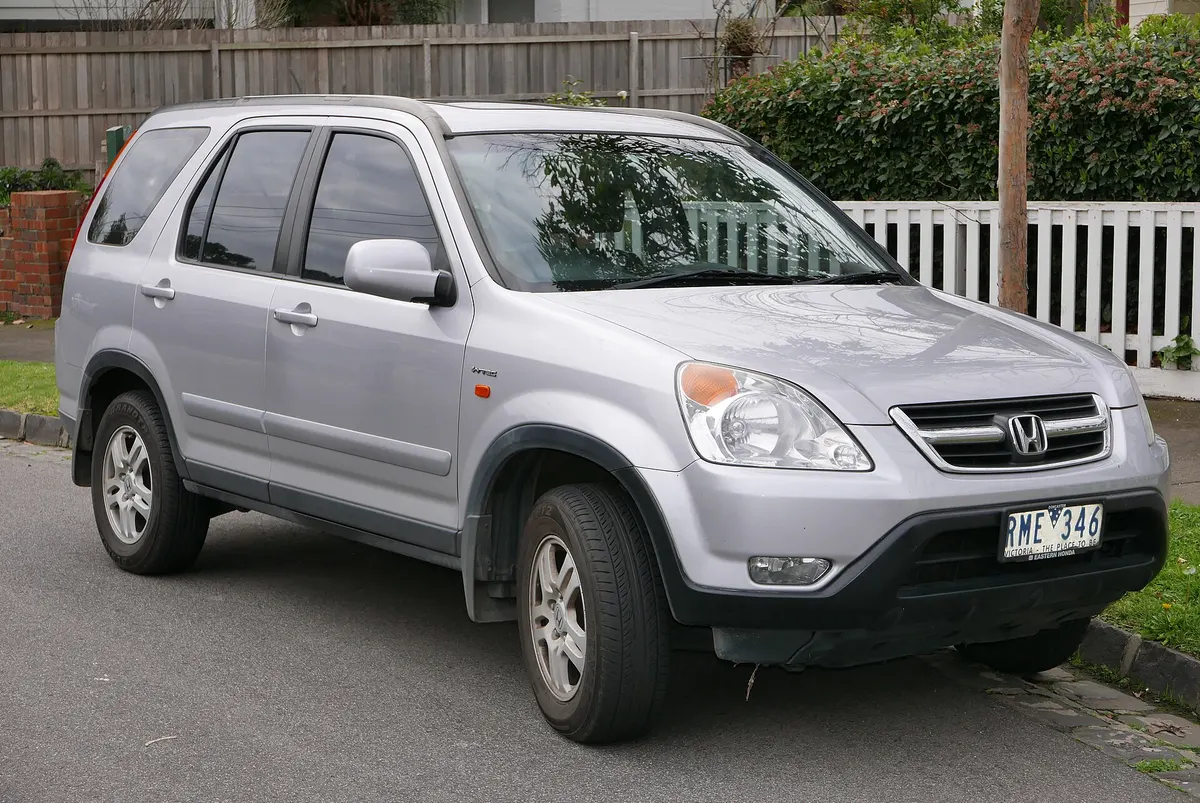
Honda CR-V 2002–2006Common problems, reliability & repair costs
The 2nd-gen CR-V is one of the most durable small SUVs ever sold. The K24 engine and the drivetrain routinely clear 250k miles. Its one famous weakness is the A/C compressor 'black death': the compressor grenades internally and contaminates the whole A/C system, turning a compressor job into a $1,500–$2,500 full-system replacement. Everything else is cheap, well-documented upkeep.
2005, 2006
None outright. But a 2002 with an unreplaced Takata 'Alpha' +1 more
Engines
- K24A1 · 2.4L gasoline, 160 hp
Transmissions
- automatic , 4-speed
- automatic , 5-speed
- manual , 5-speed
Drivetrain
FWD / AWD
Body
suv
Trims
LX, EX, SE
Honda CR-V part-number cross-reference
Start from the OEM number, then pick the brand you trust. Verified equivalents for the Honda CR-V (2002–2006).
Part links go to Amazon, and to eBay where Amazon does not stock the part. Affiliate links, so we may earn a commission if you buy. Your price is unchanged, and a commission never changes a verdict.
Engine oil filter
Wix
Wix 51356/51358 also listed as compatible on the cross-reference page
Look up Wix engine oil filterMobil 1
Bosch 3323 and Denso 150-2003 also verified on both cross-reference sources
Compare Mobil 1 engine oil filterVerified via: HondaPartsNow: 2005 CR-V OEM oil filter (15400-PLM-A02 current; PLM-A01/PLC-004 alternates listed), oilfilter-crossreference.com: Honda 15400-PLM-A02 aftermarket equivalents, GETOPAUTO: 15400-PLM-A02 cross-reference and fitment guide (confirms CR-V fitment)
Engine air filter
Wix
Wix Europe catalog number as listed by the cross-reference database
Compare Wix engine air filterVerified via: Bernardi Parts Honda: 17220-PNB-003 (fits 2002-2006 CR-V, 2003-2006 Element, 2004-2005 Civic Si), airfilter-crossreference.com: Honda 17220-PNB-003 aftermarket equivalents, HondaPartsNow: CR-V air filter catalog by generation (lists 17220-PNB-505 as the current 2002-2006 catalog listing)
Cabin air filter
Verified via: Bernardi Parts Honda: 80292-S5D-A01 (fits 2002-2006 CR-V; page states each vehicle requires 2 filters), airfilter-crossreference.com: Honda 80292-S5D-A01 aftermarket equivalents, HondaPartsNow: CR-V cabin air filter catalog by generation (80292-S5D-406 / 80292-S5D-A01 for 2002-2006)
Should I buy a 2002–2006 Honda CR-V?
Buy it. A maintained 2002–2006 CR-V is about as safe as a 20-year-old vehicle purchase gets. The K24 engine is a workhorse, rust aside the body holds up, and parts are cheap and everywhere. Your money questions are all up front: does the A/C blow ice cold (a dead or weak system means the $1,500–$2,500 'black death' bill, not a $150 recharge), have the two big safety recalls (Takata airbag inflators, driver's window switch) been completed by VIN, and on AWD cars, does it groan in tight turns (cheap fluid fix, but a sign of neglect). A 2005–2006 with cold A/C, recall paperwork, and service records is the pick.
Best years
2005, 2006
Years to avoid
None outright. But a 2002 with an unreplaced Takata 'Alpha' driver inflator is on NHTSA's do-not-drive list until fixed (verify by VIN), Any year with dead or weak A/C, unless the price already reflects a full-system replacement
Pre-Purchase Checklist for Honda CR-V
- ☐Run the A/C hard on a warm day for 10+ minutes. Warm or weak air on this generation usually means compressor 'black death,' a $1,500–$2,500 full-system job, not a recharge. Price the car accordingly or walk.
- ☐Run the VIN through NHTSA's recall lookup (nhtsa.gov/recalls). Confirm the Takata airbag inflator recall AND the driver's power window master switch recall (12V-486 and its 2021 re-recall) are both marked complete.
- ☐On AWD (Real Time 4WD) cars: do slow, full-lock figure-8s in a parking lot. A groan or shudder from the rear is broken-down dual-pump fluid. Cheap to fix, but it tells you fluid services were skipped.
- ☐Ask for proof of a valve adjustment if the car is past ~100k miles. K24 exhaust valves tighten with age; tight valves are silent and eventually burn.
- ☐Test the driver's window switch through all four windows. Erratic or dead switches on this generation are the exact recall failure, and it's a fire risk, not just an annoyance.
- ☐Look for oil leaks and check maintenance records. These engines don't die from design flaws; they die from 8,000-mile oil changes.
- ☐Check for rust at the rear wheel arches, tailgate, and rear subframe on northern cars.
Common Honda CR-V problems & repair costs
A/C compressor 'black death' (full-system contamination)
$1,300–$2,500Symptoms: A/C gradually weakens or abruptly blows warm; sometimes a rattle or clutch noise from the compressor first. The compressor's internals shed metal while it keeps running, mixing shavings with the oil into a black sludge that clogs the condenser, expansion valve, and lines. Hence the nickname.
Fix: Once it's failed internally, a compressor-only swap is a waste of money. The debris kills the new unit. The correct repair is compressor + condenser + receiver/drier + expansion valve plus a full line flush. CarComplaints owner reports average around $1,800. When shopping, treat 'A/C just needs a recharge' as a red flag.
Sources: CarComplaints: 2004 CR-V A/C compressor failure (avg ~$1,800, ~81k mi), BuyAutoParts: 2002–2006 CR-V A/C black death repair, CR-V Owners Club: Signs of A/C black death
Takata airbag inflator recalls (2002 'Alpha' driver inflator = do-not-drive)
$0–$0Symptoms: No warning at all. That's the danger. Degraded inflators can rupture in a crash and send metal fragments into the cabin. The 2001–2003 'Alpha' driver inflators (which include the 2002 CR-V) have rupture rates as high as 50% in testing, and NHTSA lists them under its do-not-drive warning.
Fix: Free recall repair at any Honda dealer, with replacement parts available for all affected models. Check the VIN at nhtsa.gov/recalls or Honda's recall site before buying; do not drive an unrepaired 2002 'Alpha' car until it's done.
Sources: NHTSA: Takata do-not-drive warning list, Honda: Takata airbag inflator recall information
Driver's power window master switch overheating / fire risk
$0–$250Symptoms: Driver's window switch works intermittently or dies; in the failure mode behind the recall, moisture entering through an open driver's window causes electrical resistance, and the switch can overheat, melt, smoke, or ignite. Honda logged over 100 warranty claims and multiple fire reports.
Fix: Recalled in 2012 (NHTSA 12V-486, ~269k US CR-Vs); the original butyl-tape sealing fix proved insufficient, so Honda re-recalled these cars in 2021 to install a redesigned switch and inspect the wiring harness. The fix is free at a Honda dealer. The cost range above is only for out-of-pocket replacement if you skip the recall path.
Sources: NHTSA recall 12V-486: 2002–2006 CR-V power window master switch, Honda Safety Recall P9D: driver's power window switch, The Drive: 2021 Honda re-recall for window switches
Rear differential groan/shudder in tight turns (AWD only)
$80–$200Symptoms: A moan, groan, or shudder from the rear end during slow, tight turns in parking lots and driveways. It's the rear differential clutches chattering on broken-down dual-pump fluid.
Fix: Replace the rear differential fluid with Honda Dual Pump System Fluid II and burnish the clutches per Honda TSB 07-024 (drive in tight circles both directions). Owners who change the fluid every 15k–30k miles never hear it again. Cheap fix, but ignored long enough it can wear the clutch packs.
Sources: RepairPal: CR-V groaning noise on turns, differential fluid breakdown, UnderhoodService, Honda TSB: rear differential moan or groan (07-024), CarComplaints: 2006 CR-V rear differential noise
Tight exhaust valves (K24 valve adjustment neglect)
$250–$600Symptoms: Usually none. That's the trap. K-series exhaust valves tighten with wear (intakes loosen and get noisy). A tight exhaust valve never fully seats, runs hot, and eventually burns the valve and seat: misfires, rough idle, low compression on one cylinder.
Fix: A valve-lash check and adjustment (Honda specs the check at ~100k miles; many owners do it every 30k–60k). At $250–$600 it's cheap insurance. A burned valve means cylinder-head work at $1,500+. On any high-mile CR-V with no adjustment history, budget for one immediately.
Sources: CR-V Owners Club: Did you do the scheduled valve adjustment?
Day to day this is one of the cheapest small SUVs to own: timing chain (no belt service), simple suspension, inexpensive brakes and tires, and an engine that shrugs off high mileage on basic oil changes. The realistic big-ticket items are one A/C system rebuild somewhere in the car's life ($1,300–$2,500) and a valve adjustment every 100k or so. AWD cars add a cheap but non-optional rear-diff fluid habit ($80–$200 a service). Both safety recalls are free. Just verify they're actually done.
Cost calculator
What will this Honda CR-V cost you by a given mileage?
Drag to a mileage. We total the documented problems whose typical onset falls at or before it. The same cost ranges listed above, nothing new invented.
$0 estimated repair range
5-Year Maintenance Schedule & Cost to Own
Every scheduled service by mileage, fluid capacities, independent shop ranges, and parts cross-references.
Have a repair quote for this Honda CR-V?
Audit against OEM book times, uncover duplicate pad and rotor labor, and verify parts markups.
How to fix common Honda CR-V problems (DIY)
Rear differential fluid change (fixes the turning groan)
Tools: 3/8" ratchet (the fill/drain plugs take the square drive directly), Fluid pump or long-neck funnel with hose, Drain pan, Jack + jack stands (or ramps). Keep the car level
- With the car level and the diff warm, remove the fill plug first (upper), then the drain plug (lower), and drain into a pan.
- Reinstall the drain plug with a new crush washer.
- Pump in Honda Dual Pump System Fluid II until it runs out of the fill hole (roughly 1.1–1.3 quarts depending on year).
- Reinstall the fill plug with a new crush washer and torque snug.
- Burnish the clutches: drive slow, tight figure-8s in an empty lot, several in each direction, per Honda's TSB procedure.
- Confirm the groan on full-lock turns is gone; if it faded but lingers, a second fluid change usually finishes it.
Parts
- Honda Dual Pump System Fluid II (2 quarts) · Amazon $20–$35
- Drain/fill plug crush washers (18mm/20mm) · Amazon $5–$10
Cabin & engine air filter change
Tools: Phillips screwdriver
- Open the glovebox, release the side stops, and swing it down to expose the cabin filter housing.
- Slide out the old cabin filter(s) and insert the new one(s) with the airflow arrows pointing the right way.
- For the engine filter, unclip the airbox lid, swap in the new panel filter, and re-clip.
- Run the blower on high to confirm airflow improved and nothing rattles.
Parts
- Cabin air filter (2002–2006 CR-V) · Amazon $10–$18
- Engine air filter (2002–2006 CR-V) · Amazon $10–$20
K24 valve adjustment
Tools: Feeler gauges (0.008"–0.013"), Socket set + torque wrench, 10mm wrench for the adjuster locknuts, plus a flathead screwdriver, New valve cover gasket set
- On a stone-cold engine, remove the valve cover and set cylinder 1 to TDC on the compression stroke using the crank pulley marks.
- Check clearances with feeler gauges: roughly 0.008–0.010 in. intake, 0.011–0.013 in. exhaust.
- Loosen the locknut, turn the adjuster screw until the gauge has a light drag, then hold the screw and torque the locknut.
- Rotate the crank to bring each remaining cylinder to TDC in firing order (1-3-4-2) and repeat.
- Reinstall the valve cover with a new gasket, torque evenly, and check for leaks after a warm-up drive.
Parts
- Valve cover gasket set (K24 CR-V) · Amazon $15–$35
- Feeler gauge set · Amazon $8–$15
Some parts links are affiliate links. We may earn a commission at no cost to you. We only list parts that fit this generation.
The short version
The 2002–2006 Honda CR-V is a genuinely boring used car in the best way: a timing-chain K24 engine that clears 250,000 miles, simple mechanicals, and cheap parts. It has exactly one famous wallet issue and two paperwork issues.
The wallet issue is the A/C compressor “black death.” The compressor doesn’t just quit. It disintegrates internally while still running, pumping metal-laced black sludge through the entire A/C system. Owner-reported repairs on CarComplaints average about $1,800, because the honest fix is a whole-system replacement, not a compressor swap. Thousands of these failed between 2002 and 2009, which is why cold A/C is a real line item on the price of this car.
The paperwork issues are recalls: Takata airbag inflators (a 2002 with the original “Alpha” driver inflator sits on NHTSA’s do-not-drive list until it’s replaced) and the driver’s power window master switch, which can overheat and catch fire and was recalled twice: 2012 and again in 2021 after the first fix proved inadequate. Both repairs are free.
What that means when you’re shopping
Run the A/C hard for ten minutes on your test drive. Ice cold = proceed. Weak or warm = assume a $1,500–$2,500 system rebuild and negotiate or walk. The phrase “it just needs a recharge” is the most expensive sentence in 2nd-gen CR-V shopping.
Run the VIN through NHTSA’s recall lookup before you hand over money. Then, on AWD cars, do slow full-lock circles in a parking lot: a groaning rear end is only an $80–$200 fluid fix, but it tells you the seller skipped cheap maintenance. Ask what else they skipped. Past 100k miles, ask for valve-adjustment records; K24 exhaust valves tighten silently and burn if ignored.
The oil-change fire story, debunked
You’ll read that early CR-Vs “catch fire after oil changes.” Partly true, worth understanding: 27+ fires on 2003–2004 cars were investigated by NHTSA, which blamed improper oil-filter installation, not a defect. A stuck old gasket double-stacks and dumps oil on the hot exhaust. No recall was issued. It’s a quick-lube quality-control story, not a reason to avoid the car.
How this file is built: failure modes and cost ranges are compiled from NHTSA recall and complaint data, Honda TSBs and recall bulletins, CarComplaints owner reports, and CR-V owner-forum reporting, then sanity-checked against shop-floor experience. Cost figures are independent-shop estimates and vary by region. Spot something off? Tell us.
Viral car myths, checked against this car
- Misleading
Is the "$2 liquid that stops any leak" really banned in 11 states?
Automotive stop-leak products are not banned in any US state. The products are real (Bar's Leaks, BlueDevil), they work in specific narrow situations, and they can permanently damage your cooling or oiling system if applied to the wrong leak.
- Dangerous
Is the "$2 liquid that destroys engine sludge forever" real? Our shop-floor verdict.
An aggressive solvent flush on a high-mileage engine is a textbook way to spin a bearing. The viral 'kitchen-cabinet flush' is folklore that real shops spend money cleaning up after.
Frequently asked questions
What is the Honda CR-V A/C 'black death'?
It's the nickname for the way this generation's A/C compressor fails: the internals wear and shed metal while the compressor keeps running, pumping black metallic sludge through the condenser, lines, and expansion valve. Once it happens, you replace the whole system and flush the lines, typically $1,300–$2,500 at an independent shop. That's the compressor, condenser, drier and expansion valve. A compressor-only swap will fail again. When buying, cold A/C is worth real money on this car.
Did the 2003–2004 CR-V oil-change fires lead to a recall?
No. At least 27 early CR-Vs caught fire shortly after oil changes, but NHTSA's 2004 investigation concluded the cause was improperly installed oil filters, not a vehicle defect. Typically the old filter's gasket sticks to the block, causing a double-gasket leak onto the hot exhaust. Honda responded with technician warnings and packaging changes rather than a recall. The practical takeaway today: after any oil change on one of these, confirm the old gasket came off with the old filter.
Which recalls should I check before buying a 2002–2006 CR-V?
Two big ones. First, the Takata airbag inflator recalls. 2002 cars with the original 'Alpha' driver inflator are on NHTSA's do-not-drive list until replaced. Second, the driver's power window master switch (NHTSA 12V-486, re-recalled in 2021), which can overheat and catch fire. Both repairs are free at Honda dealers; run the VIN at nhtsa.gov/recalls and don't take the seller's word for it.
How many miles will a 2002–2006 CR-V last?
250,000+ miles is realistic and common. The K24 uses a timing chain, tolerates high mileage well, and the AWD system is simple. The cars that die early die from skipped oil changes, skipped valve adjustments, or rust. Not from a design flaw.
Is the AWD worth it, and what's the groaning noise in turns?
Honda's Real Time 4WD is a reactive system. Fine for snow and rain, not an off-roader. The groan or shudder in tight, slow turns is the rear differential's clutches chattering on broken-down fluid. The fix is a fluid change with Honda Dual Pump Fluid II plus a figure-8 burnishing drive (Honda TSB 07-024), usually under $200. It's also a useful seller-neglect detector on a test drive.
Every Honda CR-V generation
The full case file run, beyond the generation before and after this one.
Cross-shopped rivals
Files on what buyers weigh against the Honda CR-V of this era.